Note: The Shawnee Mission Post is making much of its local coverage of the coronavirus pandemic accessible to non-subscribers. (If you value having a news source covering the situation in our community, we hope you’ll consider subscribing here).
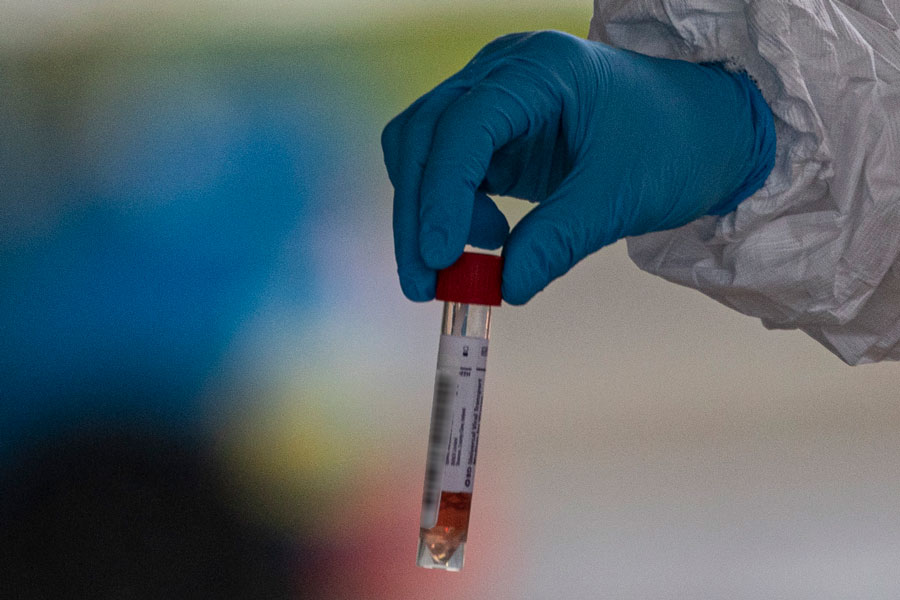
With a predicted shortage of intensive care beds fast approaching, the Johnson County Commission took the first steps Thursday toward a dramatic increase in testing for COVID-19. The county’s public health department hopes that increasing the number of tests fivefold will provide enough data to develop an intelligent strategy for containment.
Commissioners asked staff to expedite a report on the cost and a game plan for increasing the testing from the roughly 700 done so far to 3,000 to 5,000 more. Once the report is done, the commission will meet in emergency session to vote on it.
The tests and lab capacity exists for that to happen, said Dr. Sanmi Areola, director of the county Department of Health and Environment. But the equipment and processing aren’t free. Areola did not have an estimate of how much the testing and processing might cost.
More testing is needed so the county can know whether the social distancing measures are effective and whether removing them might result in another outbreak.
Once it was determined about a week ago that the disease was circulating freely throughout the county, the state health department limited testing to only those with more severe symptoms who were recommended by their doctors.
An increase would allow some people with milder symptoms to be tested, since research is showing that even asymptomatic people can spread the disease. Areola said the ideal sample size for testing would be about 4,000, along with a renewal of efforts to trace contacts of those who test positive.
Although there isn’t a cost estimate yet, Commissioner Mike Brown pointed out that the county may be able to get reimbursed from the federal government.
ICU bed availability poses major concerns

Commissioners expressed support after hearing some alarming news about the availability of hospital beds. County Public Health Officer Dr. Joseph LeMaster said even with optimistic estimates some 1,800 adults across the metro area may need beds. However there are only 1,100 beds available metro-wide, the majority of which are often filled with people with other chronic conditions.
A recent tally of intensive care beds in Johnson County was just as worrying. LeMaster said there are 148 available, but 104 people have so far been admitted to hospitals under suspicion of COVID-19. Typically 30 percent of people hospitalized for the disease will need critical care, he said.
COVID-19 is especially dangerous for older people, and the county’s population is aging. The number of people 60 and older was estimated to be 130,000 this year and has been the fastest-growing segment of the population, according to county figures.
“There’s a very grave potential for the health care system to be totally overwhelmed,” he said.
Hospitals in Johnson County have enough capacity for right now, the health officials said. “But it takes only a few days of the right steps not being taken for the capacity to be overwhelmed,” Areola said. “One hundred fifty ICU beds are not enough.”
Examining impact of stay-at-home order
Commissioners also discussed whether having more testing could provide enough data to tell whether the stay-at-home orders have been effective, or whether they should be fine tuned.
Many calls have come in since the order went into effect on Tuesday, with compliance proving to be a popular subject, commissioners said.
Assistant County Manager Joe Connor said callers have either been reporting businesses that don’t follow the social distancing rules or asking why they are necessary. So far most people are taking it seriously and there haven’t been any tickets or arrests. Connor said the county hopes to get people to cooperate through education.
But just in case that’s not effective, the legal department and law enforcement officials are working out how prosecution might look. Connor said the district attorney’s office supports prosecution if education proves not to be enough.
Commissioner Steve Klika said he’s taken calls from people who don’t see the reasoning behind the rules on which businesses can remain open. Day cares, for example, are allowed to be open although children are believed to be possible spreaders of the disease. Golf courses are open but playgrounds are not. And public transit is also still running.
“We better get (the messaging) right otherwise we’re going to have a number of folks who are just not going to give credence to what we are saying,” Klika said.
LeMaster said the testing data may help guide future decisions on how the disease can be slowed, at least until treatment and a vaccine are available.
“We’re doing all we can to try to prevent a disaster in terms of our health care infrastructure and the death we’re going to see,” he said.
“We recognize (distancing measures) are disruptive. We recognize there is a cost,” LeMaster said. But on the other hand, if the county doesn’t embrace those difficult measures, “I think history (would) judge us very severely because of the massive amount of death and problems that we’re going to have.”