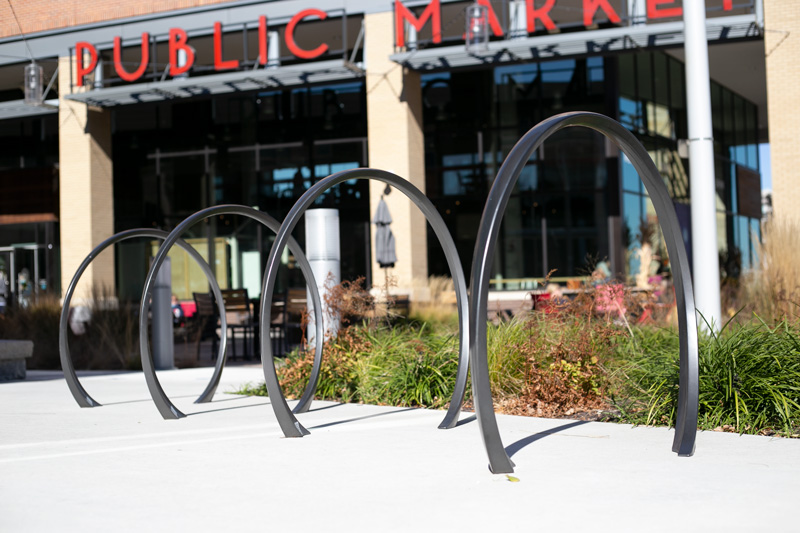
Lenexa pedestrians and cyclists may find themselves able to navigate the city in a more safe and efficient manner following changes to city code unanimously approved Monday during the Lenexa Planning Commission meeting. But at least one of the proposed changes could cause concern for developers, according to one commissioner.
The Lenexa Planning Commission on Monday unanimously recommended a series of changes to existing policies and additional requirements and standards related to pedestrian networks and bicycle parking. The changes are part of the city’s Complete Streets initiative, which the city approved in December 2019.
“Overall, the intent of these code changes are to build on the city’s existing strengths and to make Lenexa a more connected and livable community,” city staff reported in a memo to the planning commission.
While planning commissioners seemed generally supportive of the changes and additions, some had concerns. The city’s recommendation to make sidewalks wider could end making projects more expensive for developers, which could discourage them from investing in Lenexa.
“I like the idea of this, but having been around Lenexa for a long, long time, I can remember when a lot of the development community was upset with Lenexa,” said Commissioner Don Horine of the city’s history of high standards for development. “This could be an example of that. If we imposed all these regulations, before long, somebody’s gonna say yeah, I’m not going there anymore. I’ll just go someplace where it’s cheaper to build.
“If we are similar to our neighbors that we are competing for development with, then fine. If we are trying to make it more difficult for the development community, then I don’t think that’s a good idea.”
Magi Tilton, planning and development administrator for Lenexa, said the city doesn’t want to make it more difficult for developers, and is simply trying to address needs for all segments of transportation within the city.
“We’re looking at how to make our community a friendly community for all modes of transportation, just like other cities are throughout the region,” Tilton said, noting that other cities have adopted requirements related to their own Complete Streets initiatives.
Scott McCullough, community development director, said the city is working to “strike the balance” by considering input from stakeholders, including other developers.
“Our intent is… let’s look at the whole pedestrian-bike network, and let’s do reasonable amenities to make sure that we’re getting a good entire network out of it,” he said. “We’re not trying to be overbearing, but you’re the barometer of that. I hope we’re taking smaller, middle steps with this round of amendments.
“We already have this product out there, and it looks like it’s working in a lot of neighborhoods in Lenexa. We’re codifying what we’re already seeing out there.”
Below is a list of changes and additions which the city council will consider at a future meeting.
Design and development standards
- The addition of the requirement for safe and convenient pedestrian access from a street sidewalk to building entrances
- Changing the requirement for sidewalks serving off-street vehicle parking areas from a minimum of 4 feet to 5 feet in width and from 6 feet to 7 feet where car overhangs are permitted
- The addition of bicycle parking standards (layout/location/dimensions/signage)
- The addition of a table for bicycle parking space minimum requirements by use and the ability to defer bicycle parking for good cause
- Differentiate between vehicle parking and bicycle parking in off-street parking standards
Subdivision design standards for sidewalks and trails
- Changing the requirement for sidewalks from a minimum of 4 feet to 5 feet wide
- Changing the requirement for multi-purpose trails from a minimum of 8 feet to 10 feet wide
- Changing the requirement for sidewalks from none to one side of the road within industrial/business parks
- The addition of the requirement for multi-purpose trail connections at the end of cul-de-sacs at the discretion of the City Engineer
- Changing the requirement for pedestrian pathways through blocks from the Planning Commission’s discretion in blocks longer than 600 feet, to requiring a multi-purpose trail through blocks more than 800 feet long at the discretion of the City Engineer
 Thanks for reading! If you value having an independent news outlet keeping tabs on local government, schools and taxes, we're asking you to contribute to our Education Reporting Fund.