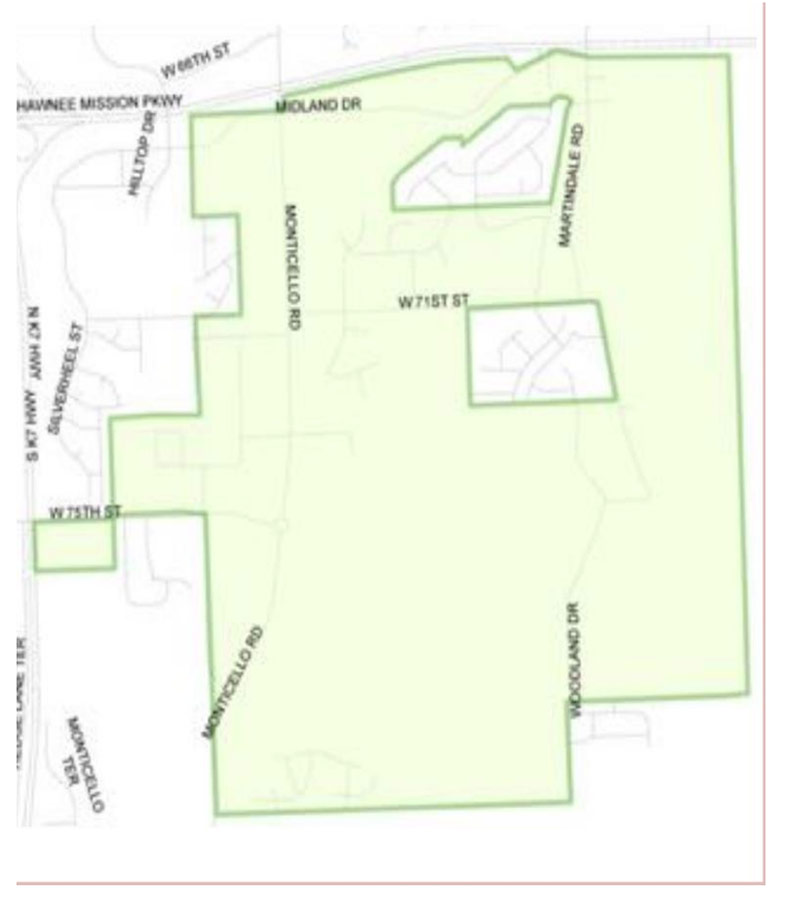
Shawnee city councilmembers are considering a plan to create a 2.58-square-mile improvement district in a historic and mostly undeveloped area as a way to guarantee funds will be available for major road and intersection improvements as the area eventually grows.
What’s going on? The area dubbed the Hickok-Zarah district is being proposed as a sort of proactive tax increment financing area for 1,648 acres of land likely to be difficult to develop.
- The area sits mostly between Monticello Road and Woodland Drive, but does include a bit near the intersection of W. 75th Street and Kansas Highway 7.
- It stretches from Shawnee Mission Parkway in the north to the city’s southern limit.
Why now? The area is expected to become mostly residential, but substantial infrastructure will need to be built to make that happen, said Jeff White, of Columbia Capital Management in his presentation at the City Council meeting last Monday, Oct. 10.
Digging deeper: For instance, he said, there are 11.6 miles of street where water drains into ditches, 204 homes on septic systems, more than 2,000 feet of stormwater pipe in poor condition and 7,646 in unknown condition.
- As more subdivisions are built, the city will need to build bigger roads, White said, and the intersection of K-7 and West 75th Street will also be an expensive improvement as development comes to the west.
Bigger picture: Typically, developers pitch city councils on the advantage of tax increment financing, which is a way of raising money based on the increments of increasing property value as the area is developed. But under Kansas law, it’s the cities that must get the TIF ball rolling, after being convinced by developers.
- The law also restricts where tax incentive money can go, focusing on site improvement and infrastructure.
- In the case of Hickok-Zarah, however, there’s no developer knocking at the door.
- Instead, city staff is proposing a district be created for the whole area instead of piecemeal, with proceeds going to help the city pay for infrastructure.
- Developers could come later with project plans and could perhaps ask for their own incentives at that time.
What they’re saying: The area in question has topographical challenges to development, White noted, which can make developing difficult.
- But White said that it’s already beginning to happen in some locations: “Development will come. You’re already seeing it.”
Key quote: “The challenge with that for a city is that as development comes, the expectations for improved infrastructure are going to come along with that. Narrow ditches are going to be less acceptable,” he said. “One way or the other, folks living here are going to be impacted by growth. What this tool allows us to do is manage the growth in a little more planned way with a better funding source.”
Discussion: Some councilmembers said the idea has a certain appeal.
- “TIFs a lot of times have a negative connotation because the incentives are for developers, but in this case the city will be a beneficiary,” said councilmember Kurt Knappen.
- Councilmember Angela Stiens agreed: “I like the fact that the city is benefitting from this and not developers.”
- Councilmember Eric Jenkins also expressed support, saying Shawnee could use an additional way to pay for infrastructure: “Shawnee is not a really rich community as far as rich communities go,” he said, and big infrastructure requirements can cause a strain.
- Councilmember Tammy Thomas said she felt hesitant because the land in question has multiple owners, some of whom may not want to see their land developed.
- White replied the district would not require anyone to sell their property and that the city would still have approval power over future project plans developers might bring.

What else: The area in question also has a notable history.
- Monticello, a former stagecoach stop, gave James Butler, later known as “Wild Bill” Hickok, his first law enforcement job as town constable.
- The town of Zarah was platted in 1869.
What’s next for proposed Hickok-Zarah district?
The council voted unanimously to continue with plans for the Hickok-Zarah district.
- The next action will be a public hearing on November 14.