Last month, we asked our readers what issues they wanted to hear the candidates running for office address ahead of November’s general election. Based on the input we received, we developed a five-item questionnaire for candidates running for the 3rd District U.S. House seat covering Johnson County.
We’ll be publishing the candidates’ responses to one item per day each day this week. See the candidates’ responses to previous questions on election integrity, inflation, abortion and immigration.
Today we’re publishing the candidates’ responses to our final item:
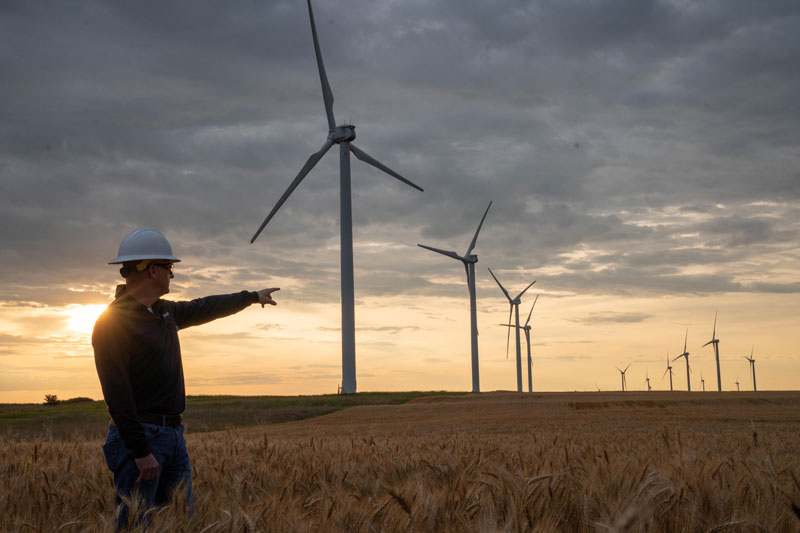
Climate change continues to be a major issue of concern for our readers. What steps should the federal government be taking to build climate resiliency and prepare for more extreme weather events?
 Amanda Adkins (Republican)
Far too often, Washington resorts to burdensome regulations and costly taxes to address issues. The Biden Administration’s restrictions on American energy production have been costly to American families. They have also forced the United States to buy oil from other countries, most of whom generate more emissions to produce energy than we do. America should not be buying oil from Russia and Saudi Arabia when we can produce our own oil here, where the process is much cleaner.
Instead, we should look at long-term solutions that are both clean and efficient, like nuclear energy. Nuclear energy produces fewer emissions and will be more resilient in the case of extreme weather events.
Decarbonizing the environment will only happen if we allow all forms of energy, including wind, solar, hydroelectric, and nuclear, to compete in the energy market.
Congress will play a role in incentivizing investments in new energy; however, the free market has been leading the way in working toward cleaner energy and a healthier environment.
 Steve Hohe (Libertarian)
There are things in this world that you cannot control, but you can prepare yourself for that possible event, so the outcome will not be so severe. The logical approach is to have empirical evidence. Empirical evidence is more reliable because it represents real-life experiences or events and not just theories.
There already is a “Five Basic Steps” framework for building climate resiliency in regard to economic impact, developed by the EPA. This is a tool that “if” placed in the hands of logical thinkers could come up with possible solutions for an extreme weather event. If placed in the hands of irrational thinkers who base it on feelings, the outcome of the event will remain the same at a cost far greater than needed.
Now, I want to return back to the Shawnee Mission Post readers and I want to offer you, “with gentleness and respect”, something: KNOWLEDGE IS POWER, FACTS WEIGH FAR GREATER THAN FEELINGS.
Over the last fourteen years, I have witnessed a degradation of the politician in America. As a voter, I look for the best of the best, and that’s why I run! Politicians are a rare breed, we are elected and placed in the arena armed with our perceived knowledge and logic in decision-making. We are loved and hated at the same time by all sides, but we serve.
On November 8th you’ll have one decision, and that decision is brought into the collective. It will be up to you to figure out how your decision is made, by fact or fear, by logic or feelings, or by “A” versus “B” versus “C” in algebraic terms. Good skill to you!
 Sharice Davids (Democratic incumbent)
I often hear from parents and grandparents in our community who are worried about the future we are leaving for the next generations — and I hear from those younger generations, too.
We must address the threat of climate change, and I’m proud to have voted for the most significant climate policy in our nation’s history, investing in clean energy and pollution reduction so our grandkids can have clean air, clean water and good jobs. My opponent disagrees. She endorsed a plan to slash funding for renewables and erase anti-pollution protections.
And we can’t ignore that this issue has resounding impacts across our district, from Wyandotte down to Anderson County. Not only do we all see the increased flooding and live through stronger heat waves, our farmers and ranchers are some of the most impacted by extreme weather events, like drought. As one of the newest members of the Agriculture Committee, I will make sure that rural and farming communities are included in our climate policy.
The investments I’ve voted for in clean energy, climate resilience and pollution reduction are going to be especially impactful on our economy here in Kansas, where we have some of the highest wind potential in the nation and where we’re already starting to attract companies like Panasonic that are going to power the future with their electric battery technology. I promise to continue standing up for smart, sustainable policy that moves Kansas forward.
 Thanks for reading! If you value having an independent news outlet keeping tabs on local government, schools and taxes, we're asking you to contribute to our Education Reporting Fund.