By the Johnson County Museum
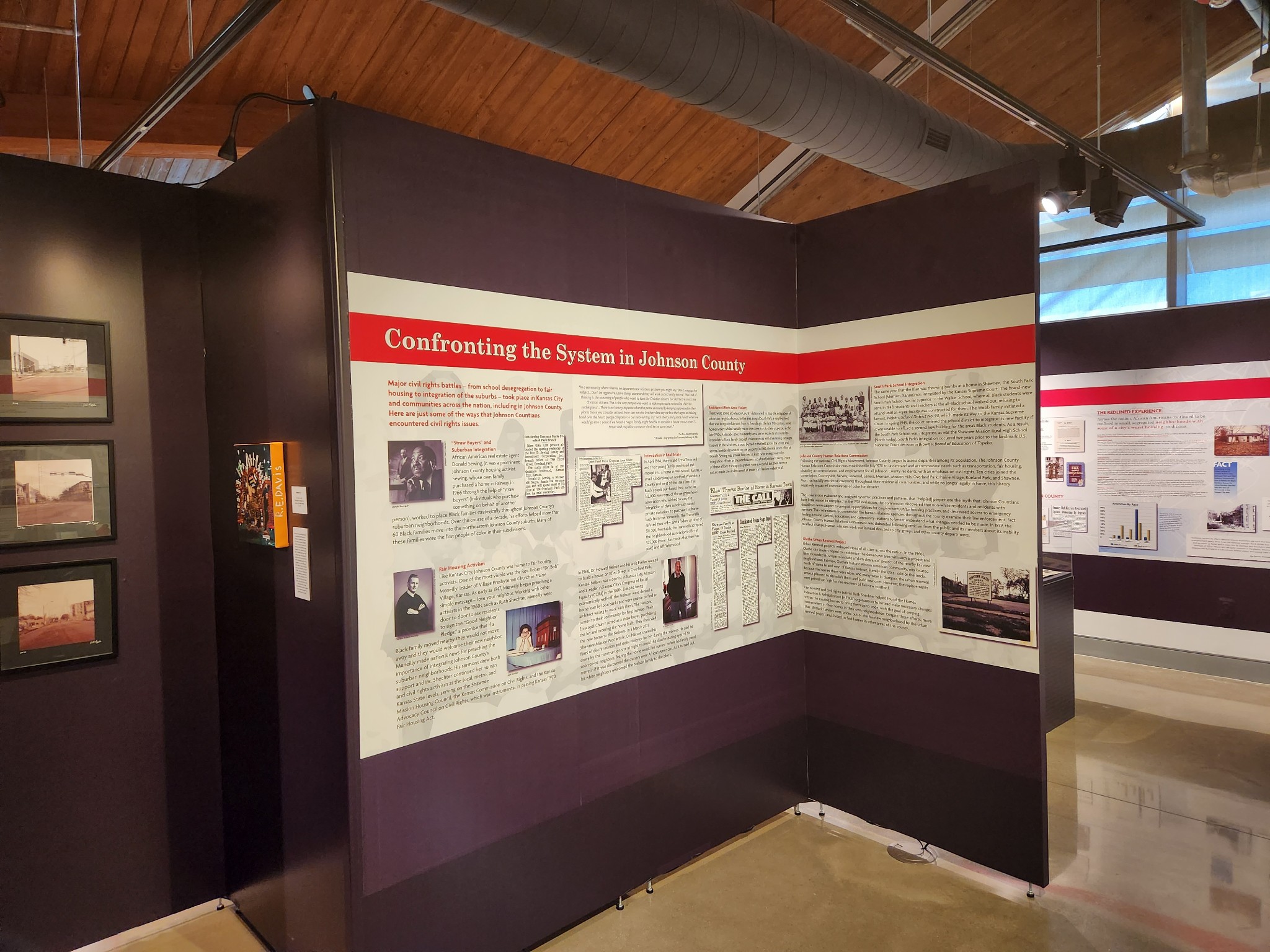
The Johnson County Museum’s special exhibition, “REDLINED: Cities, Suburbs, and Segregation” (on display through Jan. 7), is a gripping exploration of the history of redlining from its origins to its legacies, which continue to shape our lived realities today. REDLINED tells a national story with a local focus that reveals how Johnson County both shaped and was shaped by the history of redlining. While the bulk of the exhibit is about the federal policy of redlining from its origins to its lasting legacies, the exhibit also highlights Johnson County’s unique role in each stage of the process, including efforts to combat redlining and its effects. In this post, we are highlighting the work of three Johnson Countians who confronted the system of redlining and, in doing so, changed our community.

Suburban Integrator
African American real estate agent Donald Sewing, Jr. was a prominent Johnson County housing activist working for integration. Sewing, whose own family purchased a home in Fairway in 1966 through the help of a prearrangement with the seller, worked to place Black families strategically throughout Johnson County’s suburban neighborhoods. Sometimes this involved “straw buyers” (individuals who purchase something on behalf of another person). Over the course of a decade, his efforts helped more than 60 Black families move into the northeastern Johnson County suburbs. Many of these families were the first people of color in their subdivisions. Sewing attributed the lack of white flight to his scatter approach in placing Black families.
Sewing lived in Johnson County until his death in 2007. Reflecting on his choice to move his family to a previously all-white neighborhood, Sewing said, “I don’t think integration should be a matter of waiting until a neighborhood is ready. I think the best kind of education for a person who hasn’t had the experience of living in an integrated neighborhood is to integrate it.”
Fair Housing and the “Good Neighbor Pledge”
Like many communities, Johnson County was home to fair housing activists. One of the most visible was the Rev. Robert “Dr. Bob” Meneilly, leader of Village Presbyterian Church in Prairie Village. As early as 1947, Meneilly began preaching a simple message – love your neighbor. Working with other activists in the 1960s, such as Ruth Shechter, Meneilly went door to door to ask residents to sign the “Good Neighbor Pledge,” a promise that if a Black family moved in nearby, they would not move away and they would welcome their new neighbor. Meneilly made national news for preaching the importance of integrating Johnson County’s suburban neighborhoods. His sermons drew both support and ire.
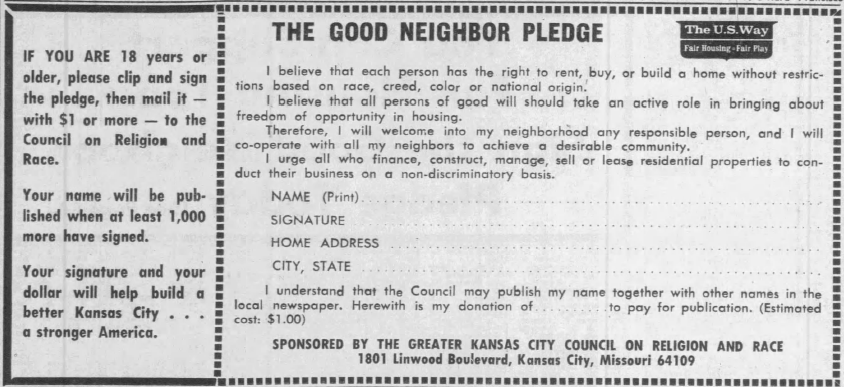
In a sermon titled “I Trouble – Segregating God” delivered on Valentine’s Day Sunday in 1965, Rev. Meneilly told his congregation:
“In a community where there is no apparent race-relations problem you might say, ‘Don’t bring up the subject… Don’t be aggressive. Leave things alone and they will work out naturally in time.’ This kind of thinking is the reasoning of people who want to look like Christian citizens but don’t care to act like Christian citizens. This is the way people who want to look respectable rationalize their ‘do nothingness.’ …There is no beauty in peace when the peace is ensured by keeping suppressed in their places those you consider a threat. How can we who live here dare say we love the Negro, or holding hand over the heart, pledge allegiance to our beloved flag, say: ‘with liberty and justice for all’ when we would go into a panic if we heard a Negro family might be able to consider a house on our street? …Prayer and prejudice can never dwell in the same heart.”

You can hear a recording of Rev. Meneilly, who passed away in 2021, read his own sermons in an interactive display in the Johnson County Museum’s signature exhibit, “Becoming Johnson County.” For her part, Ruth Shechter, who was Jewish, continued her human and civil rights activism at the local, metro, and Kansas State levels, serving on the Shawnee Mission Housing Council, the Kansas Commission on Civil Rights, and the Kansas Advocacy Council on Civil Rights, which was instrumental in passing Kansas’ 1970 Fair Housing Act.
Advocating for Displaced Communities
Urban Renewal projects reshaped cities of all sizes across the nation. In the 1960s, Olathe city leaders hoped to modernize the downtown area with such a project and later expanded its scope to include a “slum clearance” project of the nearby Fairview neighborhood. Fairview, Olathe’s historic African American community, was located north of Santa Fe Street and west of Kansas Avenue, literally the other side of the railroad tracks. Because the homes there were older and many were in disrepair, the urban renewal project planned to demolish them and build new ones. However, the new homes were priced too high for the residents of Fairview to afford.

Ruth Shechter helped found the Homes Evaluation & Rehabilitation (H.E.R.E.) organization to instead make necessary changes to the existing homes to bring them up to code. The goal was to keep homeowners in their homes in their own neighborhood. Despite these efforts, more than 30 Black families were priced out of the Fairview neighborhood by the urban renewal project and forced to find homes elsewhere. Shechter continued to advocate for all Johnson Countians, later reflecting, “I’ve been involved in civil rights – that’s been my life.” Shechter died in 2018 at the age of 96.
Learning More
These are just three of the many inspiring stories from Johnson County and the Kansas City region recounted in the REDLINED exhibit, and we continue to learn new histories from visitors about the experiences of their loved ones. If you have a story to share related to Johnson County’s history, your family, and overcoming obstacles, reach out and share at [email protected].
The REDLINED exhibit remains on display through Jan. 7 and is included in museum admission. You can learn more about the exhibit, learn about upcoming programming at the Johnson County Museum and at our partner sites across the bi-state area, and find additional resources to learn more about redlining at JCPRD.com/Redlined, and by following the hashtag #RedlinedKC on social media.
Dive deeper into this history in these past JoCoHistory Blog posts:
 Thanks for reading! If you value having an independent news outlet keeping tabs on local government, schools and taxes, we're asking you to contribute to our Education Reporting Fund.