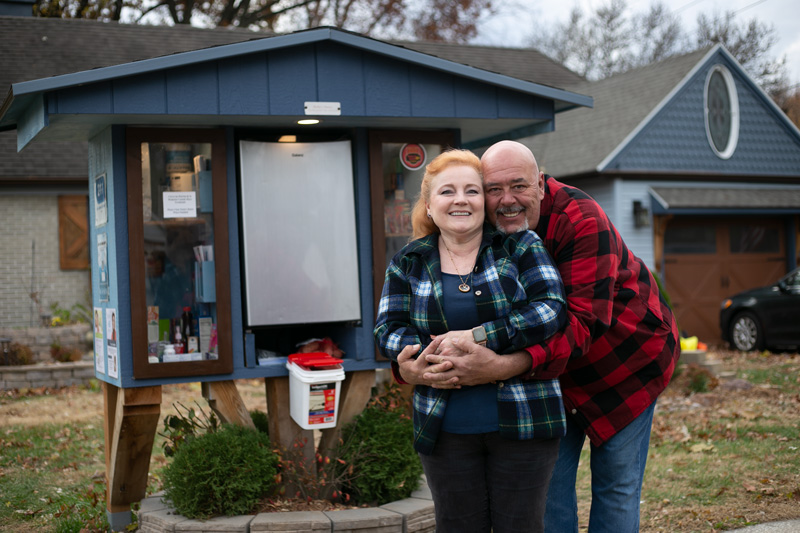
Since it opened in the midst of the COVID-19 pandemic, the Tiny Pantry Times food pantry in Overland Park has become a popular oasis for people struggling to find enough to eat.
Designed to put food and personal hygiene products in the hands of anyone in need, the sturdy hutch in Jennifer Parker’s front yard at 7215 W. 71st St. has grown from distributing about 2,500 pounds a month to roughly 18,000 pounds after schools let out last month.
But with that growth has come problems – in the form of increased traffic in the residential neighborhood around 71st and Metcalf Avenue, which has recently prompted some of Parker’s neighbors to start complaining.
Now Parker and her husband Adam, who founded the pantry together in September 2020, hope to find a way to relocate their DIY operation without disrupting a charity that now serves an estimated 3,000 people a month.
“We absolutely feel that it’s vital to serve our recipients. And we also feel it’s absolutely vital that we maintain our location in northeastern Johnson County,” Jennifer said. “It doesn’t have to be at our house, but this area is where our donor base is and where our recipient base is and obviously where the need is.”
The Parkers and members of the Tiny Pantry Times nonprofit board had been scheduled to meet with city officials and a local church representative next week to discuss options.
But that meeting was canceled after the city decided to put the nonprofit directly in touch with a possible partner church.
They’ve been searching for a new location for a year
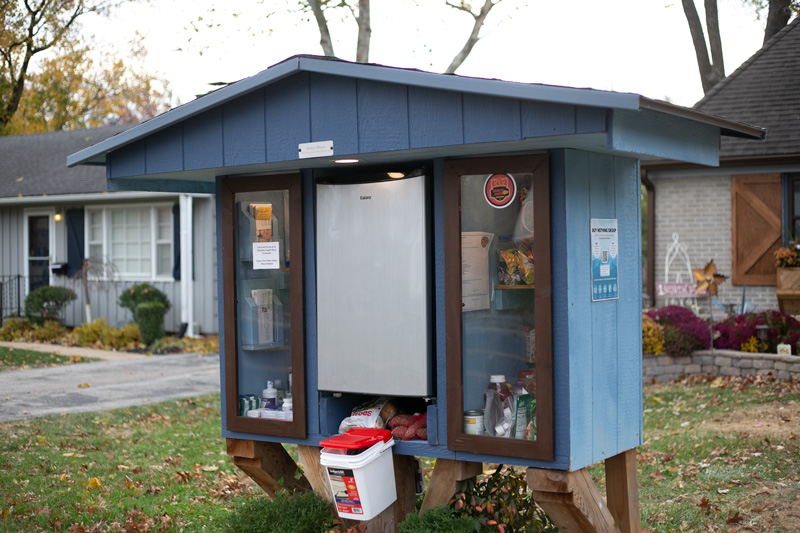
The pantry hutch itself was once the site of a Little Free Library but was rebuilt to include sections separating items and a mini fridge.
Since its inception, it has gained a following on the neighborhood messaging app Nextdoor and was recognized last year in the Best of KC issue of Kansas City Magazine.
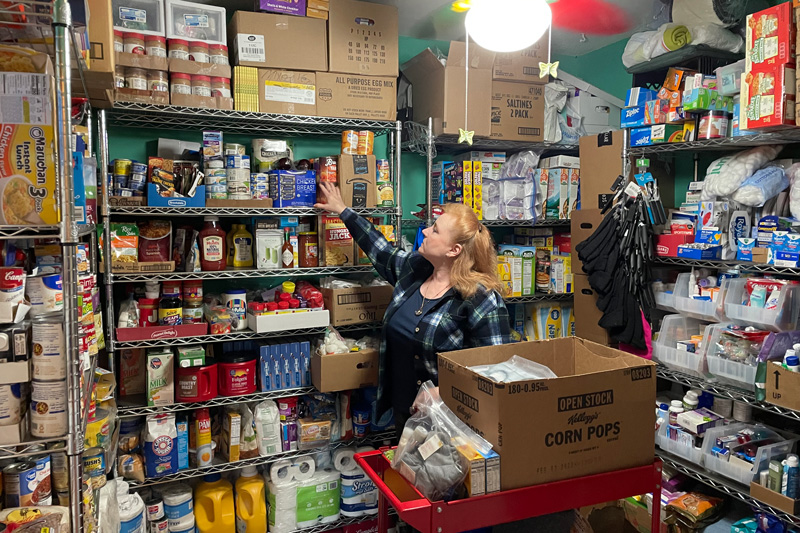
The more well known the pantry became, the more food it needed.
That also meant more people stopping at the house to drop off items, as well as recipients picking things up.
Adam said a location with better access than a residential street became a priority. But the Parkers’ plans to relocate have been thwarted by the cost of paying moving expenses, Jennifer said.
“Ninety percent of our donations are in-kind. So far I have not figured out anybody that will accept a carton of cottage cheese for a mortgage,” she said.
The pantry services are continuing for now
Neither the Parkers nor city officials say the pantry is in any immediate danger of being shut down, and it continues to operate as usual.
There’s no deadline for the problems to be resolved, said Meg Ralph, a spokesperson for the city.
“We are not interested in shutting down the Parkers’ tiny pantry. The city recognizes the need for this service and the use the Parkers’ pantry sees every day, and we appreciate their efforts to keep the residents fed,” she wrote in an email to the Post. “However, growth at their current location in a neighborhood is not feasible.”
The Parkers say the city has been “absolutely wonderful about supporting the pantry and our mission,” which is to provide year-round, 24-hour pantry access to those in need.
Still, the complaints and ensuing conversations with city staff have been concerning to them.
The complaints began this past spring
As Jennifer tells it, the pantry had no complaints until April of this year, when city officials said they had an issue with traffic.
The Parkers notified the city they would start a GoFundMe campaign to raise $8,000 to install a circle drive on their property.
But when the contractor tried to get a permit for work to start, she said, he was denied because of another restriction on the green space it would consume.
After that, the Parkers said the issue became the number of people going into and out of their home.
“Every time we address a concern, the concerns change,” Jennifer said. “I think it is to appease whoever is doing the complaining at the expense of, unfortunately, the families and neighbors and friends who are so food insecure.”
More vexing was the fact that a review process started because of only two formal complaints, the Parkers said.
“Those two complaints are now jeopardizing the nutritional security of thousands of people,” Jennifer said.
The Tiny Pantry does violate some city rules
Ralph confirmed that there were two formal complaints, in addition to a few phone calls and informal comments.
She also offered more explanation for the city’s issues with the pantry.
Overland Park considers free little libraries and tiny pantries to be “landscape elements” that do not require permits, she said.
They are, however, limited to no more than four feet in height.
The city also does not license home-based businesses, but there is a restriction to no more than ten business-related visits per day between 6 a.m. and 9 p.m., she said.
The pantry is taller than four feet and has 30-40 visitors per day. Vehicle traffic and parking has also become an issue, Ralph wrote.
Pouring a circle drive would not solve those problems, she said. In any case, the driveway would have exceeded the maximum the city allows of 35% of the total space of the front yard.
What happens next
Ralph said the city is committed to collaborating on a feasible way for the Parkers to expand the pantry, and there is no deadline for resolving the issues.
Adam said the pantry is needed in a county that doesn’t have a lot of resources for those living on the margins except some churches and other private pantries.
Jennifer noted their pantry also serves the county by helping people maintain their independence.
“By keeping these people fed they are now able to maintain their living status in a home or an apartment. They’re still able to get their medications, they’re still able to put gas in their cars in order to go to work,” she said. “You create less of a burden on the city as a whole.”
Roxie Hammill is a freelance journalist who reports frequently for the Post and other Kansas City area publications. You can reach her at roxieham@gmail.com.