Starting at the end of this year, Overland Park will require some new streets to be built with concrete instead of the traditional asphalt mix.
The move is expected to cut down on the disturbance from regular street maintenance on these new roads and, overtime, reduce the city’s reliance on chip seal as a road resurfacing tool. Overland Park expects to eliminate about 220 lane miles from the future list of candidates for chip seal over the next 15 to 20 years.
On Monday, the Overland Park City Council unanimously accepted the city staff’s plan to begin paving all new residential and collector streets with concrete.
“We believe that concrete pavement is a feasible option. It is a sound engineering decision,” said Public Works Director Lorraine Basalo. “We also believe that the savings to the city with the maintenance is a very big difference.”
Concrete streets cost less to maintain
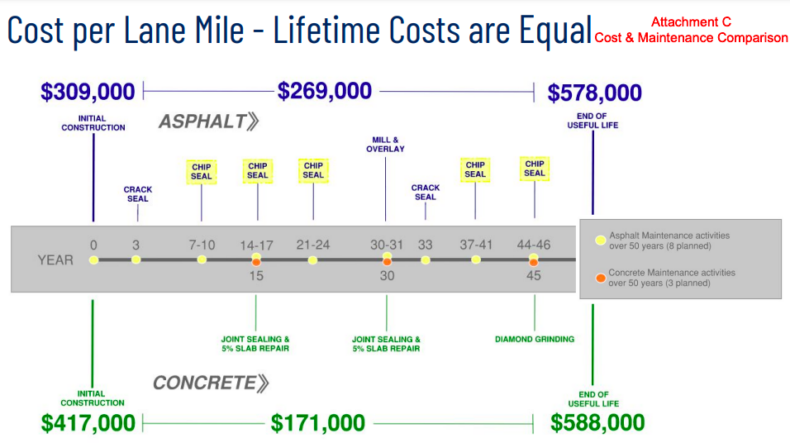
- Currently, Overland Park requires asphalt for residential and collector streets. That costs about $300,000 for developers to build per lane mile and roughly $270,000 for the city to maintain over 50 years.
- Up front, concrete streets cost about $400,000 for developers to build per lane mile. The city would then spend about $171,000 maintaining it.
Concrete streets require fewer maintenance projects
- Over the 50-year life of an asphalt street about eight projects are required to maintain it, usually using the chip seal method.
- In that same period of time, a concrete street would require three, and other maintenance methods would be utilized.
- Today, Overland Park uses concrete to pave some thoroughfare streets and in its neighborhood street reconstruction program.
Overland Park reduces neighborhood street width too
- The vote Monday night also reduced Overland Park’s minimum width requirement on new residential streets to 26 feet.
- Under the current standards, new residential streets are required to be 28 feet or greater.
- Basalo said 26 feet is wide enough to accommodate street parking, traffic in neighborhoods, snow plows and any public safety vehicles that would pass through.
- This shift, she told the city council, will probably provide some cost savings on both road construction and maintenance.
- “Staff is always looking for ways to improve or to efficiently manage our capital resources,” Basalo said.

Next steps:
- These new concrete street rules only apply to neighborhoods that are platted after Dec. 11, 2023.
- Anything that comes to the city for a preliminary plat before that date will be grandfathered in, so long as project builders obtain construction permits by the end of 2026.
- This update to the city’s Design and Construction Standards Manual will primarily affect new neighborhoods coming in southern Overland Park as most areas of the city north of I-435 are built out.
- Chip seal won’t go away entirely, as it is still the city’s official maintenance strategy for existing asphalt streets.
More on this: Overland Park voters OK increased sales tax for street maintenance
 Thanks for reading! If you value having an independent news outlet keeping tabs on local government, schools and taxes, we're asking you to contribute to our Education Reporting Fund.