A proposed project that aims to bring a mix of hundreds of single-family homes, townhomes and apartments alongside a new industrial development in southern Olathe gained a key approval this week.
On Monday, the Olathe Planning Commission voted 7-1 to recommend approval of the rezoning and preliminary site development plan for the nearly 250-acre Park 169 development near U.S. Highway 169 and 167th Street.
Commissioner Megan Lynn cast the dissenting vote, concerned specifically with the traffic implications such a large project could have for the area.
Currently, the property holds a carryover county industrial zoning designation, which it has maintained since the city annexed it in 2012. Over the years, it has largely been used for agricultural purposes.
Commissioner Chip Corcoran was absent from the meeting.
Park 169 envisions 700+ dwelling units
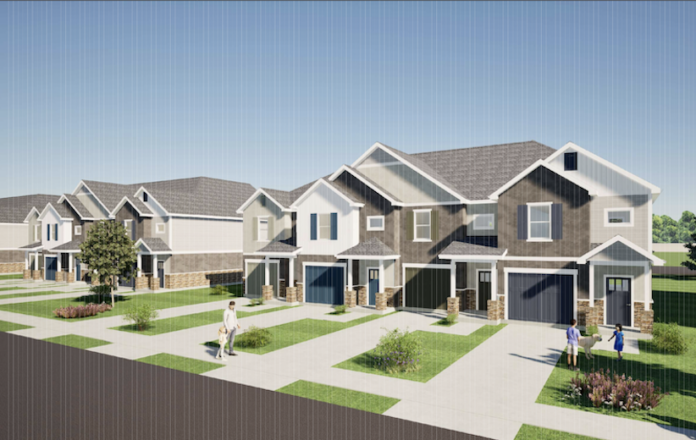
- The Park 169 plan features three proposed residential zoning districts on the eastern half of the property.
- Towards the center of the property are two separate medium-density residential zoning areas.
- One will have five, three-story apartment buildings each with 30 units and 33 townhomes with four units each, totaling 282 units.
- A second residentially zoned district will have 13 additional townhome buildings ranging in size from eight to 10 units apiece. That’s an additional 118 units.
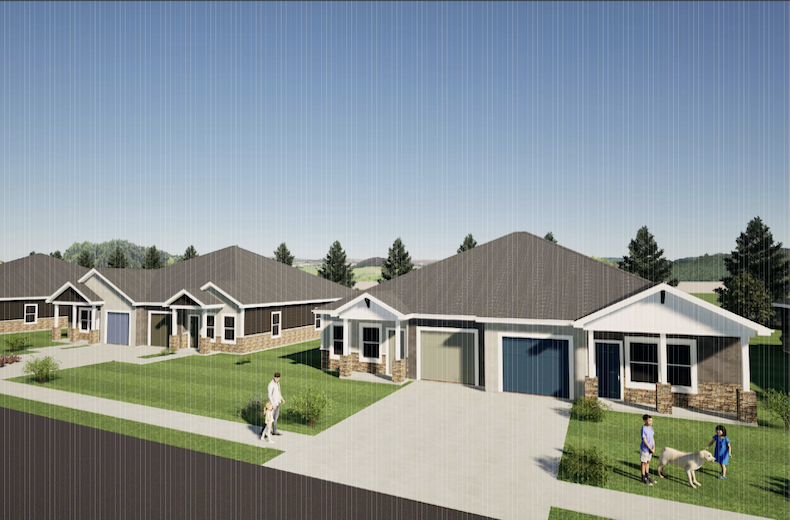
- Further east, there will be an area for two-family housing with 188 units stretched across 94 lots.
- Finally, a 113-home single-family subdivision is also planned for the project.
Industrial is also a big part of the Park 169 plan
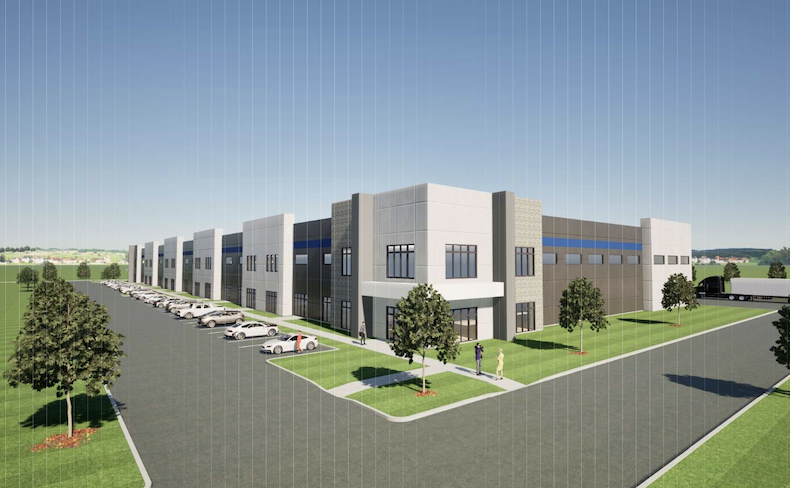
- Nearly 140 acres of the project are also expected to feature industrial development.
- A total of 13 general industrial buildings are planned on the western side of the property.
- They will range in size from 62,000 square feet to nearly 264,000 square feet.
- Exactly what they’ll be used for is unclear, though some uses — like power plants, recycling centers and storage facilities — will be prohibited.
- Tracks for the Burlington Northern Railroad are located to the west of the Park 169 project area.
Park 169 requires some infrastructure work
- Barker Road will need to be built through the middle of the site, and it will divide the industrial and residential elements of the development.
- Additional turn lanes, a traffic signal at 159th Street and Barker and upgrades to 167th Street will all be required as well.
- Beyond the Park 169 project boundaries, the developer has to help upgrade the intersection at 159th Street and US-169.
- Plus, the final phase of development will be dependent on the construction of a 167th Street overpass, according to city documents.
- Additionally, Chief Development Engineer for Olathe Charlie Love said a new traffic study will be required between each of the four planned phases of construction.
Neighbors worried about traffic, quality of life
During the meeting, roughly a dozen people were in attendance, seemingly from nearby neighborhoods. The four neighbors who spoke, including a representative from the Madison Place Homes Association, were all opposed to the development.
They cited concerns about traffic both to the residential areas as well as truck traffic to the industrial developments, potential issues with stormwater drainage and the impact of industrial uses on the environment and their quality of life.
There was also some concern about whether such a large-scale development would fit in with the area.
“It does not seem like it’s community-driven, and it does not seem like it’s very Olathe-esque,” said Nathan Jones, from the Madison Place HOA.
He proposed alternative uses, like keeping more open space in the area, using it for office development or adding some kind of bulk grocer like Costco to the area.
Commissioners also have some concerns
While the bulk of the commissioners ultimately supported the project, there was a lengthy discussion about stormwater, environmental impact, traffic and other worries commissioners had about the development.
At one point, Commissioner Tony Bergida tried to offer an amendment to change the general industrial development part of the rezoning to a light industrial zoning designation. That effort failed.
Chair Wayne Janner, too, said he hoped to see more of the residential side of the project be available for sale, worried that much of it would be for rent instead.
“When we talk about the major issues that need to be addressed in the city — top three — attainable housing is always on the list, and the ability to get people into homeownership,” he said. “Here’s an opportunity, and if it’s not plausible for the applicant, what can the city be doing to make it happen?”
Janner, who works in real estate, said he felt it would take “creativity” to address that problem “and make it a win for everyone.”
It was Commissioner Lynn, however, who ultimately felt like she couldn’t support the project as presented.
She fretted over the traffic impacts and the state of the railroad crossing in the area.
“I have serious concerns,” she said.
Keep reading: Olathe OKs incentives for warehouse project but not before bigger talk about their purpose