By David Markham
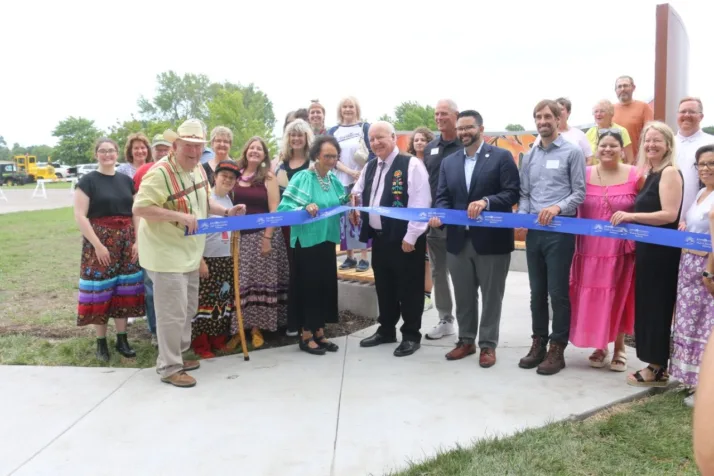
More than 200 people, including over 40 members of the Potawatomi Nation from Oklahoma and across the country, attended the recent dedication of JCPRD’s newest permanent art installation.
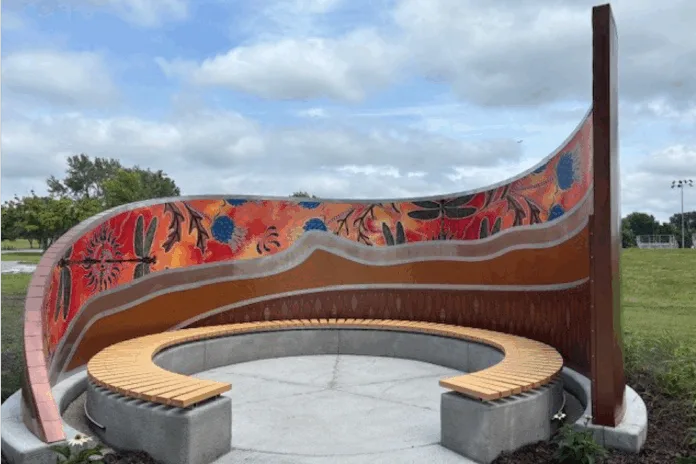
A ribbon cutting and celebration for “Fire Keepers Circle,” created by Native artists Leah Yellowbird and Aaron Squadroni of Grand Rapids, Minn., took place in late July in Heritage Park. With multiple levels of symbolism and meaning, the sculpture honors the journey of the 859 members of the Potawatomi Nation were forcibly marched from Indiana to an area near present-day Osawatomie, Kan., in 1838. The sculpture is located near an existing monument by the park’s marina building which marks the site of a local encampment along the Trail of Death.
“We come here today to remember those who walked this trail,” Citizen Potawatomi Nation Member and JCPRD Public Art Selection Committee Member Angela Montgomery said in her opening prayer. “As a public art piece in this busy park, the educational value of “Fire Keepers Circle” is immeasurable. For both teaching history and guiding the future, it can serve as a bridge between knowledge and betterment. Elements of the “Fire Keepers Circle” represent renewal, like a circle, can remind us to celebrate this history and stoke the fire to keep it burning. Help us learn from their difficulties so that we can be better people.”
Inspired by the fire pit in a traditional sweat lodge, the sculpture constructed of concrete, steel, composite wood, and paint. The design includes 859 metal cutouts—one for each person who walked the Trail of Death—and 31 metallic feathers imprinted with designs submitted by Potawatomi tribal members from 21 states. A nearby panel provides historical context and background about the Trail of Death and the artwork. The panel was co-created by staff from the Johnson County Museum and the Citizen Potawatomi Nation Culture and Heritage Center in Shawnee, Okla.
Native Artist and Composer Alexis Dawson of Emporia, Kan., accompanied herself on guitar as she sang a song called “The Ones We Left Behind,” which she wrote for the occasion.
“This was probably the most difficult song I’ve ever written, and my intention is that the ancestors and relatives who walk this path will be honored by our efforts here today,” she said.
“At the end of cold November, we stand with monotony.
Family and friends are gathered, proud and Potawatomi.
We depart from eastern woodlands where ancestors made a home.
Someone called it Indiana. Now they say it’s theirs alone.
We are marching on to Kansas with their rifles on our backs.
There’s no time to mourn our children. Tears and blood stains in our tracks.
We will walk to foreign prairies for these treaties we have signed.
We are burying the memory of the ones we left behind.”
“The Fire Keepers Circle you see here is more than just a sculpture,” added JCPRD Executive Director Jeff Stewart. “It’s a sacred space for memory and resilience. Before this project was imagined, there was a great effort to build relationships and friendships and to develop an understanding. The Art Selection Committee for this project, which included several descendants of survivors of the Trail of Death, helped shape this project with great care and insight and we’re so grateful for that.”
“This is absolutely beautiful and for the 660 miles of the Trail of Death, I believe that this is the most beautiful and the greatest monument that we’ve had,” said Citizen Potawatomi Nation Vice Chairman Linda Capps. “I just think it’s wonderful that our Potawatomi people are here today to recognize this monument and the beauty that it represents and what it represents to us whose relatives were on the Trail of Death.”
“I couldn’t help but imagine what it would have been like for the people that were here back in the removal to walk across this piece of ground, especially when it wasn’t cleared and there were no roads,” added Art Selection Committee Member and Citizen Potawatomi Nation District 4 Legislative Representative Jon Boursaw, whose great-great-great-grandparents were on the Trail of Death. “It must have been a difficult journey. All of these kinds of remembrances along this trail remind us of the price that they paid in order to get us to where we finally ended up.”
Capps and Boursaw presented JCPRD Superintendent of Culture Susan Mong with a native-designed Pendleton blanket and a “lifetime supply” of tobacco, cedar, sage, and sweet grass, which the Potawatomi consider sacred.
“It means respect, honor, and gratitude for what you have done for us and what you mean to us, and it also means that we want you to keep the memory of this event warm in your heart,” Capps said.
“Thank you for your willingness to share your experience with our community,” Johnson County Board of Park and Recreation Commission Chair Leslee Rivarola told the visiting Citizen Potawatomi Nation members. “Your participation in every part of this process, whether it’s from prayer or planning to art making, has truly been a gift and I think it’s absolutely reflected in this amazing piece of art. “Fire Keepers Circle” is a space for remembrance and understanding. Every feather embedded in this wall carries a story, a memory, a voice, and part of it can truly embed in every single feather.”
“It’s such a moving experience being able to welcome you, to learn from you, to connect with you, and to welcome you back here today. It’s a great honor for Johnson County,” added Johnson County Board of Commissioners Chairman Mike Kelly. “Recognizing our history and being intentional about that recognition in today’s world is sometimes hard. I’m glad that we invest in art in Johnson County. I’m really pleased about the intentionality behind “Fire Keepers Circle.” Not only the feathers that are embedded in the wall designed by many families across the country, it’s just meaningful. It’s deeply powerful and I’d like to thank the artists, the Art Selection Committee, and all who helped realize this project.”
Artist Aaron Squadroni said he and his partner wanted “Fire Keepers Circle” to be more than just an object.
“For this sculpture, we really wanted the viewer to be part of the artwork,” he said. “So we had this idea of an artwork that surrounds you and kind of embraces you and that requires people to gather in it to actually be complete. So the artwork feels like it’s missing something unless there’s people gathered there. And then we thought about the idea of a many-layered blanket that wraps the seating area and kind of embraces the viewer as they come to look at it.”
The piece’s feather design is meant to “give voice to the ancestors through the current generation as a way of remembering some of the family designs and patterns. For some of the submissions we got for the feather designs, (somebody would write “this is the beading pattern of my great-great-great grandfather’s belt” or it’s a pattern from the moccasins of somebody that was generations ago. We were very amazed at the beauty of all the designs, the variety. I really think that once the feathers were added, it really brought the sculpture to life and gave it integrity and strength of expression to that blanket of art. I really want to thank all who participated in that.”
Squadroni noted that his fellow artist, Leah Yellowbird, died unexpectedly in April of this year.
“She was very proud of this project and was really excited about doing the artwork for the project,” he said. “She was a friend of mine and a partner on many of the sculptures that I’ve done in the past. She will be greatly missed, but I do think her vibrant personality and her warm spirit live on through the people that she’s inspired and through her many artworks. Leah has said in the past, that the voices of our ancestors come back to us when we least expect it, and a major theme for us in the artwork was to honor the ancestors’ stories. In some of the layers of the blanket, there’s spiritual and cultural legacies that were left by the Potawatomi ancestors.”
To learn more about the “Fire Keepers Circle” project and public art process, visit JCPRD.com/1968/Heritage-Park-Public-Art-Project.