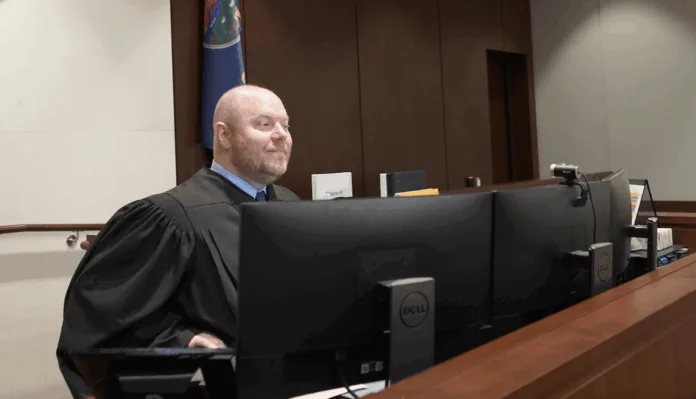
A new approach to tenant eviction cases has earned Johnson County national recognition and status as a possible model for other Kansas courts.
The Eviction Mediation Pilot Program has proved so successful at settling landlord-tenant cases without involuntary evictions that District Magistrate Judge John McEntee says other Kansas counties have begun to reach out about starting similar pilot programs.
McEntee shared statistics recently with county commissioners on the two-year-old program.
Johnson County Government announced its accolades earlier this year.
How the program got its start
The program began in 2023, as a COVID-era rental assistance program was ending and evictions were beginning to increase. At the time, Commissioner Becky Fast asked McEntee, who tried eviction cases, for a way to help people who would no longer be able to get aid from the Kansas Emergency Rental Assistance program, which ended in 2022.
Because Kansas law moves eviction cases quickly through the system, Fast was concerned that tenants behind on their rents would end up homeless because they lacked a way to catch up on rent. A court eviction judgment can become a long-term stain on the record of someone trying to find a new place to rent, McEntee said.
Local courts can’t change the eviction deadlines. But McEntee told commissioners he’d seen some success in his own courtroom when tenants and landlords went into mediation to try and work something out.
People who come to an agreement, “are happier than when the person in a black robe is telling them how it’s going to be,” he said.
The pilot program sprung from that. McEntee made it mandatory that tenants and landlords try to work something out with a neutral volunteer mediator before coming back into his courtroom for judgment.
Judge says less than 1% of cases return to court
Most of the time, the mediated agreements hold, he said. “The good news is that fewer than 1% of the cases return to the courtroom, which is a pretty fantastic success the way I’m looking at it,” he said.
“That means that 99% of the people who walked in that room had some control over their destiny and some involvement, some seat at the table,” he continued.
In three-quarters of the mediated cases, participants avoided judgment, usually by either catching up on rent or leaving voluntarily, McEntee said. Involuntary eviction involves sheriff deputies and can be dangerous for officers. In Jackson County, Missouri, a process server and Independence police officer were killed while serving an eviction.
About a third of the tenants in mediation were able to stay because of arrangements with landlords to get caught up on rent.
He shared some demographic statistics as well. The average age of tenants is 42, and about 88% of participants are at least $1,000 behind on rent. About 22% are at least $4,000 behind, he said.
The majority — about 78.6% — reported no other evictions in the previous five years.
Racially, the breakdown among participants is 41% Black, 42% white, 6% multi-racial and 10% Latino. About 59% are women, McEntee said.
Although some landlords pushed back initially, the program has proved popular, with 80% of tenants and 70% of landlords saying it was beneficial, he said.
Other counties are interested in starting their own pilots
Johnson County’s program is effective because it’s mandatory, he said. Sedgwick County also has a mediation program, but landlords and tenants are not required to go through it. Sedgwick County courts only had 17 mediations in 2023, with 14 of those reaching an agreement, according to a 2024 report by Kansas Supreme Court Chief Justice Marla Luckert to the state legislature.
McEntee said more openness to mediation may be on the horizon in the Kansas Legislature. In the meantime, he said he’s heard from officials in other counties interested in starting pilot programs of their own.
Johnson County has about 2,800 eviction cases filed each year, which amounts to one-sixth of the state total, McEntee said, so there’s still work to be done to get more into mediation. But he told commissioners he was encouraged by response to a bright pink insert he recently added to the informational court packet. The one-page paper explains the mediation process in English and in Spanish.
“People are appearing in court holding the piece of pink paper saying, ‘I want mediation,’” he said.