Olathe Public Schools won’t allow students to use Grammarly after the AI editing tool started rewriting students’ work.
That’s just one example the school district pointed to when describing the challenges of striking a balance between embracing new, rapidly evolving AI technologies and setting guidelines for students and teachers.
At the April Board of Education meeting last Thursday, district officials gave the board a “progress report” on Olathe schools’ approach to AI, from restricting student access to expanding teacher training.
“Our philosophy on the use of AI in Olathe schools is empowering learning with AI and doing so responsibly,” Jennifer Kennedy, the district’s director of technology and advancement said at the meeting.
Student guardrails
Kennedy said that since generative AI hit the mainstream in fall 2022 with ChatGPT, the district has worked to limit student access. Generative AI tools can create text, images or other content based on prompts.
In 2024, the district created an Olathe Public Schools committee to develop AI policies and guidelines.
“The purpose of that work group was to start looking at how to design guidelines and policies that were flexible to allow for the technology to change, but then also maintain policies that we felt would be unchanging over time, like maintaining data privacy and things like that,” Kennedy said during her presentation to the board.
Currently, the district blocks several AI tools for students, including ChatGPT, Google Gemini, Copilot and AI video generators.
“All websites that are categorized as AI are automatically blocked for our students,” Kennedy said.
The district has also removed some tools already in use. For instance, Kennedy said, Grammarly was pulled after it began rewriting student work rather than just assisting with grammar.
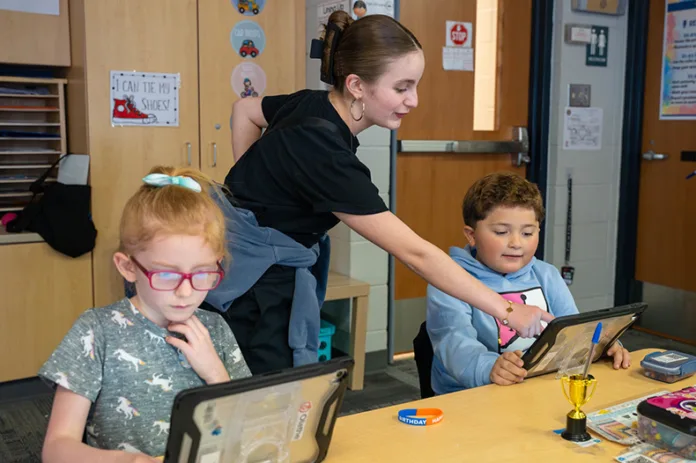
Some AI tools are still allowed, but only those designed for classroom use and monitored by teachers.
Kennedy said Curipod, Magic School and SchoolAI are all being used by Olathe students in the classroom.
“Teachers must be involved and they have a dashboard where they can see everything that’s happening and how students are interacting with the AI,” Kennedy said.
She added that besides blocking generative AI tools, a big part of the plan moving forward is AI literacy for students.
“We want to ensure that they have that awareness that AI produces false results,” she said. “AI can be misused. We shouldn’t be copying and pasting from AI and getting answers to our math homework.”
In an interview with the Post last October, Board of Education Vice President Julie Steele said that while she has concerns about students using AI to cheat, she also has confidence that teachers would be able to intervene.
“Our teachers know our students, and if something feels off, they’re going to dig deep,” she said. “This is what teachers do.”
Tools for teachers
While the district is restricting access for students, it is also empowering teachers to use AI in the classroom. All AI tools have to be vetted and approved before teachers can use them.
Kennedy emphasized that AI in schools goes beyond chatbots. She pointed to platforms like Canvas and Nearpod, which have AI features built in to assist with grading and content creation.
She said teachers still need to double check the work AI is doing for them.
“It’s critical to maintain that human in the loop,” Kennedy said. “I’m constantly verifying information.”
Use of AI is optional for teachers.
“We’re not adopting AI,” Kennedy said. “If educators are interested, we want to point them in the direction of the tools that are available and then the resources available to them.”
New guidelines
The district uses a rubric to decide which AI tools are appropriate for the classroom.
Using the rubric, Kennedy and her team evaluate tools based on:
- Cost effectiveness
- Safety and security
- Ethical considerations
- Accessibility
- Educational value
The district’s priority is academic integrity, proper citations of AI content and protecting personal data.
“We’re not plagiarizing AI-generated text. We’re not using AI tools when they’re not permitted,” Kennedy said. “Be honest about your work. Cite your sources.”
Teachers are also given classroom resources, including posters and an “AI assessment scale,” to help communicate when AI use is allowed.
More changes are coming
Board member Will Babbitt supported the district’s approach so far but wanted to know more about the plan moving forward.
“As we know this is changing daily,” he said. “So what’s the plan to be able to adapt as the industry is and as our kids are too?”
Kennedy said the district will continue updating policies as technology evolves, with a focus on AI literacy and responsible use.
The district has started discussing future plans like developing an AI literacy course, training staff annually, parent education and having students sign an AI integrity pledge.
“It’s constantly changing,” Kennedy said. “We have to constantly monitor it.”