At least 300 Gardner Edgerton students will find themselves at a new school starting in the fall of 2027.
Gardner Edgerton School District’s Board of Education met in a special meeting on April 27 to address next steps for an upcoming boundary change.
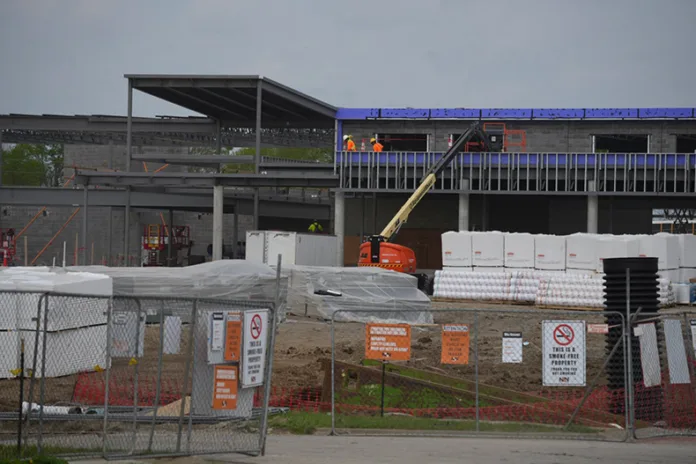
With the construction of a new elementary school, Sunflower Elementary School will be converted into a centralized early education center, a move set to happen in 2028. Meanwhile, the new elementary school is set to come online for the 2027-28 school year, so current Sunflower Elementary students will need to be placed at other schools.
Additionally, as the boundary lines are redrawn, some students from other elementary schools and middle schools will be affected as well.
“We do know that this is one of the most difficult processes for a community,” said Superintendent Brian Huff. “But, we also see it as being a very exciting process because the reason we’re doing this is that we live in a growing community.”
The district is working with RSP & Associates, a school planning firm based in Overland Park, to help guide the process.
“The things that we’re going to be changing are going to impact the student experience,” said Chief Executive Officer and Principal Planner Rob Schwarz of RSP & Associates. “I always want us to think about everything we do from that standpoint — it’s the student experience, right? That’s what we’re trying to make better with these changes.”
A boundary study committee consisting of parents and staff representatives from each building, city officials from both Gardner and Edgerton, community members, specialized program staff, students and a principal from each building level will be announced at the May meeting.
The committee will also include board of education members Lana Sutton, Julie Aldridge and board President Tom Reddin.
The summer will be quiet for the committee, with meetings starting in September:
- the first meeting will begin with developing boundary concepts at 5 p.m. Sept. 10,
- the second meeting will refine potential boundary scenarios at 5 p.m. Sept. 24,
- the third meeting will continue to look at different scenarios, with the goal for the committee to reach a general consensus at 5 p.m. Oct. 8,
- public forums will be held back-to-back at 6 p.m. Oct. 21 and 22, allowing the public opportunities to provide feedback on the committee’s recommendations thus far,
- and the final committee meeting will review the public’s feedback, refine the final scenarios and reach a committee consensus on what recommendations to provide the board at 5 p.m. Nov. 12.
From there, the board of education will receive an updated enrollment analysis from RSP & Associates and the boundary committee’s recommendations in December. The goal is to approve new boundaries in either January or February of 2027, Schwarz said.
The goal of Monday night’s meeting was to set the committee’s makeup, along with guiding principles and boundary criteria as the committee develops recommendations for the board of education, which will make a final decision early next year.
The board of education and district leadership decided on 11 guiding principles, items including:
- the boundary can anticipate and accommodate future growth of the neighborhood,
- the boundary proposed should utilize all of the available district resources; do not increase capital costs to increase capacity,
- and the committee recognizes specialized programs should align with the feeder system to provide students’ continuity and stability.
Additionally, the board selected four key boundary criteria for the committee to consider:
- aligning as many elementary and middle school boundaries to keep students together as much as possible,
- balancing enrollment so buildings are well utilized, but still have room for future growth,
- building boundaries that are durable and last for a long time,
- and maximizing district resources to keep operational costs low.
Huff said the district is going to do the best it can to find a solution that works for the growing community, but asked for grace knowing that it’ll be a challenge to find a solution that makes everyone happy.
“I think above all, we ask for patience as we seek input,” Huff said, “and knowing that when we get to the end of this, we may not have a process or a product that everybody is exactly pleased with.”
 Thanks for reading! If you value having an independent news outlet keeping tabs on local government, schools and taxes, we're asking you to contribute to our Education Reporting Fund.