A proposed 300-acre data center in Gardner has nearby residents in an uproar.
California-based Beale Infrastructure, which also leads the De Soto data center project, recently proposed another data center in eastern Gardner, near the northeast corner of 191st Street and South Clare Road.
Many Gardner and nearby residents, including Kyle Eisenbarger, believe that data centers have no place in the community. Eisenbarger lives just across the street from the proposed site, in unincorporated Johnson County.
He can see the 300 acres from his driveway.
“The health aspects are probably the biggest concern,” Eisenbarger told the Post on Thursday. “You’ve got pollution from the diesel generators, you’ve got the noise — there’s a lot of things you can mitigate, and noise is one of the few you really can’t.”
Eisenbarger launched a website condemning the proposal, and the community has followed suit with both a Facebook group and a petition, which had more than 1,000 signatures as of Monday morning.
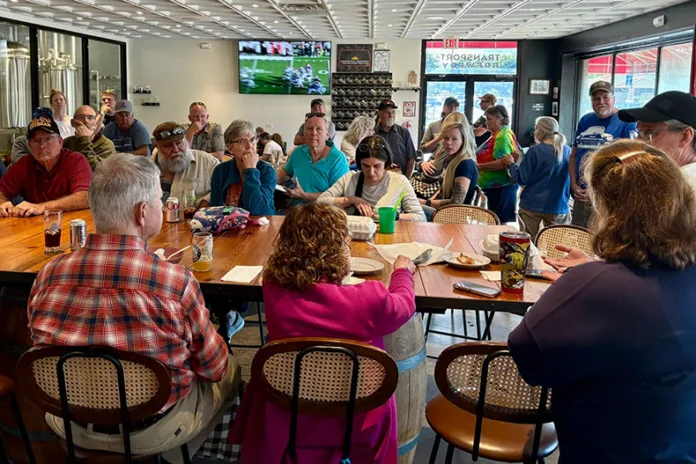
Two city councilmembers, Mark Wiehn and Kelly Johnson, held an informal meeting Monday night with residents to talk about the project and the coming steps.
“As city council considers the proposed data center project, I want you all to know what I’m focused on,” Johnson said in a newsletter after Monday’s meeting. “The question isn’t simply whether data centers are ‘good’ or ‘bad,’ but whether this specific proposal is in Gardner’s best long-term interest.”
Eisenbarger attended the event, and while he’s adamantly against the proposal, he said he appreciates the city councilmembers taking time to meet with the public.
“I know that they’re taking time out of their day, doing something they didn’t have to do,” Eisenbarger said. “But generally, the consensus of the public was, ‘Why are we even having this conversation?’”
Nearby facilities and proposals
The Beale Infrastructure proposal comes nearly two months after another data center developer, Bullock Capital and Colossus Advisors, withdrew an application for a 316-acre facility at 191st Street and Renner Road in Spring Hill.
De Soto’s data center, which has already been approved and is now underway, is about 22 miles from the proposed site in Gardner. Beale Infrastructure announced last week that the first phase breaks ground this month.
Earlier this week, the De Soto Planning Commission reviewed a site plan and a final plat for the project, as well as another site plan for a nearby substation operated by Evergy, the predominant utility company providing electricity in the Kansas City area, to support the incoming data center.
The $3.1 billion project will take seven to nine years for a full build-out at 103rd Street and Edgerton Road in De Soto, with the first building completed by 2027. The four-building facility will total 1.14 million square feet, or 285,000 square feet per building.
The proposal
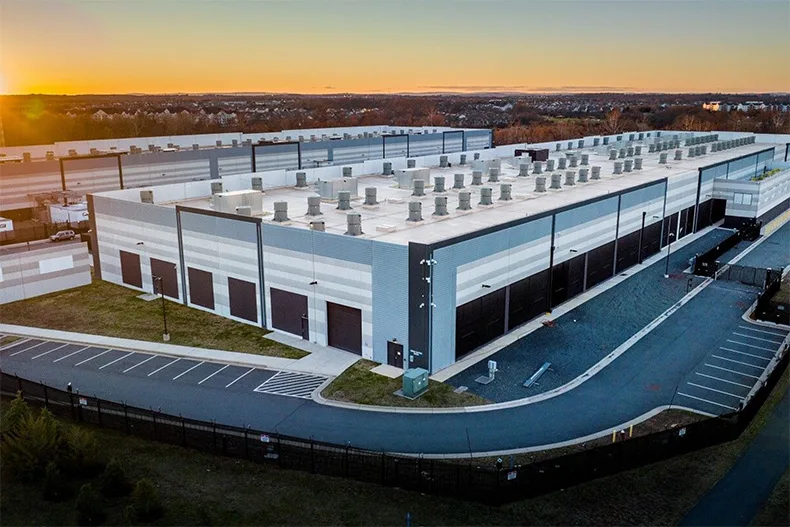
Data centers are home to rows of computers meant for storing, processing and transmitting data, reports the Associated Press. One large data center uses the same amount of electricity as it takes to power 400,000 electric cars.
Technology companies, the Associated Press reported, are increasingly using data centers to train and operate artificial intelligence systems.
It is unknown at this time what clients the Gardner data center would serve.
Beale Infrastructure would privately fund electrical, roadway and water infrastructure improvements to the area. Initial operations would bring 50 full-time employees online, with the potential to expand staff as the facility grows, the company states on its website.
The proposed Gardner facility would use a closed-loop, air-cooled system — similar to the incoming De Soto data center — instead of using water to cool the facility.
The facility would use an estimated 15,000 to 20,000 gallons of water per day, compared to other large data centers that use up to 5 million gallons per day, according to an article published by the Environmental and Energy Study Institute. A town the size of 10,000 to 50,000 residents also uses about 5 million gallons of water per day.
Evergy would provide power to the facility, separate from the city’s electrical grid. This includes private on-site substations, as well as another substation to improve the regional grid’s reliability and resiliency.
The company plans to incorporate sound mitigation — including berms, sound walls and something called acoustic treatment, which could include specialized wall paneling that reduces sound — in order to keep levels below 60 to 65 decibels, the register for normal conversation. Beale also plans to establish a sound monitoring and reporting program with the city.
However, Eisenbarger said he doesn’t think it’s going to be enough.
“There’s just enough sound that can’t be controlled there,” Eisenbarger said. “There’s a ton of research that shows that having a constant hum like that is really bad for kids’ health and adults [health] and everything really.
“The noise is the biggest one (concern),” he added. “They can hide it (the facility) and they can close the water loop and they can pay the energy bill. They can do all this stuff, but they can’t make it quiet, and they can’t bring our property values back up.”
According to the U.S. Department of Labor, anything above 85 decibels can damage hearing. However, another study published by the National Institutes of Health, found that chronic exposure to low-frequency noise in an industrial environment resulted in exacerbated pain perceptions and higher rates of anxiety and depression.
What’s next for Gardner?
Before the Gardner Planning Commission considers the proposal at its 7 p.m. May 26 meeting, Beale Infrastructure will host two Q&A sessions:
- the first one will be in-person from 7 to 8 p.m. May 13 at Wheatridge Middle School, 318 E. Washington St.,
- and the second one will be held via Zoom at 10 a.m. May 15. Participants must register 24 hours in advance on the company’s website.
For those unable to attend the virtual Q&A session, a recording will be posted on Beale’s website.
In a statement to the Post representing the City of Gardner, Communications Manager Daneeka Marshall-Oquendo said “the governing body’s priorities are to gather as much community input as possible and to ask the developer to provide information and a project design that addresses those concerns.
“We are still in the application review process and communicating community concerns to the developer as we receive them,” the city stated. “A determination of whether this project is or is not in the best interests of Gardner has not been made at this point.”
Since the site at 191st Street and Clare Road was annexed into the city and the nearest residents weren’t, like Eisenbarger, he’s worried the city council won’t consider him and his neighbors in unincorporated Johnson County.
Eisenbarger said he feels trapped, with no representation on the city council.
The Gardner City Council tentatively plans to consider the project at 7 p.m. June 15.
“I have mostly heard from residents who have concerns about the proposed data center,” said Councilmember Johnson. “That said, I want to be very clear that I am always interested in hearing all perspectives — including from those who are supportive of the project or see potential benefits. A complete understanding depends on hearing from everyone in our community.”