Olathe Public Schools is preparing to launch a new bullying prevention system that will allow students to anonymously report incidents online.
The tool is part of a larger overhaul of the district’s bullying policy — the first major update since 2007. District officials say the current policy isn’t up to date with student behaviors, specifically cyberbullying.
“It wasn’t just about updating our policy,” Superintendent Brent Yeager said. “It was really about updating our entire process and our mechanisms for addressing bullying in our schools in our district.”
The district created a 16-member committee to help develop the new plan over this school year.
The committee was made up of school counselors, teachers, administrators and parents who based the updates on the Kansas State Department of Education’s bullying prevention toolkit and neighboring districts’ policies.
Assistant Superintendent for Elementary Education Jill Smith presented the plan to the Olathe Board of Education last week.
The board will vote on implementing the new plan at next month’s meeting.
New reporting website
At the center of the update is a new district website that will host an anonymous bullying reporting form. Submitted reports will be routed directly to a building administrator.
Smith said the district wanted to lower the barrier for reporting bullying, something the committee was also “very passionate” about.
But Smith said anonymous reports may limit how thoroughly some cases can be investigated, which a statement at the top of the form cautions.
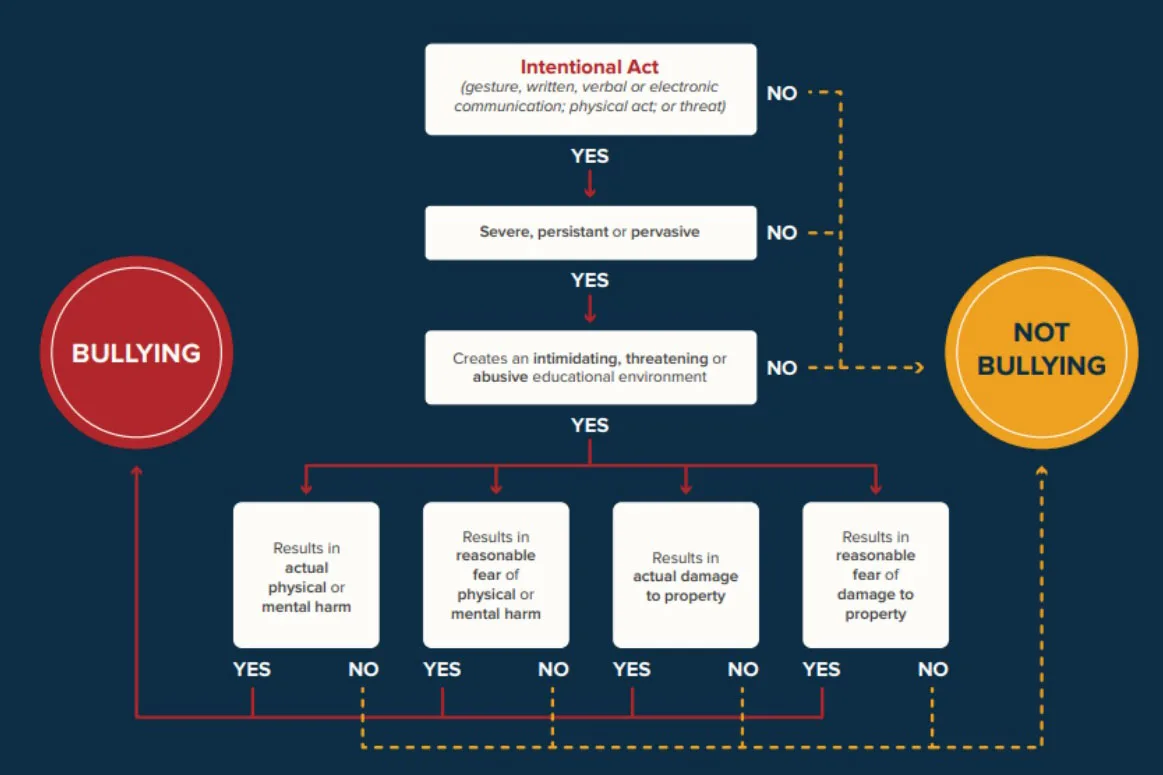
It will also have a graphic defining what the district considers bullying.
The first questions the submitter will be asked are:
- Do you believe an intentional act occurred such as a gesture, written, verbal or electronic communication; physical act; or threat?
- Was the intentional act severe, persistent or pervasive?
- Do you believe the intentional act created an intimidating, threatening or abusive educational environment?
The site says that a “no” to any of those questions means the incident does not fit the definition of bullying.
Even if a report does not meet the formal definition of bullying, it will still be sent to administrators for a follow-up.
Yeager said the form will streamline the reporting process.
“It immediately, whether it’s four o’clock in the afternoon or two o’clock in the morning, goes right to the principal,” he said.
The website will also have the full anti-bullying plan and guidance for families.
Smith said the website has been created and will be published when the board approves the plan.
Defining bullying
The updated plan provides detailed guidance on what qualifies as bullying.
The committee used the Kansas State Department of Education’s bullying definition to guide the district’s.
To meet the qualifications, the behavior has to be “intentional, severe, pervasive or persistent” and create an intimidating or abusive environment, like causing physical or mental harm or fear of harm.
The plan identifies four types of bullying: physical, verbal, cyberbullying and relational.
Relational bullying includes behaviors like spreading rumors and social exclusion.
The plan also outlines what’s not considered bullying.
“If it’s not bullying, it can be conflict, it can be rude and it can be mean,” Smith said.
She added those behaviors are still taken seriously and addressed by staff.
Training
The updated plan also emphasizes prevention and training more than the current version.
“There’s much greater detail in this plan around prevention,” Smith said. “There’s greater detail on reporting and investigating … and greater detail in intervention plans.”
As part of the plan, administrators are required to take all reports seriously, gather information, determine whether the behavior meets the definition of bullying and follow up with the students involved.
Staff will receive bullying and prevention training at the beginning of every school year.
District leaders said the goal is to create a more consistent and thorough response across schools.
The plan also expands intervention strategies for students involved in bullying, whether it be the bully, the target or the bystander.
Support could include a behavior or safety plan or referrals to mental health resources.
Unlike the current plan, the new one won’t be embedded into board policy, meaning it can be changed and updated more easily.
“I just appreciate the work that the committee did to make a space that’s safe, anonymous and available for everybody,” Board member Becky Johann said at the meeting.