At the Overland Park Arboretum, you can walk on trails, watch birds, smell countless flowers and spend time in nature.
Plus, you can get pretty close to the body of water with the most populated watershed in the region — the Blue River.
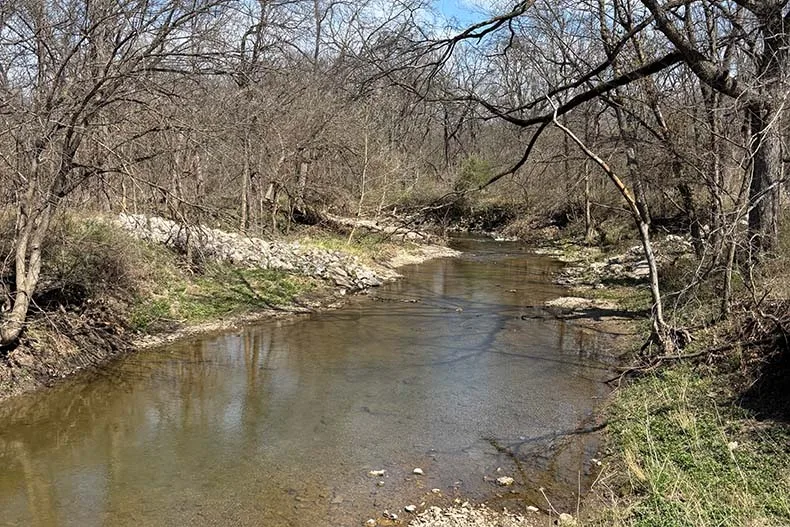
Still, not many people know that the Blue River starts near the Arboretum, at the convergence of Coffee and Wolf creeks.
From there, it rushes through the Kansas City metro, flowing for roughly 40 miles and touching suburban, urban and rural parts of the region alike. Along the way, it links up with three more well known tributaries: Indian Creek, Brush Creek and Tomahawk Creek.
But the river itself faces several challenges — like flooding, pollution, erosion and loss of natural wildlife — and more development encroaching on the upper watershed in southern Johnson County poses a threat, experts warn.
In a recent report card compiled by the nonprofit Heartland Conservation Alliance that considers dozens of factors ranging from water quality to politics, the Blue River got a score of 47%, barely scraping by with a passing grade.
“It means that we’re an average student, so we’re not failing, which is great, but there’s clearly significant room for improvement,” said Jess Hartel, senior director of conservation and education.
Why it matters: “Healthy river” means “healthy communities”
The way Hartel looks at it, the environment is a lot like a computer’s operating system; you don’t really think about it when things are going well.
“As long as it’s doing the job it’s supposed to be doing, allowing you to email, it’s running quickly … you don’t think about the operating system,” she said. “The only time you notice it is when your computer starts going slow.”
A lot of the time, people don’t start thinking about the health of an environment and the natural features that make it up until there are problems.
“If it goes wrong, then you’re in a really terrible situation,” Hartel said. “You’re trying to dig your way out of a failing operating system. And in the case of the environment, you can’t just upgrade and go get a new Mac; we’ve got one, and that’s it.”
At the same time, people can’t always see how the health of the environment impacts their own health.
“There is a major disconnect between people understanding that healthy rivers and healthy ecosystems mean healthy communities,” Hartel said.
Erin Seybold is an assistant professor of geology at the University of Kansas and an assistant scientist for the Kansas Geological Survey. While her team doesn’t have any active studies or data collection occurring on the Blue River, they do study water resources throughout the state.
From her perspective, a lot of things a community can do to help preserve the health of a river can also go a long way to make living near the river more enjoyable. She sees those as “win-win” scenarios.
For instance, more green spaces mean more vegetation that slows water down and helps with rainwater absorption. At the same time, more dedicated spaces like that mean more spots for people to congregate and spend time outside.
A denser tree canopy also helps to cover rivers and bring down water temperatures, which is good for the organisms and animals living there. It’s also good for the people living nearby, because more shade can help bring land temperatures down, too.
“It is helpful to realize that a lot of the things that would improve the health of the river are probably also really good for communities that live nearby,” Seybold said.
Upper Blue River in southern Johnson County is at risk
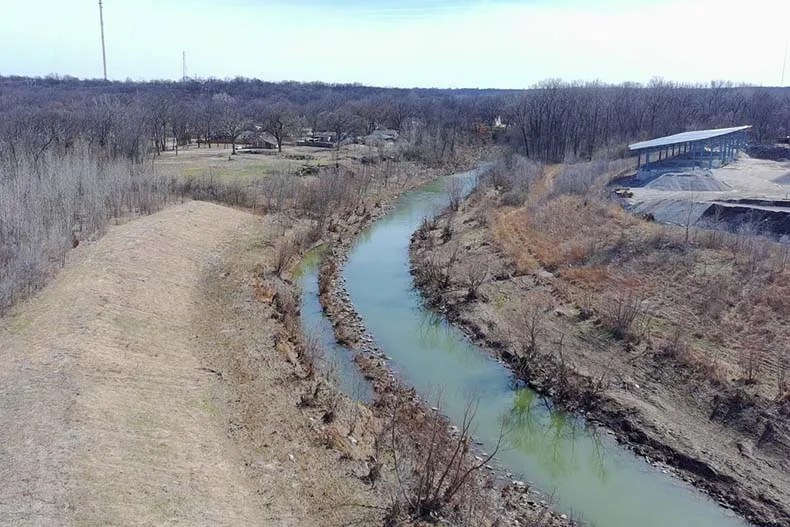
Some portions of the river’s watershed received different grades, but the upper Blue River watershed, which goes from Wolf Creek in southern Overland Park to Indian Creek, received a “C” grade.
That portion of the river and its watershed earned points for its higher water quality, protected open space and trails.
However, encroaching development could change that, particularly residential development right on the banks of the Blue River.
“The biggest concerns we see are the movement of development, the active land use and land cover change that is occurring from just suburban development,” said Ian Fannin-Hughes, Heartland Conservation Alliance board president and a water resource project manager for Johnson County.
All of that leads to the loss of the riparian buffer — the natural buffer that transitions between a body of water and land. In the case of the upper Blue River watershed, that’s the dense woodlands and natural vegetation that surround it, which help protect against erosion and flooding and also preserve water quality.
If nothing changes, Fannin-Hughes said, “we’re quickly going to be losing that” buffer. By 2050, the watershed is expected to be fully built out, per the alliance’s assessment.
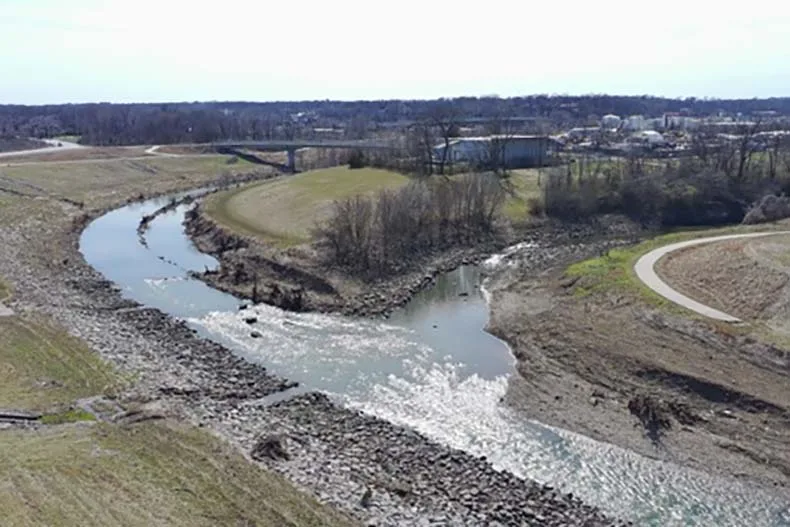
And all you have to do is look downriver to see what that could look like.
Other sections of the Blue River watershed and the people who live there have faced a myriad of issues stemming from generations of unchecked development, like flooding, erosion, water quality degradation and pollution.
In fact, the lower Blue River — which goes from Brush Creek in northeastern Johnson County to the Missouri River — got the lowest grade in the alliance’s most recent report card with a D+. That makes it “the most vulnerable subwatershed” on the Blue River, according to the report card.
With that in mind, the alliance’s report calls for a mix of actions to help protect the upper Blue River watershed, including policy reform and the adoption of more nature-based development practices, as well as more protection for green spaces.
Politics can get in the way
The length of the Blue River and the number of different jurisdictions it runs through can make real solutions hard to enact.
That’s because the river crosses through two states, four counties and nearly two dozen municipalities, meaning there isn’t just one authority overseeing it.
For example, the Heartland Conservation Alliance keeps a list of seven ordinances that it wants all jurisdictions on the Blue River to consider adopting that could help protect it, including pollution prevention, tree protection and minimum development setbacks on streams.
Of the 24 communities tracked, just Kansas City, Missouri, had adopted all of them as of December 2025, and some communities, like Mission Woods in northeastern Johnson County, haven’t adopted any of them.
“Everybody has a different thing that they care about, that they don’t care about,” Fannin-Hughes said, describing politics as “constantly a problem.”
That can make it hard to address problems affecting parts of the river watershed and problems affecting the whole river.
But, as Hartel puts it, “natural systems do not care about political boundaries.”
Still, despite those political challenges, the Heartland Conservation Alliance has a straightforward goal for the Blue River, even if the path to achieving it is anything but.
“Our goal is for our streams to be swimmable, fishable and lovable, and that is challenging in an urban area, but it’s not impossible,” said Logan Heley, the nonprofit’s executive director, who also sits on the Overland Park City Council.
Looking back: Why Overland Park wants you to know more about the Blue River