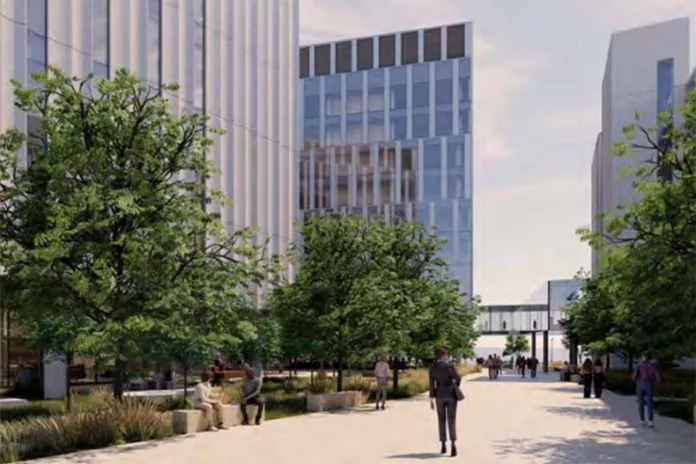
Black & Veatch is now seeking $267.6 million in public financing incentives for its $1.34 billion headquarters overhaul, making one of the largest redevelopment proposals in Overland Park history even bigger.
On Wednesday, the Overland Park City Council Finance, Administration and Economic Development Committee voted 6-0 to recommend amending the terms of the previously approved redevelopment district, adding roughly $20 million to the engineering firm’s request for public tax dollars to go towards its central Overland Park campus makeover.
The committee on Wednesday also directed city staff to continue with negotiations for a forthcoming redevelopment agreement.
The committee’s move follows the city council’s approval earlier this month of an amended mixed-use rezoning plan for the project in the evolving College Boulevard corridor.
The incentive package Black & Veatch is requesting eclipses the roughly $200 million in incentives the Overland Park City Council narrowly approved for the Brookridge redevelopment in 2019. Though local and state officials broke ground at that site in 2023, progress has been slow for several years, with a new plan recently emerging.
How they voted:
Here’s how members of the finance committee voted:
Holly Grummert: Yes
Drew Mitrisin: Yes
Richard Borlaza (filling in for Amy Scrivner): Yes
Gregg Riess: Yes
Andrew Payne: Yes
Christopher Newlin, committee chair: Yes
What incentives are Black & Veatch asking for?
Under the updated applications, Black & Veatch is requesting $253 million in tax increment financing (or TIF) reimbursement and $14.6 million in reimbursement through a Community Improvement District (or CID) special sales tax, for a combined total of $267.6 million in public financing incentives.
That’s an increase in total public dollars of about $20 million, after the firm last year initially requested $227 million in TIF reimbursement and $19.9 million in CID reimbursement.
In a TIF district, tax revenues generated by increased property values are remitted to a third party as property values rise, to cover or reimburse costs incurred in a defined development area over a set period.
Some are critical of TIF district incentives specifically, saying it takes dollars away from public use, including local public schools. However, in Kansas, the 20 mills the state collects for schools and the maximum of 8 mills school districts can set for their capital outlay budgets are exempt from TIF increment diversion.
Additionally, Overland Park’s internal data on economic development investments show that several active TIF districts in the city have worked as intended, like the Cherokee South TIF district near 95th Street and Antioch.
A CID functions similarly with funds raised through a limited sales tax paid to a third party for a set amount of time to reimburse eligible development costs. In this case, Black & Veatch has requested a 2% sales tax to be levied at the headquarters site.
In addition to the $267 million in tax incentives, the engineering and construction firm has also requested $1.34 billion in economic development revenue bonds with a sales tax exemption on building materials.
Some councilmembers, like Councilmember Melissa Cheatham, have been skeptical over what Black & Veatch has requested, particularly around housing attainability requirements and environmental sustainability standards.
Several of those details are likely to be settled when the city council considers the obligatory redevelopment agreement at a later date.
Still, during the rezoning vote earlier this month, she emphasized that supporting the planning item didn’t lock the city council into approving incentives down the line for the Black & Veatch project. That echoed some of her 2025 trepidation, when she said “the details are really going to matter.”
Black & Veatch wants to reimagine its HQ campus

The plan is to remake Black & Veatch’s central Overland Park headquarters campus into a place to live, work and spend time, complete with housing, retail, dining, office and green space.
Dubbed Overland Park Plaza II, the project centers around the firm’s 22-acre headquarters property at 11401 Lamar Ave.
The plan features nearly 800 multifamily units, a 25,000-square-foot childcare center, a 250-room hotel, 1 million square feet of office space (750,000 square feet of which will be reserved for Black & Veatch’s headquarters) and 137,000 square feet of retail space.
The campus will also include more than 4,500 parking spaces, primarily in structured parking garages, and a private green space.
Assistant City Manager Jack Messer said all of that fits in with Overland Park’s vision to reinvent the College Boulevard corridor that’s historically been defined by large-scale corporate offices, the city’s primary industry.
The idea is to turn the area into a more vibrant, walkable zone with a variety of different uses, including housing and retail, as well as office complexes.
“Black and Veatch, in many ways, has bought into that idea,” Messer said on Wednesday.
Next steps for Black & Veatch redevelopment:
Now that the committee has voted on the TIF modification plan, the item goes to the full city council for consideration. That is tentatively scheduled for June 15.
Also in June, the finance committee will likely vote on the first project plan tied to the TIF district. A total of 11 project plans are proposed. After that, the item goes to the Overland Park Planning Commission for consideration on July 13.
Later, the city council will need to hold a public hearing to get feedback on the project plan and the CID, as well as the redevelopment agreement. That is tentatively scheduled for Sept. 28.
Keep reading: Black & Veatch’s $1B HQ overhaul clears key vote. The harder conversation is still ahead
 Thanks for reading! If you value having an independent news outlet keeping tabs on local government, schools and taxes, we're asking you to contribute to our Education Reporting Fund.