
A federal plan to reduce flooding risk along Turkey Creek in downtown Merriam may require up to a decade of additional planning and construction, as well as the removal of 17 buildings.
After four years of design work and $6.5 million, the U.S. Army Corps of Engineers revealed 65% of its plans for flood mitigation in downtown Merriam — namely, 740 feet of levee, more than 6,000 feet of floodwall and the replacement of both the Merriam and Johnson Drive bridges.
The city has yet to sign on to the Corps’ plan and is simultaneously mulling over a separate flood mitigation plan from engineering firm HNTB. That other plan calls for even more invasive work, demolishing all of historic downtown between the Johnson Drive and Merriam Drive bridges.
Alongside the flood mitigation efforts in downtown Merriam, the city is also in the middle of a downtown master plan to guide future redevelopment in the area.
While city and Corps officials say the threat of downtown flooding from Turkey Creek looms, some downtown business owners and residents balk at the idea of any change coming to the area in the name of flood mitigation.
Some of those same residents and business owners say flooding has not been a concern for downtown Merriam in decades.
Geoff Henggeler, a civil works section chief for the Corps, told a crowd of about 80 gathered at the Merriam Community Center on Monday night that the Corps is still operating under the $39 million that was approved for the project at least 10 years ago — not accounting for inflation.
“In today’s dollars, the cost limit, the ceiling that (U.S.) Congress has set is $73 million,” Henggeler said. “While we don’t have a cost estimate yet, we do know that this project will cost, more than likely, more than $73 million.”
If the Merriam City Council and the Corps do eventually enter a project partnership agreement — effectively giving the green light to complete the project — then the city and downtown businesses are looking at up to 10 years before construction is finished.
City Administrator Chris Engel told the Post following Monday’s presentation that the two flood mitigation plans coupled with the downtown master plan give the city options.
“We can compare all of them together, contrast all of them together, see what makes sense,” Engel said.
Still, Engel told the Post that the city will complete a downtown master plan before making any decisions about whether to partner with the Corps or go with HNTB’s proposal.
Watch the Corps’ entire presentation to the city council in the embedded video below:
How we got here
For more than two decades, the Corps has been working with the city on flood mitigation efforts along Turkey Creek, which runs through downtown Merriam.
Last summer, during a July storm, Turkey Creek left its banks for the first time since a deadly 1998 flash flood. Before that 1998 flood, the creek flooded several times a decade.
Downtown Merriam businesses pay federal flood insurance. At 77, the area also has the highest number of potential flooding locations of any project area within the Turkey Creek and Brush Creek watershed in northeastern Johnson County.
In 2022, after several years of inaction from the federal government due to a lack of funding, the Corps allocated $23.9 million in federal funds for the Upper Turkey Creek project.
For the past four years, the Corps has worked on completing 65% of the design work that representatives shared with the city council on Monday.
From 2022 to this year, that design work cost $6.5 million in a cost-share split between the federal government, Merriam and Johnson County.
Last year, before Turkey Creek left its banks for the first time in 27 years, the city of Merriam also asked HNTB to develop a flood mitigation plan for downtown.
The early proposals for that plan call for the razing of all of historic downtown, which is a cause for concern for business owners.
Rick Williams, owner of a longtime musical instrument accessory store, told the Post last year that he thinks the flood mitigation efforts are part of a larger plan to oust businesses and remake downtown.
“People have been trying to throw this part of town out for a long time, but it’s managed to survive,” Williams had told the Post. “I think there are smarter things to do with money than evict people at a great expense to turn it into a gentrified area.”
Since 2023, and as the Corps completed design work, the city has purchased 12 downtown properties for $7.1 million total — largely in the name of flood mitigation efforts. There is an option for reimbursement if the properties are needed for the Corps project.
Engel told the Post on Monday that even if the city council opts against the Corps’ project, the city still owns those downtown properties and can determine their best future use.
A look at the Corps’ project
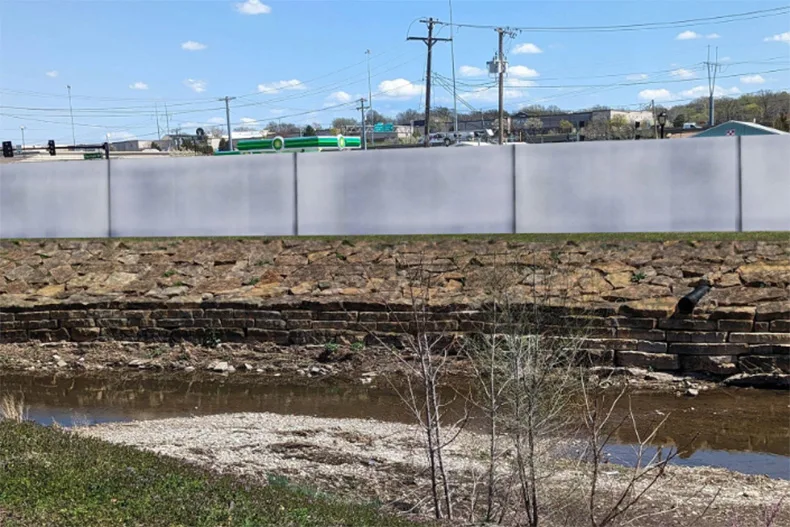
In general, the Corps’ plan features a combination of the following, according to city documents:
- 6,035 feet of floodwall, which is a large concrete wall, ranging between 6 and 12 feet
- 740 feet of earthen levee, which looks like a berm, ranging between 10 and 14 feet tall
- The complete replacement of the bridges at Johnson and Merriam drives
- An 11-acre detention basin to the immediate north of the Merriam Farmers Market pavilion
- The permanent removal of 17 buildings
Corps staffers working on the project told the Post on Monday night that a full list of the 17 buildings slated for removal is unavailable to the public at this time. The city of Merriam also told the Post there is no list to share at this time.
The Post compared the fee acquisition parcels — or properties that need to be purchased outright — outlined on Monday night’s presentation boards to a map of the city.
It appears five of the businesses currently sitting on five of the 17 properties the city would have to own outright as part of the project are as follows:
- Enterprise Rent-A-Car, 10000 Shawnee Mission Parkway
- Long John Silvers, 9900 W. 63rd St.
- Pet Care, 5854 Merriam Drive
- All Out Tint and Wrap, 5816 Merriam Drive
- SRA Roofing and Gutters, 5600 Merriam Drive
A property at 6108 Merriam Lane also appears to be needed for outright purchase as part of the project.
The properties the city already owns to the north of the farmers market pavilion at 5700, 5718 and 5726 Merriam Drive — the former Baker’s Marble and Electronic Technology Institute — would be used for a detention basin, according to the plan.
Additionally, it appears that at least one of the iconic KC Strings buildings on Merriam Drive is also needed for the Corps’ project. In March, the city approved a $3 million deal to purchase all four KC Strings properties along Merriam Drive.
The project is designed to withstand a 100-year flood, with the levee and floodwall heights being nearly 3 feet above the height of the water line recorded in the 1998 flood.
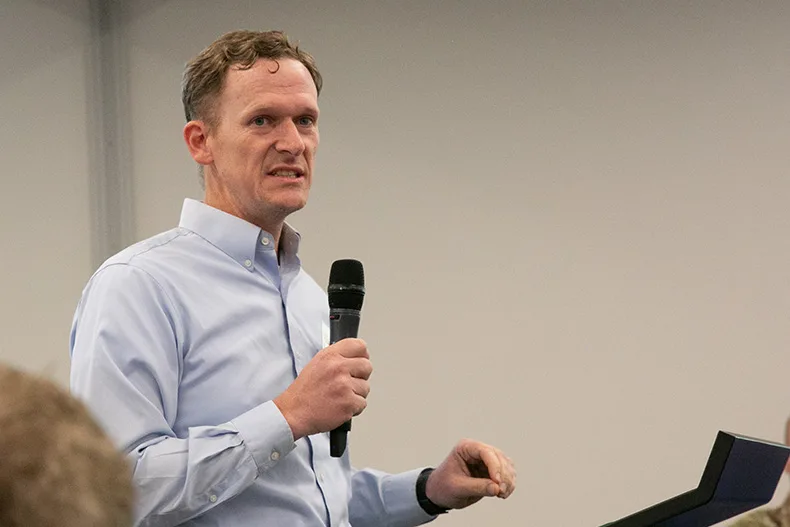
Henggeler said that since the project is likely to cost more than $73 million — the $39 million cap the Congress placed on the project roughly 10 years ago but in today’s dollars — the Corps needs to ask for a cost increase.
An approval from Congress is likely to come in an even year, and it is unlikely that the Corps will submit in time for 2026, Henggeler said. That means the earliest Congress could approve a cost increase is in 2028, he said.
The Corps needs to complete design work, start utility relocation and finish two bridge replacements before the actual levee and floodwall construction can start in roughly 2034, Henggeler said.
If the city moves forward with the Corps’ project, it will be finished roughly 10 to 11 years from now, Henggeler said.
Experts say Turkey Creek is “flashy”
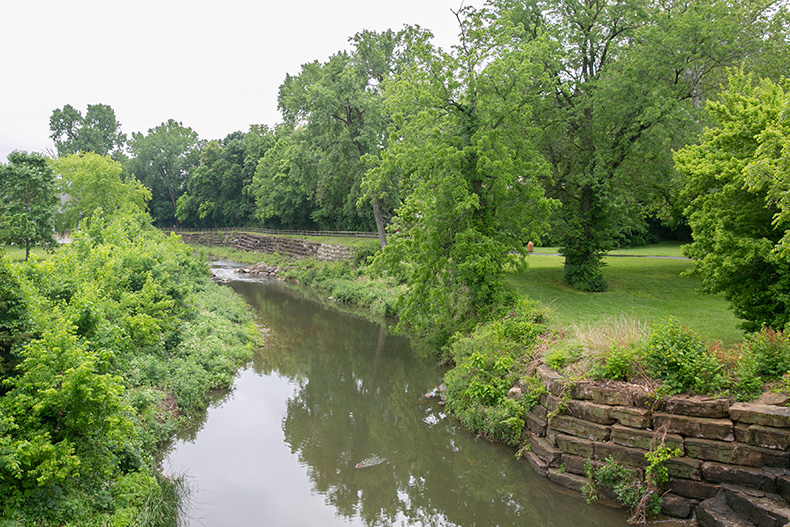
Councilmember Reuben Cozmyer asked the Corps to explain why flood protection is still important when residents don’t see flooding as much of an issue in the past few decades.
Conner Szarwinski, a hydraulic engineer with the Corps, said the term “100-year flood” doesn’t mean it only comes once a century; rather, there is a 1% chance that such a flood will happen each year.
Szarwinski said a 100-year flood could happen two years in a row, or there could be 200 years between two such events.
“There’s a little uncertainty in that, but just based on historic data, it’s less of a question of if there is going to be a big flood and more of when there will be a big flood,” Szarwinski said.
The October 1998 flood was a 50-year event and caused $12 million in damage in the city at that time (in 1998 dollars), according to the Corps’ documents.
While the heavy rainfall in July 2025 did not lead to widespread flooding in Merriam, it was a 25-year event, according to Corps documents.
Reed Brown, geotechnical branch chief, told the crowd on Monday night that the “flashy nature of Turkey Creek” is also a cause for concern.
In other areas where there are hundreds of miles of levees in Missouri that Brown oversees, the Corps and the municipalities know for weeks ahead of a flood.
Brown said that knowing a flood is on its way gives the community time to prepare.
“We don’t have that luxury on Turkey Creek,” Brown said. “When we have the 100-year event, or even the 25-year event, it comes up in a matter of minutes, and you don’t have the ability to prepare and get people out of the water’s way.”
“That’s the heart of our city”
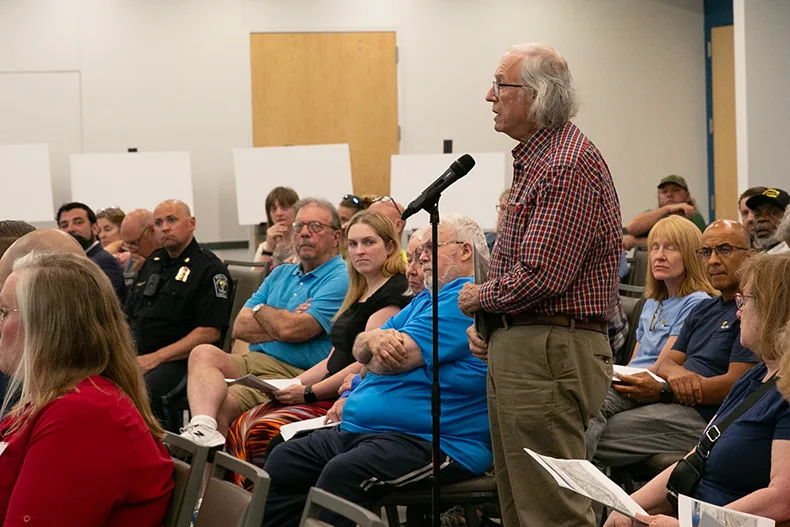
For Tracy O’Connell, a lifelong Merriam resident who lives near downtown on Johnson Drive, the Corps’ plan “is devastating.”
O’Connell told the city council on Monday during public comment that she believes floodwalls will be an eyesore with the potential to attract graffiti.
In a follow-up interview on Tuesday, O’Connell told the Post her parents own a strip of businesses on the west side of Turkey Creek that would lose visibility “because of the monstrous retaining walls they’re wanting to put in.”
That loss of visibility would hurt any businesses in that strip of buildings, O’Connell said, calling it “shockingly brutal.” She said the current plan is designed “to hold back a biblical flood.”
O’Connell is also against the HNTB proposal to demolish all of historic downtown. She said she believes “there was a total lack of sensitivity to” the residential and historical nature of the downtown area.
“That’s the heart of our city, it’s a historic area, and it needs to be celebrated, not torn down or, you know, run retaining walls through it,” O’Connell said.
Williams, who spoke with the Post previously about his concerns with flood mitigation efforts as a downtown business owner, told the city council during public comment on Monday “to remember … that the foundation of many small places is a small business.”
“If you make it so there’s no place for small businesses to begin, you make it for no roots for bigger businesses to go,” Williams said. “So just keep that in mind.”
Billy Croan, a resident who lost a mayoral candidacy against Mayor Bob Pape in November, told the city council on Monday that he thinks it is important to protect downtown, but he wants to see the city “focus on the actual chokepoint … the railroad bridge.”
“I’d like to keep the authentic downtown that we have rather than bulldozing it and creating a Disneyland downtown,” Croan said.
The city council still needs to make a decision
The city council did not take any action regarding the Corps’ plan on Monday night.
Instead, the city plans to continue work on its downtown master plan to help guide the city council’s decision regarding Turkey Creek flood mitigation.
Then, the city council will need to determine whether to address Turkey Creek flood mitigation by agreeing to the Corps’ plan or HNTB’s plan to raze all of historic downtown.
The downtown master plan is expected to be completed by the end of the year.
Keep reading local government news: Merriam’s police drone still works, but they’re replacing it anyway — because it’s made in China