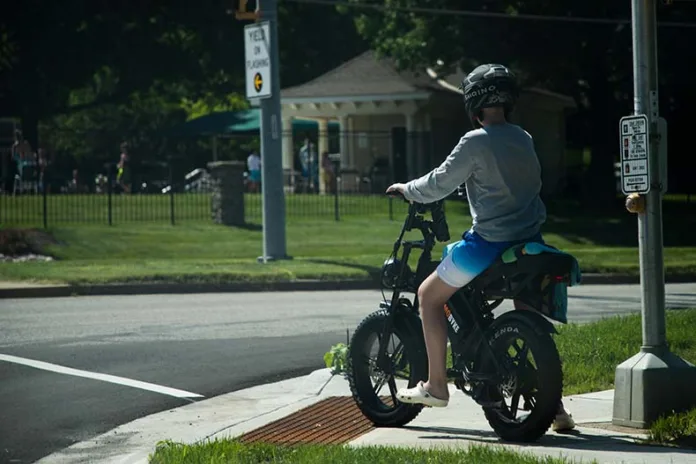
Kids caught riding electric motorcycles in Overland Park could face citations, and their parents could face criminal charges.
That’s because the Overland Park Police Department has said it will be enforcing state and local laws as safety concerns and complaints about improper use mount.
While complaints are coming in from all over Overland Park, Officer John Lacy, the police department’s public information officer, said the vast majority are coming from the southern portion of the city, and there’s been more complaints recently since school is out for the summer.
“They’re seeing these e-moto bikes whizzing throughout the neighborhood, on the sidewalks, on public streets,” Lacy told the Post. “These kids are zipping in and out of traffic, and we want them to be safe.”
E-moto vs. e-bike: What’s the difference?
The devices the police department is particularly worried about aren’t the different classes of electric bikes you might see kids and adults alike riding around Overland Park legally. Instead, it’s the e-motorcycles, or e-motos, which are a different beast entirely.
Councilmember Gregg Riess told the Post that he hears a lot of confusion from the public about e-bikes and e-motos. In fact, he’s fairly certain that many complaints people are bringing to his attention or posting on various social media platforms are actually about e-motos.
“They tend to lump this all together as e-bikes,” he said.
These e-motos do not usually have pedals like an actual e-bike would, but they do have higher-powered motors that can reach speeds of 30 miles per hour or more, and usually cost upwards of $2,500. They are not street legal for children. (Read more about the difference between e-motos and e-bikes here.)
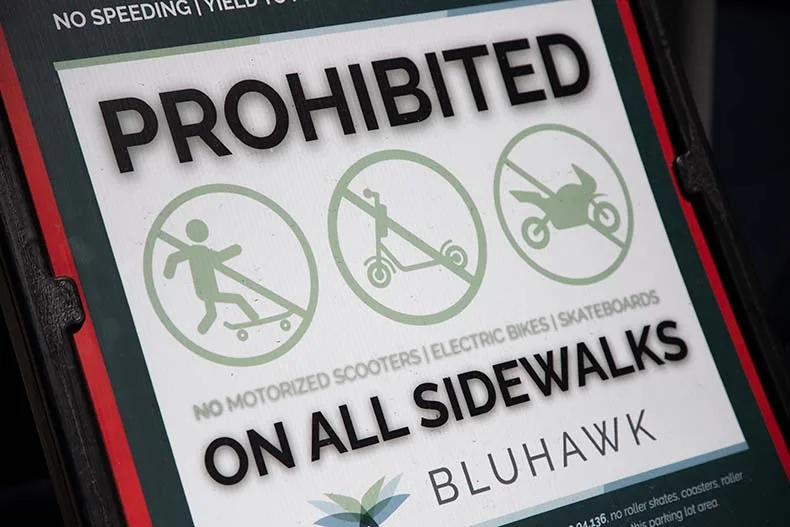
Kansas law considers e-moto devices to be motor vehicles, making it illegal for an individual without a driver’s license and motorcycle endorsement to operate them. They also need to be insured and registered like a regular motorcycle, and it’s illegal to operate them on sidewalks, in bike lanes, on trails or in designated bike paths.
All of that means some kids riding these devices might be breaking four or more laws at once.
For instance, imagine a 12-year-old who is riding an e-moto to get to a neighborhood pool. This child is too young to have a driver’s license or a motorcycle endorsement, and they can’t provide proof of insurance, nor is their vehicle registered. Plus, he’s caught riding the e-moto on the sidewalk, which is also illegal.
Additionally, since he’s too young to drive, he probably hasn’t taken a driver’s education course, and likely doesn’t know all the rules of the road, potentially putting himself and other drivers at risk.
Riess, an avid cyclist on a traditional bicycle, said he frequently encounters e-motos while he’s out riding. He’s gotten the sense from talking to some of the kids he sees riding e-motos that their parents and they know that these e-motos aren’t allowed but have developed a “don’t get caught” mentality.
He’s hopeful that the police department beginning to enforce the law on e-motos will change that mindset.
“I am very much in favor of the police department interacting with them,” Riess said. “We have these ordinances, we’re doing education, but now we’re going to be moving into an enforcement phase.”
Councilmember Inas Younis, who represents part of southern Overland Park and has been particularly concerned about kids on e-motos, feels similarly.
“I see this as supporting parental responsibility,” she said. “We are signaling that, as a society and as a culture, we value the safety of our children, and that this [e-moto use] is crossing a line.”
“We are trying to protect lives at the end of the day, so the measures we’re taking, I think, are reasonable and fair,” Younis continued.
Overland Park Police may issue citations for e-motos
If an officer stops a child riding an e-moto, then they may issue a citation with potential fines or a written warning.
Regardless, the child will not be permitted to ride their illegal e-moto back to their home. Instead, a parent or guardian will need to come get them and their device, Police Chief Doreen Jokerst told the Overland Park Public Safety Committee last week.
A post on the police department’s Facebook warns that repeat offenses might result in a parent being criminally charged for “contributing to the delinquency of a minor.” In Kansas, that could be a felony and would carry fines.
Officer Lacy said some parents and children might feel like the police department is being the “bad guy” in all of this, but it’s about making sure everyone is safe.
“We want to get that information out, we want to educate the parents, we want to educate the kids that are riding these [e-motos] that what they’re riding on the street is illegal,” he said. “We don’t want to go in and slam people left and right, or seriously issue citations to parents.”
But, Lacy said, if that’s what it comes to, the police department and its officers will do it.
“We don’t want anyone to get hurt, we don’t want any accidents,” he said.
Jokerst encouraged people who see children riding e-motos to call the police nonemergency line to report it, which is 913-895-6300.
“If we have officers available, we’re going to try and have them swing by and educate the individuals that are on them,” she said.
Johnson County cities grappling with e-bikes, e-scooters, too

Separately from the e-moto issue, several cities in Johnson County have also taken steps to impose new safety restrictions on e-bikes and e-scooters following the death last fall of 10-year-old Duke Ommert in Leawood, who was struck and killed while riding an electric scooter.
Last month, Overland Park established a slate of new rules for e-bikes and e-scooters, specifically banning kids under the age of 16 from riding class 3 e-bikes, which are throttle-assisted bikes that can reach higher speeds (but are still distinct from e-motos).
The city could also become the latest to impose a helmet requirement on e-bikes and e-scooters for riders under 18.
Olathe, Leawood, Shawnee, Fairway and Prairie Village have similar helmet rules already on their books.
Councilmember Younis likes the idea of kids enjoying a little bit of independence with their friends, and things like e-bikes and e-scooters do offer some of that. However, she wants them to be safe.
“We want our children to feel free and to be out of the house and to enjoy the great outdoors,” she said. “I see that as a positive, but we want them to be safe doing it.”
Keep reading: Overland Park poised to require kids to wear helmets on e-scooters and e-bikes
 Thanks for reading! If you value having an independent news outlet keeping tabs on local government, schools and taxes, we're asking you to contribute to our Education Reporting Fund.