The Leawood City Council is leaning toward asking voters to approve a new higher sales tax next year to replace the city’s current 1/8-cent tax dedicated to stormwater and street projects.
Councilmembers left a work session on Aug. 10 with an emerging consensus to replace the existing tax with one that could be as high as 5/8 of a cent, or 0.625%, over 10 years.
The higher tax would come with an expanded scope to cover not only streets and stormwater but also public safety needs.
The idea is likely to be discussed again at the council’s September 8 meeting.
Driving the proposal is a long list of needs to control stormwater and update police technology that councilmembers consider urgent.
The impending loss of the city’s share of the countywide sales tax that was used to pay for a new courthouse and medical examiner’s building is also a key factor. (That county tax is set to expire next year.)
The clock is ticking on the city’s corrugated metal pipe replacement program as well as police technology that is now considered outdated enough to be unsupported by its manufacturers, councilmembers said.
“We are reaching this very critical time in our city where things are starting to fail,” said Councilmember Julie Cain, adding that there’s no telling what the next session of the Kansas Legislature will bring.
“Let’s bite the bullet. We know what’s coming down,” she continued, “Let’s just get it done right now.”
What is the city council considering?
The current Leawood sales tax rate is 9.1%, which includes a 6.5% state rate, 1.475% for Johnson County and 1.125% for the city. Those numbers are due to change as the county tax ends.
Johnson County voters approved the quarter-cent public safety courthouse tax a decade ago, and the revenue generated by the tax is shared with municipalities.
Leawood’s share of the courthouse tax money amounts to about $1.5 million a year, which it will stop receiving after the tax sunsets on March 31, 2027.
That’s roughly the same amount that Leawood’s own one-eighth cent dedicated stormwater and street repair tax brings in. That tax has been around since 2000 and has been renewed several times with voter approval. It’s scheduled to expire on June 30, 2028.
The staff proposal under consideration Monday asked councilmembers to consider a half-cent sales tax to bolster funds, with the revenue split among public safety, street repair and stormwater projects.
Leawood has added the use tax — paid on goods purchased outside Kansas — to the stormwater and street repair bucket since 2025. In that year, the combined amount of the two taxes would have been about $6.3 million at a half-cent rate.
According to staff calculations, the total would be an estimated $6.6 million in 2028, the first full year of the proposed new tax.
That money could be divvied up, with $3.4 million going to stormwater, $2.4 million to public safety and $800,000 to street repair, per the staff suggestion.
Councilmembers also discussed whether to make the change two years before the current one-eighth cent tax runs out, whether to expand the scope of the tax to include public safety and whether and when to set an expiration date.
The seven councilmembers present on Monday, along with Mayor Marc Elkins, initially said they’d be comfortable with the half-cent tax, but as they talked more, they came to view the five-eighths of a cent option as a better way to answer some of the spending needs.
Body cams, drones, license plate readers
Police Chief Brad Robbins told councilmembers that decisions must be made soon about expiring contracts for body cameras and other technology, as well as aging Chinese-made drones that need to be replaced with American-made ones.
The police department is looking at a potential tripling of the cost in camera and taser equipment, due to higher bids from its current supplier, Axon Enterprise.
The city’s contract with Axon for body cameras, tasers, cloud storage software and training amounts to $151,103 a year and runs through 2027, he said.
The proposed new Axon package for cameras is $374,052 a year over 10 years, but it includes four rounds of replacements for the body cameras and docking bays, two new tasers and license plate reader software that would enable 20 police cars to read licenses. It also includes six fixed-position Axon Outpost license plate readers.
Drone equipment also needs to be replaced, he said. The department’s four existing drones were bought from DJI, a China-based company, six years ago and were at the time the best option on the market, Robbins said.
But because of security concerns, state statutes now forbid the city from replacing them with equipment from the same company, he said.
The current drone fleet costs the city $11,000 a year. Axon’s bid to replace them with Air-Skydio equipment comes to $161,971 yearly, over 10 years, but they have improved incident response time with potential use to arrive early to scout crime or accident scenes, he added.
There was also brief mention during the meeting of the city’s plans to build Fire Station 4, which have been put on hold until the city can find a replacement for Fire Chief Colin Fitzgerald, who retired July 24.
A race against sinkholes
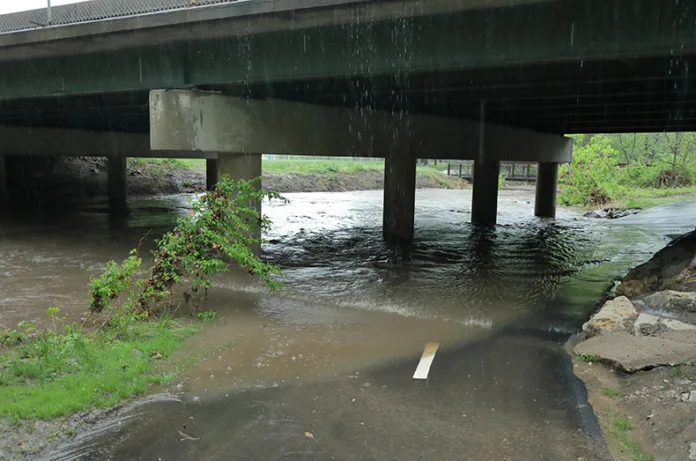
Replacement of the city’s 90,000 remaining linear feet of rusting corrugated metal pipes is the top priority for the stormwater portion of the revenue.
The pipes, installed from the late 1960s to mid 1980s, are now near the end of their life expectancy and are rusted and failing, causing sinkholes.
The city has been replacing them since 2016. At its current $1.5 million a year from the one-eighth cent tax, that will take 55 years, according to staff estimates.
The need could outlast a 10-year sales tax, though. Public Works Director David Ley said that based on the half-cent sales tax estimates, it will still take about 26 years to eliminate all corrugated metal pipes.
But replacing all 90,000 feet in ten years would have been a challenge anyway, he said, because of potential issues that arise when the pipes go into people’s side yards and back yards.
Several councilmembers said they’d prefer to make the replacements quicker and asked staff for numbers on how much revenue a five-eighths cent tax could bring.
Putting sales tax question on the ballot
Councilmembers generally agreed on setting the sales tax to expire in 10 years rather than 20 or indefinitely, saying they wanted to be able to review it sooner.
Councilmember Lisa Harrison initially said she preferred putting the measure on a higher-turnout election rather than having a March 2 special election date, which would cost $45,000. There would be no additional cost to the city to include the issue on a primary or general election ballot.
But Councilmember Matt Peppes worried that the issue might get lost in a high-turnout election with a lot of other local candidates.
Councilmember Rachel Rubin said that although the in-person special election would cost, it would pay for itself in revenue to address city needs sooner.
Having the March election means the tax, if voters approve it, would become effective October 1, 2027. Putting it on the August primary makes the effective date April 1, 2028.
Elkins said time is of the essence.
“I don’t think we can overemphasize the idea that come next year, there’s a million and a half less dollars,” he said.
Councilmember Sherrie Gayed noted that Johnson County’s other large cities have dedicated sales taxes higher than Leawood’s one-eighth levy.
“We need to do this,” she said. “It’s pretty unacceptable for us to be this far behind our sister cities as far as technology is concerned. Our residents expect our police and fire to be top of the line.”
Elkins cautioned that the sales tax will not solve all the city’s spending needs.
“It’s the age-old economic problem of unlimited demands and limited resources,” he said, adding that “this is not a chicken in every pot.”
No votes were taken at Monday’s work session. All members were present except Councilmember Alan Sunkel.
 Thanks for reading! If you value having an independent news outlet keeping tabs on local government, schools and taxes, we're asking you to contribute to our Education Reporting Fund.