Editor’s Note: This story is part of our series “Helping Hands”, which aims to spotlight Johnson Countians doing good in the background of their community. If you have an idea for someone to spotlight in a future “Helping Hands” story, email us at [email protected].
Nearly 15 years ago, everything changed for Scott Poore.
At the time, the Shawnee Mission East alum seemingly had everything he could want. He’d found success (and a decent income) in his corporate sales job, he was driving the car he’d always wanted, and he traveled often to destinations he’d dreamed of.
But something was missing. And when he realized it, it hit him hard.
“I called my boss into an office and I said, ‘You’re gonna think I’m crazy, but I have to quit my job,” he said. “I was consumed in a corporate career where the only thing that mattered was how much money I could make.”
The problem, he said, was that he was taking from the world and not giving anything back. Over the course of the next decade, that would change, one dog at a time.
Today, Poore uses his steadily-built online following to help the dogs who have had the lengthiest stays at regional animal shelters find their forever homes.
Poore’s efforts started as a shelter volunteer
After Poore left his sales job, he began killing time by volunteering at Great Plains SPCA in Merriam — at first once in a while, then daily.
It was there that he noticed a pattern. At the end of each long row of kennels sat the dogs that had been there the longest, with all kinds of disclaimers on their doors: no cats, no other dog, no kids, staff only, no stuffed animals, and so on.
This was the first (and often, the only) impression people looking for their new furry friends would get of these dogs.
How, Poore wondered, could they ever get adopted if this was all people thought there was to them? How could he show people that there was more to them than what they couldn’t handle?
“I respected the transparency,” he said. “But I thought to myself, if a first-time adopting family was to walk through, they’re never going to pick this animal.”
The solution came to him right around the time that Facebook was launching. Poore remembers signing up and realizing that he could post photos and videos. So he climbed into the kennels and started to do just that.
He’d walk into a shelter and ask which dog had been there the longest. Staff would point him to a dog that had been there for two years, and he’d get in the kennel, tell their story, and post it.
At first, he had about just over 130 Facebook friends. But the stories hit a nerve, and a few videos even went viral, pushing his Facebook following into the thousands.
Over nearly 15 years later, he estimates that thousands of dogs have found homes after being promoted. Roughly 75% of the animals he’s posted are now adopted, he said.
“What’s important is, where I’m going to hang my hat at the end of all of this, is the animals that I help specifically are the ones having the hardest time,” he said. “That’s not 4-month-old chocolate lab puppies.”
Today, Poore also uses his audience for everything from Amazon wish list drives (“We’ll get enough food for the entire year for that shelter,” he said) to more time-sensitive emergencies.
In 2025, he estimates he helped raise roughly $1.5 million for local shelters, rescue and outreach groups.
Recently, he posted about a puppy with parvo, in need of $1,500 worth of care. His followers came through.
“I didn’t have a plan; all I wanted to do was help animals,” he said. “I was in a world that gave me purpose.”
Eventually, Poore turned his attention even further, beyond his Mission home in Johnson County and toward rural shelters in other parts of Kansas and nearby states. Those shelters had long-term stays too, he said, and they didn’t have the same promotional resources — or sometimes, any other resources.
“If you go to a rural shelter and ask, ‘What do you need?’ they’re going to tell you: food, medicine, money to spay and neuter, air conditioning when it’s 100 degrees out, proper plumbing, a fenced-in yard,” he said. “The shelters in Kansas City need support, but they’re well supported. Rural shelters have nothing.”
Through his nonprofit, On a Mission KC, he’s helped fund a variety of things: HVAC systems for shelters that didn’t have heat in the winter, plumbing repairs, new fenced play yards for dogs in city-run facilities to get outside on sunny days.
Poore also launched a retail business
After roughly two years after steadily climbing the ranks as a paid staffer at the animal shelter all while building his social media following, shelter leaders asked Poore to make a choice.
“They said, very politely, ‘We need to know if you’re 100% on board with working here, or if you’re more interested in doing those videos,’” he said. “And I looked them straight in the face and said, ‘I love you guys, but I want to help animals. So (I choose) the videos.’”
While that choice felt right, it meant Poore had to find a new stream of income. Thus, pet-themed apparel brand Mission Driven Goods was born.
It started with a T-shirt: one with a dog paw and the letters “KC” inside it. For the first year, he sold shirts out of the trunk of his car, slowly ramping up operations over time.
Though Poore ceased operations for Mission Driven Goods last year, another retail venture lives on: Kansas City Dog Treats Co.
That business, launched last year, specializes in dog treats with a touch of local pride. Its bags have themes from local institutions like the Kansas City Current, the Royals, and there’s even a Country Club Plaza holiday lights-themed package on the way for the holidays.
“That business is what helps fund my work,” he said.
Poore also uses his platform for mental health advocacy
Through his time working with animal shelters, Poore learned another lesson: it takes a heavy toll on the people who keep them running.
“There are a ton of people, specifically in the animal welfare community, that struggle with mental health, suicide and addiction,” he said. “They can’t afford to go see a $150 therapist, and they definitely couldn’t afford to go get themselves help if they needed help with addiction.”
More than two years sober himself, Poore knows that struggle firsthand. He’s one of the people who used to drink in order to cope with the hardships of animal shelter work.
A year after getting sober, he launched the Twenty Percent movement, a page dedicated to mental health and addiction resources in Kansas and Missouri.
“I don’t act like a medical professional, and I don’t tell people what to do,” he said. “I say to everybody, I can’t fix you, I can’t tell you what to do, but I can give you my roadmap that worked for me. I can give you a list of resources, and I can point you in the right direction.”
In the future, another goal of his is to launch another nonprofit that can sponsor people who can’t afford mental health treatment.
“The number one reason people don’t get help in animal welfare is they don’t have the finances,” he said.
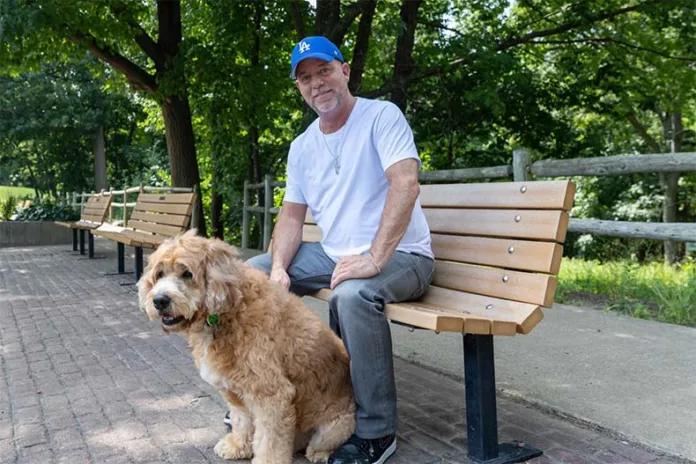
One thing that’s made Poore’s own life a bit brighter: Leo, a 12-year-old wheaten terrier–plummer spaniel mix who Poore found abandoned and tied to a tree at the shelter where he used to work.
Over the years, Leo has been a safe place for hundreds of other dogs over the years who have spent the night at Poore’s home to decompress before they enter the shelter.
Many of those dogs don’t trust people yet, Poore said. But they trust Leo.
“He doesn’t know it, but he’s a therapy dog,” Poore said.
Thinking back to that first video he made on a whim, the trajectory that followed is somewhat hard for Poore to process. It’s put a lot in his path: awards, a large social media following, even partnerships with companies like Hills Pet Nutrition and Westlake Ace Hardware.
He thinks of that earlier version of himself — in a brand new uncertain chapter, stepping into those kennels at the end of the row for the first time — as a lot like the animals that were waiting in those kennels.
They just needed a chance at a fresh start. So did he.
“I’d like to think that that was part of what really inspired me,” he said. “The guy in that first video would never in a million years believe that I’m at this point right now.”
More Helping Hands: This mother and daughter use wedding flowers to bring color to care communities in JoCo
 Thanks for reading! If you value having an independent news outlet keeping tabs on local government, schools and taxes, we're asking you to contribute to our Education Reporting Fund.