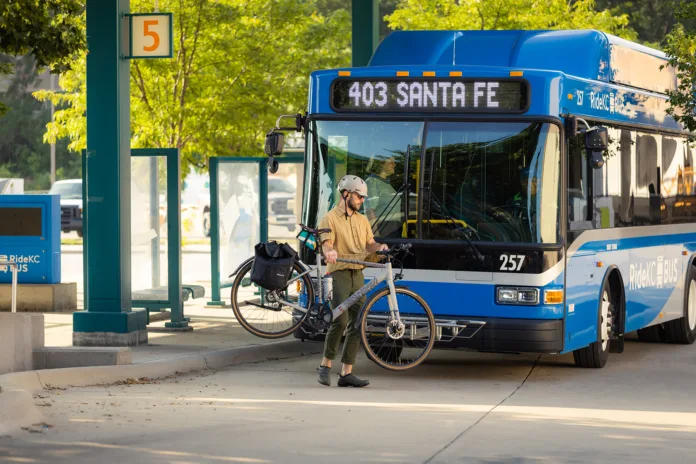
The county transit fund is running dangerously low and commissioners are exploring a $600,000 infusion to keep operations going through the end of the year. Possible future elimination of the K-10 Connector route to Lawrence and the ride-hailing microtransit service is also under consideration.
County transit staff presented the situation to commissioners in a committee of the whole Thursday, showing a steep drop in the transit fund balance after COVID relief funds were exhausted in 2024.
The fund balance dropped from $3.9 million in 2022 and $3 million in 2023 to just $148,204 last year. With the return of fares for half of this year, the balance is projected to be $700,000, which is lower than the five percent reserve target transit staff say is needed to be prepared for vehicle maintenance and replacement.
The meeting was convened minutes after the commission made its final vote on the county budget. County Manager Penny Postoak Ferguson said county officials knew the transit budget would be tight this year and that higher gas prices are exacerbating the challenges.
“To come today after just approving a budget is not ideal,” she said. “But we do have options.”
Commissioners asked staff to flesh out a proposal to add $600,000 of general fund support to the transit fund this year, which would give it enough for operations and begin to replace buses. They also asked that staff pursue more funding partners for the K-10 Connector.
Although their direction was limited to those two items, the discussion was wider and encompassed the possibility of eliminating microtransit and the Lawrence route, as well as possibly changing the fare structure for paratransit to keep transit service sustainable for the future.
HOW WE GOT HERE
Public transportation has been reeling since the pandemic, when Johnson County and other regional providers eliminated fares in 2020.
The loss of fares was backfilled with COVID relief funding. But that money was exhausted by 2024, causing a $2.68 million draw from transit reserves and resulting in the $148,204 balance. Fares were reinstated June 1 of this year throughout the Kansas City area, including Johnson County. The balance has rebounded a bit since then.
However, the bus service that was added for the World Cup a few weeks ago did not contribute to the budget problems discussed Thursday, said Assistant County Manager Aaron Otto.
Johnson County began testing a free bus drop-off and pickup to Kansas City International Airport just before the World Cup, and it will cease running Sept. 20. The county also added a circulator route to shopping and attractions. Those routes were funded separately through federal grants and appropriations, fares and city contributions, including a $400,000 county contribution from those sources. The $400,000 contribution for World Cup needs did not impact the regular transit fund reserve balance, county officials said.
Staff advised commissioners that they could get transit to the end of this year without a cash infusion, but it would be risky because it leaves a small margin for cost overruns and does not begin to address replacement of an aging bus fleet.
Otto said 17 of the county’s 71 transit vehicles are at the end of their useful lives, and another 10 will be reaching that point within the next two years. It typically takes about two years to receive a new bus, once it’s been ordered, he said.
Commissioners were presented with options that ranged from not making any changes to adding $1 million to the transit fund. The $600,000 option they landed on produces the same year-end balance of $700,000 as the option to do nothing, but it allows some of the vehicle needs to begin to be addressed.
The preference of the committee is not binding. The vote was 4-2, with Commissioners Becky Fast, Jeff Meyers, Janee Hanzlick and Shirley Allenbrand in favor. Voting no was Commissioner Michael Ashcraft, who has been skeptical of the level of public transit spending, saying it is not sustainable.
“When we went to free fares a few years ago we knew this day of reckoning would be coming,” he said.
Commissioner Julie Brewer, also voted no. She had asked for a different option that added $400,000 to the budget. Commission Chair Mike Kelly was absent.
Paratransit faces growing demand
The immediate budget need is being driven by the growth in use of paratransit, which is on track to overrun its budget by $1.4 million this year if nothing is done, according to the staff report.
“Today’s growing paratransit demand is landing on a fund with very little cushion,” said Justus Welker, the county’s interim transit director.
Paratransit provides rides to people who can’t drive because of disability. Demand has grown 69 percent since 2021 as the population ages and as some riders switch from microtransit, which has also been downsized over the years, Otto said.
Johnson County currently provides paratransit in three ways. RideKC Freedom is a fare-free curb-to-curb service that must be booked 24 hours ahead. There are eligibility requirements for that service.
Freedom on Demand, a regional book-ahead service, also has some eligibility requirements for age, income or disability. The county SWIFT service is available only to clients of Johnson County Developmental Supports.
By offering those services, the county is giving more than the federal government requires under the Americans with Disabilities Act. Under ADA rules, agencies that provide a more extensive route system than a commuter express bus service also have to offer paratransit within three quarters of a mile of the routes on the same days and hours.
Johnson County has not had to meet the ADA paratransit regulations because its bus service has been considered a commuter express. However that could change if the county switches to more of a fixed-route model, as has been discussed in strategic planning.
No changes were recommended for paratransit service in the near term, but the transit staff is eyeing what might need to be done for 2027 and beyond. Options include limiting trips or establishing a two-tier system with different fares for ADA and non-ADA riders.
Some commissioners said they will be reluctant to cut back on paratransit services. Allenbrand noted there are people who need public transit to survive homelessness and to get to jobs and appointments. “Those in need have to have transportation and how we fund it has always been a struggle,” she said. “I don’t want them to have to stay isolated in their homes.”
Fast said as the population over 80 years old grows, more people will need paratransit. “For me, paratransit is our number-one priority,” she said.
The K-10 connector
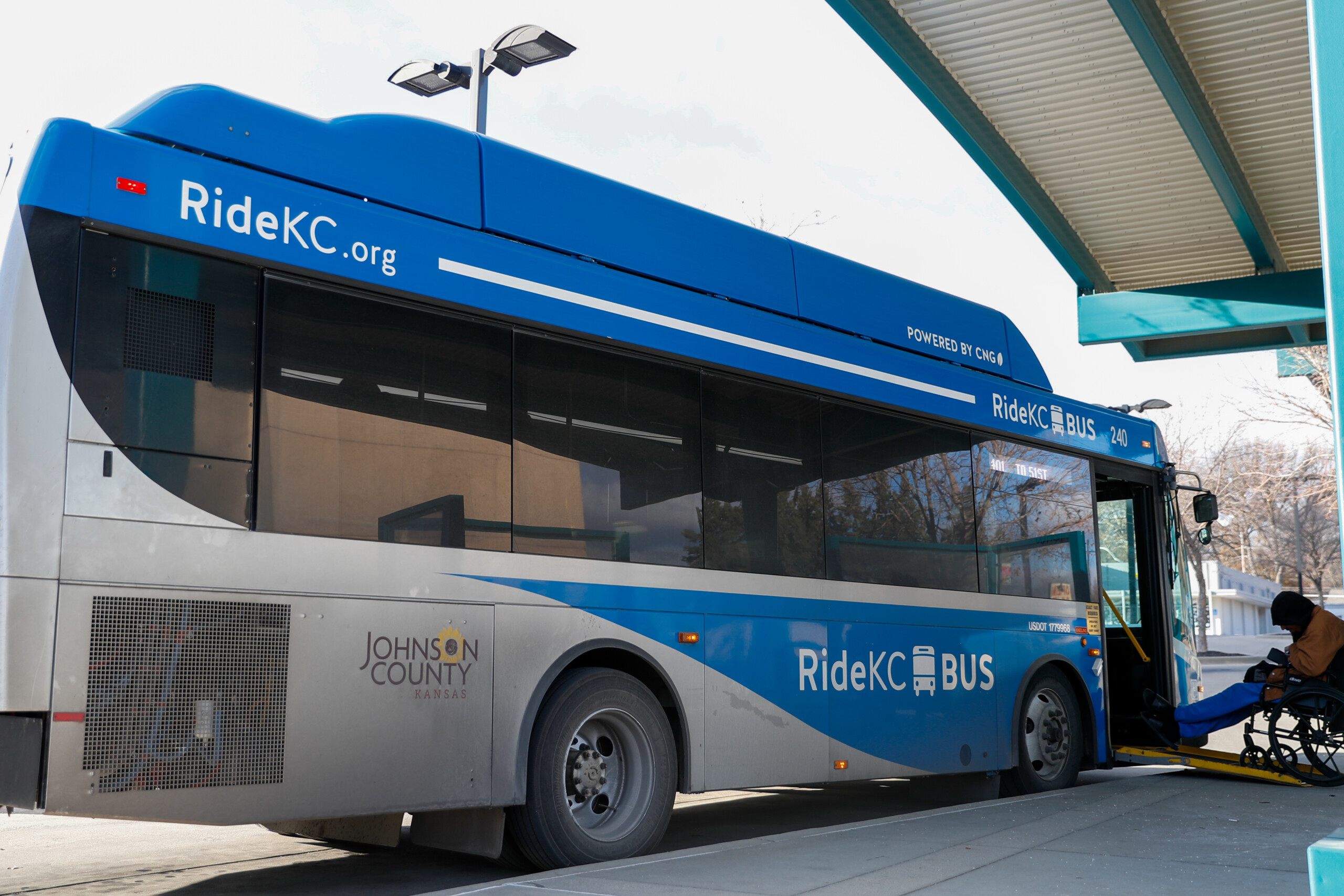
The bus line that runs from the University of Kansas Edward Campus and Johnson County Community College to Lawrence has seen some decreasing ridership, but it is still one of the top five performing routes in the county, with more than 50,000 rides in 2025, Otto said. It’s used mostly by students and faculty, he said.
Even so, it may be on the chopping block if the county can’t find a partnering entity to share the costs.
The city of Lawrence ended its annual $155,000 contribution to the route about two years ago, leaving the county to pay for the entire service. Transit officials say they would like to have about $300,000 in shared funding but have had no success finding a partner.
The discussion Thursday did not go into detail about K-10 funding, but commissioners expressed doubts about continuing the service without another source of funding.
“I don’t know how we’re expected to provide that service,” without help from other entities that also benefit, said Allenbrand. “I don’t know what else we can do if Lawrence and KU don’t want to help.”
Meyers suggested that the Kansas State University Olathe campus be added making it a potential funding source. He and Hanzlick noted that the Olathe campus inclusion might open up money from the $15 million a year collected through the one-eighth cent “research triangle” sales tax dedicated to higher education.
Ashcraft asked whether commissioners would be willing to walk away from the route if no other funding source could be found.
Commissioners voted unanimously in favor of looking for new funding partners for the route. Chair Mike Kelly was absent.
Microtransit

Microtransit service acts like a cross between a taxi and a bus. Riders arrange for a place to be picked up, then share the van with others. Routes are calculated based on where the riders want to go.
Johnson County was among the first suburban areas to try the relatively new type of transit in 2019. It grew popular, with 133,000 trips in 2023, but it was expensive for the county to run. Its fares, hours and territory were adjusted over the years to cut back on that cost. Since then, ridership has declined precipitously to a projected 7,300 for this year.
Meanwhile the cost to operate it per trip has more than doubled, from $29 to a projected $65 in the same time period, making it the county’s most expensive per trip.
Commissioners did not discuss microtransit except to say its future should be evaluated. A study of the impact on riders is required by the federal government when transit services are eliminated, and that study is already in progress for the K-10 Connector and microtransit, Otto said.
The county commission will review their options again at a meeting later this year. County staff is also expected to be back in November to talk about options to address transit longer term.