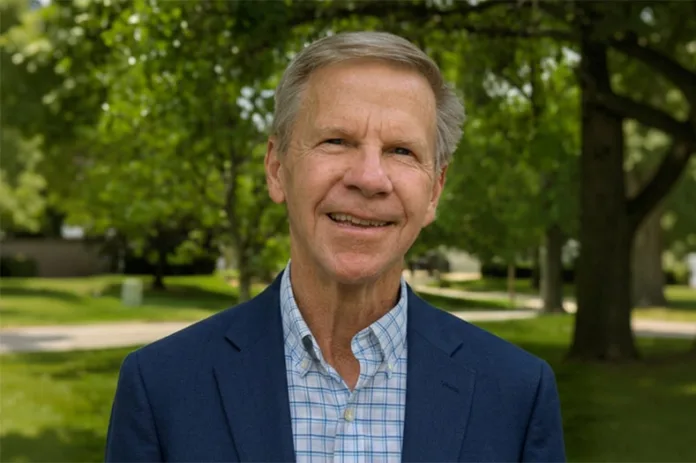
In 2014, Scott Morgan ran for Kansas Secretary of State as a Republican against Kris Kobach and lost. This year he’s running again, as neither a Republican nor a Democrat.
Instead, he’s the nominee for the relatively new United Kansas party, and his name will appear on the ballot along with Republican Pat Proctor and Democrat Jennifer Day.
He also happens to be a Johnson County native. Though he now calls Lawrence home, he grew up in Shawnee and went to Shawnee Mission Northwest High School.
Post Editor Kyle Palmer spoke with Morgan about why he’s running a third-party campaign to be the state’s top elections administrator and why he thinks that office’s power over elections should be greatly reduced.
*The Post has extended invitations for interviews to both Day and Proctor as well, and will publish those when they happen.
Watch the full interview:
Read the highlights
The transcript below has been edited for clarity, length and grammar.
Post: I’ve read in other candidate surveys you’ve done this year in the lead-up to the Nov. 3 election that you think Kansas should consider giving election administration over to a bipartisan or nonpartisan panel instead of having it under one partisan elected official. That is a major part of the Secretary of State’s job, maybe the thing that most Kansans associate with the office. Are you running for a job that you think either shouldn’t exist or should be greatly curtailed from what it currently does?
Morgan: It should be transformed, and its selection should certainly be changed. A lot of states have done this. [The U.S.] is the only functioning democracy where we elect our election administrators, and people from other countries find that very odd. And actually, most Americans, most Kansans, find it odd when I mention it and say, “Why do we elect a Republican or a Democrat to oversee our elections?” You can do it differently. I don’t like “bipartisan” because there’s more than two parties, but there can be a multi-party administration board that elects or appoints an administrator. I think that would be a lot healthier for our democracy and a lot healthier for people believing that their elections were fair.
Post: You’ve come out against adding proof-of-citizenship requirements to register to vote. This is a central plank of the Trump-backed SAVE Act, which has been before Congress this year, though it looks unlikely to pass the Senate. What worries you about having proof-of-citizenship requirements for voting?
Morgan: Kris Kobach experimented with it in 2014. It was one of the reasons I ran against him in the primary. I mean, my own daughter — who’s a sixth-generation Kansan — she tried registering and ultimately did but got kicked out on the first round because she didn’t have the right whatever it was for proof of citizenship. The original Wyandot Constitution had Article Five requiring you to be a citizen, so that’s not a question in Kansas. The question is, do we go back and require all voters to come forward with all this information to prove that they’re a citizen, so that they can exercise their right to vote, or do we allow it to continue the way it is, where you commit a felony if you do happen to not be a citizen and you go ahead and vote. I think [the current system] works pretty well. People sign statements whenever they register that they are a citizen of the United States, and that kind of thing has worked well. We can make elections very secure, but they have to be accessible, and we have to quit pushing people away from voting and discouraging them from voting. It’s our right to vote, not the government’s privilege that they hand to us.
Post: You’ve also said you want to protect advance voting in person by mail. That’s come up pretty fiercely in Johnson County over the last few months after the Johnson County Election Office’s decision to close eight early voting sites for the primary. You’ve also advocated for restoring the three-day grace period for mail-in ballots. Explain what early voting would look like under your election administration.
Morgan: I like having the counties have a lot of control over [elections]. I think county clerks do a wonderful job for most counties, and then you have the election commissioner in the [biggest] four. But in my administration, it would find ways to make it as accessible and easy for people to vote as possible. We cannot act like a random Tuesday in November is going to work for a lot of people. And you should be able to go in early and vote in person. You should be able to mail in a ballot if you choose to do that. You should not have to give the government a reason why you want that. You should just be able to. Almost half of voters use one of those two early methods, and that’s what the point is: to try to find ways to allow all eligible people to vote. And the three-day grace period is just a classic example of what’s gone awry with our system. Is that you know [the original grace period bill] passed overwhelmingly. Kris Kobach supported it. Sam Brownback signed it into law. Suddenly, somebody loses in 2020 and can’t handle it, and so they decide it was mail-in ballots that caused it, and now all these Republicans are so anti-mail-in ballot.
Post: Johnson County is one of the few counties in Kansas where the top election administrator is appointed by the Secretary of State. That’s currently Scott Schwab. That has made news here recently because it has now become Connie Schmidt. Some people, even the county chair, have said the process was not transparent enough, not necessarily criticizing Connie Schmidt herself, but the process that led to it. How would you handle such appointments? It might come to you that you might appoint the next Johnson County Election Commissioner.
Morgan: It would, and it has to be transparent. It has to be in partnership with the local county. I’m not sure it still makes sense to do it that way. [Appointing commissioners in the state’s largest counties] was an electoral reform when that was implemented. In the larger counties, the job had really outgrown a typical county clerk. It needed to be maintained by a different type of position. And again, I don’t want it elected any more than I think my position should be elected. But it needs to have that kind of working relationship between the Secretary of State in the current system and the county commission to try to have the right candidates get through and make sure it’s a professional administrator.
Post: Final question. You’re running under the United Kansas label. A lot of the things you’ve said in this interview, readers might recognize as Democratic or Democratic-leaning positions. You used to be a Republican, so some might be asking, why not just run as a Democrat? Why are you running for United Kansas, which is a party that has at last check around 1,000 registered voters in a state with 2 million registered voters? Why run under a third-party label?
Morgan: This has been a long project that I’ve been involved with since the 2014 primary, and I come out heavily on the Republican side of things. I was chief counsel for Sen. [Bob] Dole’s presidential campaign. I was appointed to the Federal Election Commission by the U.S. Senate to represent it on that body. I was chief counsel for [former governor] Mike Hayden, who endorsed me this week, and I’m heavily a Republican. We’re now trying to build a party from scratch, and everything in the system is designed to keep that from happening. It is just a nightmare to try to get a party on the ballot, and we did it. We’re on there. I’m the most qualified candidate [for secretary of state], and I’m also working with a lot of other people to build a party. You’re right: we only have 1,000 members. But I spent the day [recently] in Hutchinson at the Kansas State Fair, and there is a hunger for something different. That’s my motto. That’s been working: not Republican, not Democrat, something different. And that’s what we are. We’re a party of the middle.