All 18 judges who appeared on Johnson County ballots for the Nov. 3 midterm election were retained by voters.
That’s not necessarily a surprise.
Kansans have never voted to sack a state supreme court or appellate judge, though there have been some close calls (more on that below). Votes to retain district court-level judges in Johnson County, too, have been routine.
What is more interesting is that support for judges ticked up this year in Johnson County, compared to recent retention votes. Likewise, Johnson County voters support Kansas Supreme Court justices at higher rates than the rest of Kansas.
JoCo support for judges goes up
Remember, judicial retention votes are a matter of simply saying either “Yes,” you want a judge to retain their seat or “No,” you think they should go.
Compared to recent other years when judicial retention was on the ballot, the percentage of “Yeses” that judges got from Johnson County voters ticked up in 2026.
The chart below, made with the help of Claude, Anthropic’s artificial intelligence tool, analyzes Johnson County Election Office data going back to 2018.
Compared to 2018, 2020, 2022 and 2024, judges earned slightly more “Yes” support this year.
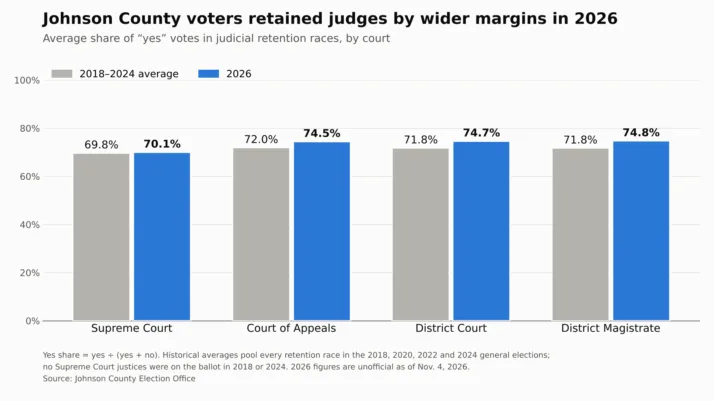
“Yes” votes for the two Kansas Supreme Court justices on the ballot this year were essentially flat. We’ll say more about that in a moment.
All other levels of judges saw an increase of at least two percentage points in “Yes” support over the average of the four previous election cycles.
Here is how each judge, other than the two Supreme Court justices, fared with Johnson County voters on Tuesday (totals will change slightly as mail-in and provisional ballots are counted this week):
Kansas Court of Appeals
- Isherwood — Yes: 72% (177,778 votes), No: 28% (67,487 votes)
- Cline — Yes: 74% (181,619 votes), No: 26% (62,961 votes)
- Schroeder — Yes: 78% (195,899 votes), No: 22% (54,188 votes)
- Fleming — Yes: 75% (184,125 votes), No: 25% (60,140 votes)
- Hurst — Yes: 72% (175,586 votes), No: 28% (68,109 votes)
Johnson County District Court judges
- O’Grady — Yes: 74% (179,764 votes), No: 26% (63,390 votes)
- Mason — Yes: 75% (183,075 votes), No: 25% (59,628 votes)
- Schoenig — Yes: 77% (186,168 votes), No: 23% (56,516 votes)
- Gyllenborg — Yes: 76% (184,631 votes), No: 24% (57,598 votes)
- Sloan — Yes: 74% (178,797 votes), No: 26% (63,086 votes)
- Joyce — Yes: 73% (175,355 votes), No: 27% (65,973 votes)
- Foth — Yes: 75% (179,648 votes), No: 25% (61,291 votes)
- Ryan — Yes: 74% (178,626 votes), No: 26% (62,315 votes)
- McCarthy — Yes: 76% (182,226 votes), No: 24% (59,060 votes)
- Rokusek — Yes: 74% (178,188 votes), No: 26% (62,423 votes)
Johnson County District magistrate judge
Ashford — Yes: 75% (180,260 votes), No: 25% (60,691 votes)
These judges at all three levels will now serve another four years before facing their next retention vote.
More support for Supreme Court in JoCo
And now to the two high court justices who topped the list of judges Johnson Countians saw towards the end of their ballot.
Both Justices Eric Rosen and Larkin Walsh are set to retain their seats, both garnering 65% “Yes” on Tuesday statewide.
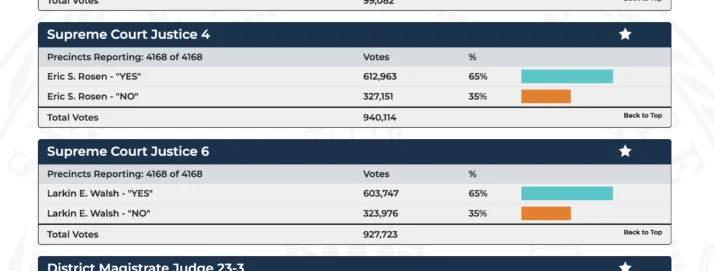
In Johnson County, the “Yes” side for Rosen and Walsh was slightly higher. As the chart above showed, both justices garnered about 70% “Yes” in Johnson County, which was higher than the state and also a tad higher than the averages recorded for Supreme Court retention in Johnson County in 2020 and 2022 (there were no Supreme Court justices on the ballot in 2018 or 2024).
It’s interesting to survey Supreme Court retention votes over time. This year’s “Yes” totals of 65% for both justices on the ballot rank among the lowest “Yes” votes dating back to 2000.
Overall, Kansans’ support for Supreme Court justices has dipped over time.
The chart below was created with the help of Anthropic’s Claude, using date from the Kansas Secretary of State’s office and information from Ballotpedia.
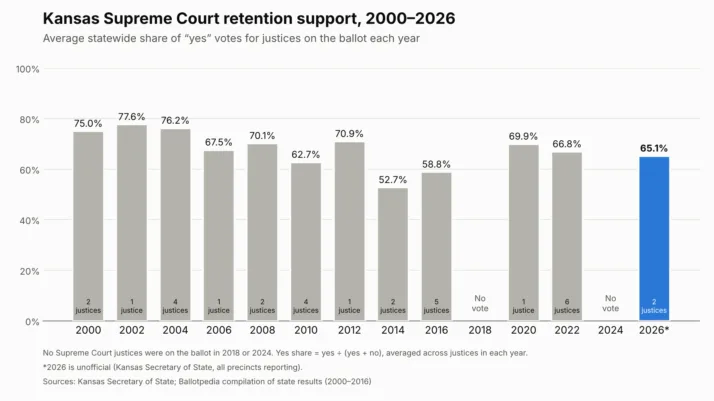
Supreme Court retention is still relatively uncontroversial (we’d call any candidate winning with 65% of the vote a landslide), but at the turn of the century it was even more so, with high court justices routinely getting “Yeses” from three out of four voters.
What changed in 2014, you may ask?
In that year, as well as in 2016, there were well-organized, high-profile campaigns to oust six Kansas Supreme Court justices after the high court, by a 6-1 vote, threw out the death sentences for brothers Jonathan and Reginald Carr, for a string of particularly brutal killings in the Wichita area in 2000. (Since then, the U.S. Supreme Court overturned that ruling and the Kansas Supreme Court later affirmed the brothers’ death sentences.)
Then-Gov. Sam Brownback endorsed the effort to oust two justices in 2014. One of the justices targeted that year was Eric Rosen, who was again up for retention this year.
In 2014, Rosen and Justice Lee Johnson both won retention with about 52% of the vote each. That’s as close as a Kansas Supreme Court justice has come to being ousted.
Two years later, the state GOP passed a resolution calling for four more justices’ removal, and prominent Republican lawmakers spearheaded the campaign.
Again, the targeted justices prevailed, all with “Yes” rates in the mid-50s. The lone justice not targeted by Republicans’ campaign that year, Brownback appointee Caleb Stegall, won retention with about 70% “Yes.”
In August, a proposed constitutional amendment appeared on Kansans’ primary ballot that would have made Kansas Supreme Court justices run for reelection, the same way state senators and representatives do. However, voters rejected it by a 61-39% margin.
 Thanks for reading! If you value having an independent news outlet keeping tabs on local government, schools and taxes, we're asking you to contribute to our Education Reporting Fund.