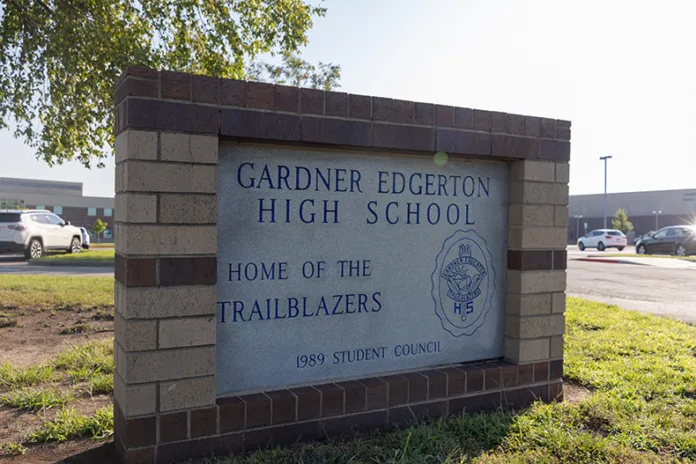
Nine minutes — that’s how long Gardner Edgerton High School students and staff spent fearing for their safety Wednesday morning.
A lockdown was initiated that morning in response to a medical emergency, though the cause was initially believed by many students, staff and parents to be an intruder. It took nine minutes to confirm a student was having a medical emergency and for district officials to check the building and announce that there was no intruder.
“We recognize how long and frightening those minutes could feel for anyone who believed they were in danger,” the district said in a Thursday email to families. “We are asking students and staff to share their experiences and concerns to help guide our review and next steps. [Principal] Mr. [Frank] Bell has already met with staff and is providing opportunities for students to ask questions and share their perspectives.”
The how and when
Every staff member carries a CENTEGIX badge for safety. Sometimes a medical emergency can trigger an intruder lockdown, Superintendent Brian Huff said in a message to families.
Pressing a button on the badge three times alerts building officials that someone needs assistance and identifies the badge’s location. Pressing the button eight times, however, alerts building officials and law enforcement. It also activates an audible alarm throughout the building, directing students and staff to begin lockdown procedures.
“In the stress of a medical emergency, a staff member may activate the eight-press alert to request immediate assistance,” Huff said. “That activation triggers the lockdown alarm, and staff and students respond as they would during an intruder emergency. Administrators must then determine what is happening and communicate whether there is a broader threat. This process can take several minutes.
“We recognize how frightening those minutes can be for students and staff, particularly younger children,” he continued. “Families may also receive calls or messages from children who believe they are in danger. Learning afterward that there was no intruder does not erase that fear. We must take every emergency alert seriously and acknowledge the impact on everyone who experiences it.”
The timeline on Wednesday, according to the district, played out like this:
- 9:03 a.m. – a CENTEGIX badge activation placed the school in lockdown.
- 9:06 a.m. – Principal Bell notified staff through Remind, a platform where staff and families can communicate with each other, that an official lockdown was in effect.
- 9:08 a.m. – Bell received information that the situation involved a medical emergency, not an intruder.
- 9:09 a.m. – Bell left the room where he had been in lockdown, explaining to those in that room why he was unlocking the door. He directed them to remain in lockdown until further notice.
- 9:12 a.m. – After verifying the situation with other administrators and police, Bell announced over the intercom that everyone was safe and there had been no intruder. He changed the lockdown to a shelter-in-place alert while the student received medical attention.
- 9:15 a.m. – Bell sent two additional messages to staff confirming the intercom announcement.
- 9:23 a.m. – Bell sent a fourth and final message informing staff that the shelter-in-place would end shortly and the bell schedule would remain unchanged.
- 9:28 a.m. – Bell made a final intercom announcement, thanked students and staff and directed students to their second block.
Communication breakdown
Part of the concern, which the district later addressed, is that the initial email from the school to families on Wednesday was misleading — specifically that “learning continued as normal.”
That email was sent by Bell at 9:30 a.m. on Wednesday. The district followed up both Wednesday and Thursday, apologizing for the statement itself and making it clear that the district wrote the email on behalf of Bell, so he could focus on student and staff safety.
“Our statement that ‘learning continued as normal’ was wrong and did not reflect what students and staff experienced,” the district said in the Thursday email. “We were working quickly to reassure everyone there was no threat, and please know that we had no intent to mislead. Mr. Bell should not be blamed for this mistake. We take responsibility for our wording and apologize for minimizing the fear and anxiety students, staff, and families experienced.”
What now?
The Gardner Edgerton district plans to review the incident and consider what might need to change.
“Our after-action review will consider staff preparedness, emergency procedures, coordination with the Gardner Police Department, communication, and access to counseling and other support for students and staff,” the district said. “What we learn will help determine where additional training, practice, or adjustments may be needed at the high school and across USD 231.”
In the meantime, the district plans to make additional counseling and assistance available to students and staff.
“Our students, staff, and families deserve clear communication, meaningful support, and confidence in our emergency response,” the district said. “We will work to earn that confidence through our actions and follow-through.”
 Thanks for reading! If you value having an independent news outlet keeping tabs on local government, schools and taxes, we're asking you to contribute to our Education Reporting Fund.