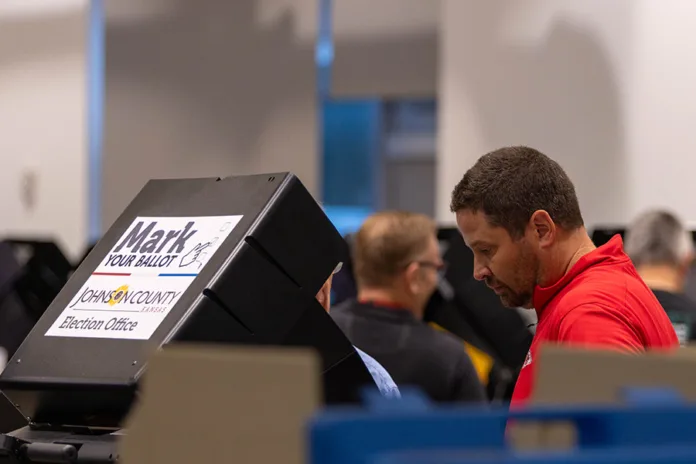
The Johnson County Election Office will begin an expanded post-election audit on Monday, taking a closer look at five races that remain too close to call after Tuesday’s midterms.
On Wednesday, the Kansas Secretary of State’s office announced the “close-race” audit for six contests statewide because all of the races’ margins were within 1% after Tuesday’s unofficial final results.
According to Kansas state law, KS 25-3009, any federal, state or state legislative race within 1% must automatically be subject to such an audit.
The audit entails reviewing ballots in 10% of precincts in each county that voted for that race. For statewide contests, that means all counties will conduct an audit.
The “close-race” audits are in addition to the routine post-election audit in which one precinct in every county is audited already.
The close races to be audited include:
- Governor
- Secretary of State
- Attorney General
- Kansas House District 27 (in Johnson County)
- Kansas House District 40 (in Leavenworth County)
- Kansas House District 117 (in both Douglas and Johnson counties)
When will the audit start?
On Thursday, the Johnson County Election Office held a random draw to select the 10% of precincts to be audited in each of the five close races in which Johnson County voters cast ballots — the three statewide offices and House Districts 27 and 117.
The election office, in a press release Thursday, said the post-election audit, now including the audits of the close races, would begin Monday at 9 a.m. at the county election office, 2101 Kansas City Rd., in Olathe.
The audit is open to the public.
How will they review ballots?
Close-race audits require a manual hand count of ballots from the randomly selected 10% of precincts impacted by the race.
Johnson County Election Commissioner Connie Schmidt told the Post in an emailed response to questions on Friday morning that the county was bringing in a “minimum of 60 bipartisan teams of two” to hand-count ballots for the audited races.
Originally, the county’s post-election audit was set to begin Tuesday, but Schmidt said the audit’s start had been moved up a day to Monday to account for the expanded number of races and ballots that needed to be reviewed due to the “close-race” audits.
Schmidt said they expect the audit to finish by Tuesday.
The county is still scheduled to hold its post-election canvass on Friday, Nov. 13. That’s where the county commission, acting as the board of county canvassers, will certify the midterm election results.
An audit is not a recount
The Kansas Secretary of State published a graphic on social media on Thursday, laying out the differences between a post-election audit and a recount.
#DYK: Close-Race Audit vs. Recount #ksleg #kselections https://t.co/xMEcHtD0aT
— Kansas Secretary of State (@KansasSOS) November 5, 2026
Recounts must be requested by a candidate and can only happen after county canvassing boards certify final election results.
Post-election audits are automatically triggered by state law and entail reviewing 10% of ballots, in the case of a “close-race” audit.
Where do close races currently stand?
Vote totals since Tuesday night have altered slightly as counties continue to count mail-in and provisional ballots.
Here’s where vote totals stand in each of the five races impacting Johnson County as of Thursday, according to figures reported by the Secretary of State and the Johnson County Election Office:
Governor
- Cindy Holscher (D) — 549,974
- Ty Masterson (R) — 542,929
Secretary of State
- Pat Proctor (R) — 523,937
- Jennifer Day (D) — 514,512
- Scott Morgan (United Kansas) — 45,942
Attorney General
- Chris Mann (D) — 551,468
- Kris Kobach (R) — 538,647
House District 27
- Sara Kiewiet (D) — 6,867
- Sean Tarwater (R) — 6,825
House District 117
- Brandon Holland (D) — 6,601
- Adam Turk (R) — 6,467
 Thanks for reading! If you value having an independent news outlet keeping tabs on local government, schools and taxes, we're asking you to contribute to our Education Reporting Fund.