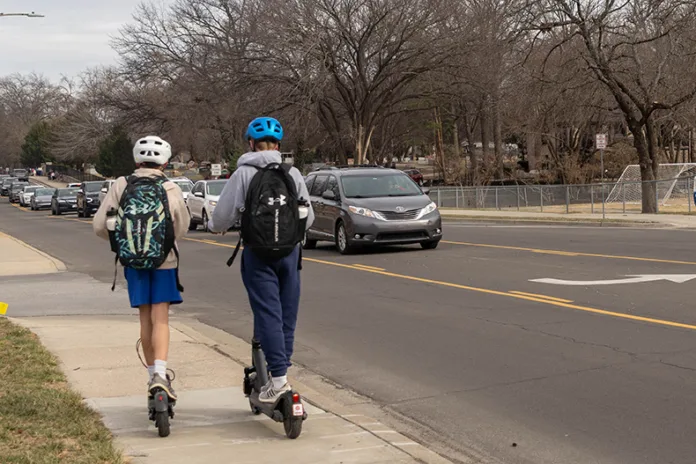
Beginning Dec. 15, riders of bicycles, electric-assisted bicycles and other “micromobility devices” will have to stay at or below 15 miles an hour on sidewalks and trails in Leawood, the city council has decided.
In unanimously voting to update its traffic ordinance on Nov. 2, Leawood became the latest city to adjust its regulations on small electric-assisted vehicles to be closer in alignment with a model recommended by the Mid-America Regional Council.
The speed limit was one of several changes that the Leawood City Council approved in the hope that consistency across city boundaries would improve compliance, said Councilmember Julie Cain. She added that she’s heard from many in the city who are worried about the dangers of these kinds of devices “flitting in and out” among traffic.
“If we could be more uniform across the metro, it’s going to help everybody, I think, because this is a big problem and it’s getting worse,” she said.
What the new rules say
Although the city council accepted the 15 mph limit on sidewalks, councilmembers passed on another MARC recommendation for a 20 mph limit in bike lanes. The bike lane speed limit will remain the same as the speed limit for cars and trucks.
Other restrictions in the MARC model that were approved include:
- An age restriction that says children younger than 16 are prohibited from operating e-vehicles that can go more than 20 mph.
- Helmet requirements for riders under 18 on electric-assisted vehicles. Leawood approved a helmet ordinance in February, which will not change, said Assistant City Attorney Kelci Weber. However, the update provides clearer definitions of “micromobility devices” that are not bicycles, she said.
- Riders may not carry more people on a device than it’s designed for.
- Riders have to give audible warning before passing and must yield to pedestrians.
The new and broader definitions are a key part of the ordinance, Weber said. They expand “micromobility” devices to include electric scooters, motorized skateboards and electric unicycles. Electric bicycles are classified separately but must meet many of the same requirements.
The update also includes the option of parental liability for children who break the rules, but police have discretion whether to issue a warning instead. In making these city code changes, Leawood city officials emphasized education before citations.
Leawood councilmembers voting for the ordinance update were Steve Kaster, Rachel Rubin, Sherrie Gayed, Matt Peppes, Alan Sunkel, Mary Larson, Lisa Harrison and Julie Cain. In Leawood, the mayor only votes to break ties. Mayor Marc Elkins did not vote.
Growing safety concerns
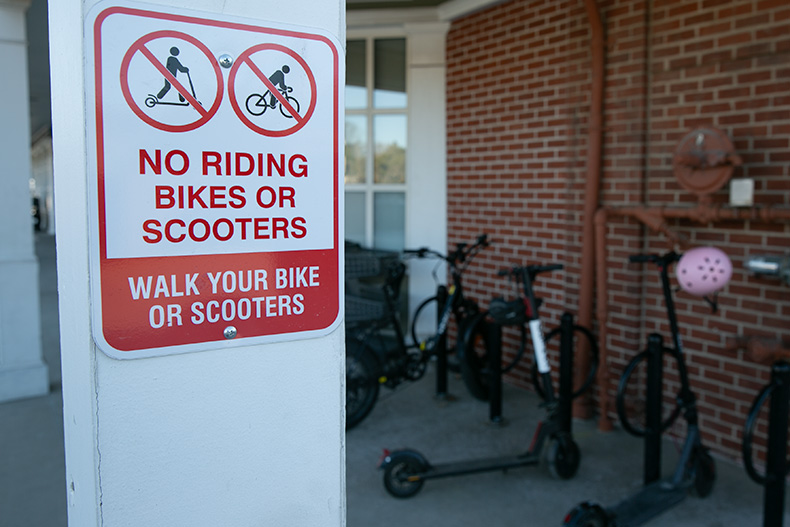
Johnson County’s city leaders and school officials have been increasingly concerned about the proliferation of riders using these small vehicles alongside automobiles, and have examined various rules and municipal laws to address that. Concern was heightened after 10-year-old Duke Ommert was killed in a crash while riding his e-scooter a little over a year ago.
But some have expressed frustration that their new rules are being ignored.
The Blue Valley School District administration has discussed banning e-bikes and e-scooters at elementary and middle schools on Jan. 1, 2027, because of safety concerns that include speeding, collisions and unsafe riding.
In Prairie Village, police have said that after more than a year of educational efforts aimed at parents and children, they will move to “more aggressive enforcement”, possibly citing parents.
Overland Park, Olathe, Lenexa and Shawnee also have worked on e-vehicle safety this year.
 Thanks for reading! If you value having an independent news outlet keeping tabs on local government, schools and taxes, we're asking you to contribute to our Education Reporting Fund.