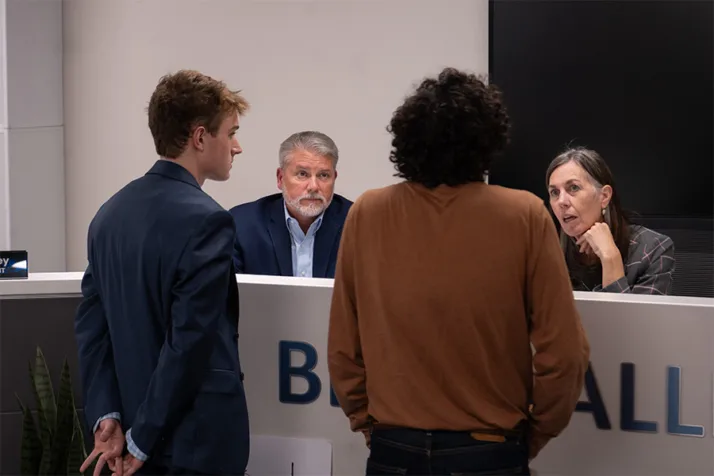
Only standing room was left in the Blue Valley Board of Education room Monday night — families, students, teachers and community members alike filled the room, spilling into the hall, to protest recent budget cuts.
Blue Valley is cutting more than $16 million between this year and next to save its budget amid declining enrollment and chronic underfunding of special education.
Among the cuts is the discontinuance of the Chinese Immersion program, staff reductions to performing arts and library programs, changes to visual arts courses and even the suspension of several middle school athletic programs.
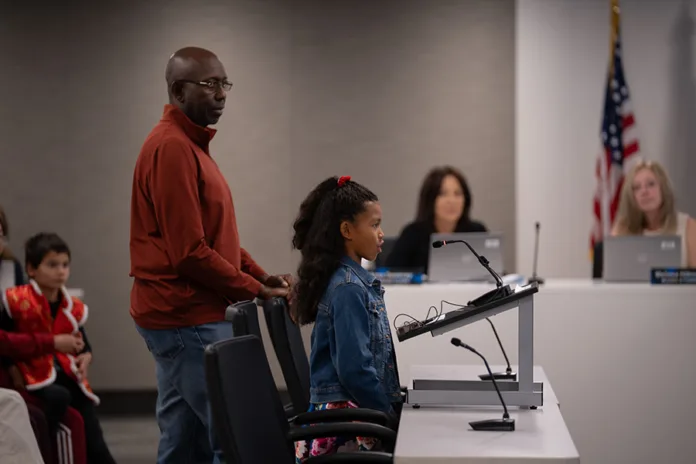
“I am so happy to speak to you tonight because I love our program and I want to share what it means to me and my friends,” said Nicole Dobbins, a fifth grade Wolf Springs Elementary student in the Chinese Immersion program. “Learning a new language isn’t easy, but it opens up a huge world for us.
“In our not so big, but beautiful city of Overland Park, this program has taught us so much more than just Chinese words and characters,” Dobbins added. “It satisfies our curious minds and shows us how big and interesting this world is.”
Dobbins was one of dozens in attendance, and several speakers, Monday night to show support for the Chinese Immersion program. Beyond that program, the board also heard concerns regarding cuts to library, music and art programming during the public comment period.
Even before the cuts were announced, the district has expressed continued concern with the state’s underfunding of special education. It even hired a lawyer, along with three other Johnson County school districts, to seek the full funding of special education.
Under Kansas statute, the state is supposed to reimburse districts for 92% of the “excess costs” associated with special education. “Excess costs” refer to the average amount it takes to serve a student with special needs above what it costs to educate a student in general education.
The districts say Kansas has failed to hit the statutorily required 92% threshold since 2011, requiring them to pull money from other funds to cover special education costs. Last year, Blue Valley transferred $18.9 million from other resources to cover that gap.
Several members of the board, including Clay Norkey, said they’re eager to see what the future holds after the recent election.
“I have hope,” Norkey said. “I have as we move forward with a new layout in Topeka — there were a number of pro-public education folks that are going up there for next session. We’re going to have some high expectations and we’re going to hold their feet to the fire.”
Watch the full board meeting here. Public comment starts at 24:58. A presentation on proposed course changes at the middle and high school levels starts at 1:40:02. Board comments start at 2:15:54.
Public comment
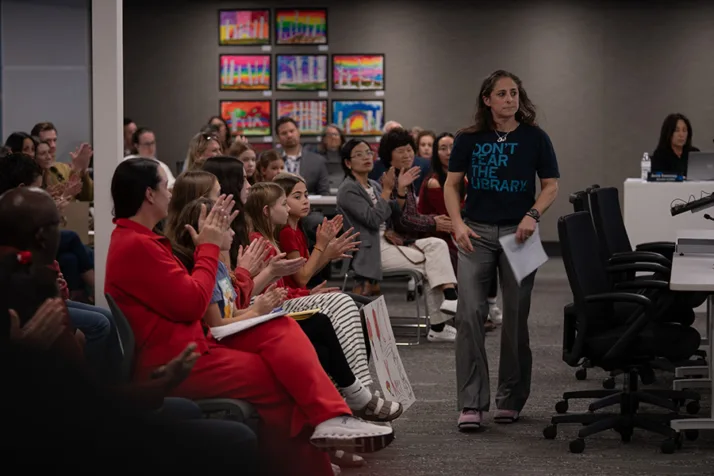
Thirteen people, including several students, spoke during the public comment period Monday night.
One of the speakers, Blue Valley High School film photography teacher Kristen Harlow, shared her concerns with budget cuts to the arts — particularly proposed changes to the photography courses, which include discontinuing dedicated film photography courses.
However, according to the district, film photography will still be taught in the adjusted Digital Photography course.
“This is not a struggling program,” Harlow said. “It’s thriving and nearly self-sufficient, funded primarily by student fees and maintained by its dedicated teachers.”
The board later heard a staff presentation Monday night on the course changes to photography, which include discontinuing Photography I and II, and combining Digital Imaging I and II into one repeatable course called Digital Photography.
Combining classes like this is called nesting — and it’s already done for several other courses. The goal, district officials said, is to help reduce the amount of classes with an enrollment of fewer than 18 students.
Also proposed Monday, the district plans to combine the two levels for drawing, Drawing I and Drawing II, into one course that’s repeatable for advanced students. The board of education will consider the changes this winter.
Another speaker, Blue Valley North library media specialist Abby Cornelius, said she wanted to address her concerns with the “systemic dismantling of the Blue Valley school libraries.”
“When I began my tenure in 2006, we had four full-time staff members in the library,” said Cornelius, who is also a parent in the district. “We now have two librarians at each school, but recently, the decision was made to cut one librarian at each high school.
“Our librarians are full-time, highly certified teachers with required master’s degrees that are the only teachers in every school building responsible for teaching curriculum to every student every year,” she continued.
Instead of the current budget cuts, Cornelius suggested that cuts should be made at the district level — students feel the impact less.
“We implore you, do not damage the education of all Blue Valley students, my child included, by reducing high school libraries to a single teacher for 1,500 students,” Cornelius said. “That 1,500 to 1 ratio is not only impossible, it’s harmful. Our students will be worse off than their predecessors because of it.”
Student protest
Also during Monday night’s meeting, dozens of performing arts students showed up with signs protesting the cuts to their programs — which primarily consist of cuts to staffing, including accompanists and sectional coaches.
Protest organizers and BV Northwest seniors Nova Rule and Wyatt Ricker spoke to the Post after the meeting, with the two stating that they don’t think the cuts to the arts are equitable.
While athletics coaching staff is also being reduced, taking one support staff from the choir department looks different from taking one support staff from the football team, Ricker said.
“We know that the budget cuts are inevitable and that they’re going to happen,” Rule said, agreeing with Ricker. “That is not what we’re upset about. It’s more so the fact that we feel like some departments have been more targeted than others, and that it hasn’t been fairly distributed across all places — whether that’s athletics, activities, academics and so on.”
Looking forward
The students said they understand the challenge before the district. Monday’s protest was their way of making their voices heard on the local level before moving on.
“Our next step is contacting the state,” Ricker said.
Ricker and Rule plan to email, call and even visit the statehouse to build connections with legislators who might be able to help.
“You can make that personal connection by sitting down with them in their office, in a boardroom, and just talking through things with them and advocating with your voice,” Rule said.
Similarly, the board urges the community to do the same: Contact your legislators, make your voices heard. In particular, Board Member Patrick Hurley said, the next six months are crucial.
“The next six months are going to be critical as we go forward,” Hurley said. “That’s going to change our trajectory, potentially. I encourage the community to stay engaged, stay informed, [and] participate in the process. We’re obviously going to be in Topeka having conversations about what we need and what that money does for our communities.”
While part of the district’s goal is to get the state to fully fund special education, Hurley said there’s another opportunity to improve funding with the state’s school finance formula, which is set to expire in June 2027.
“If we can get the funding formula that we need, then we can reverse these cuts in short order,” Hurley said. “But, the next six months are critical. Hopefully, we can minimize the impact on the most number of kids going forward. If we’re fortunate and everything works out, we should be able to move forward in some fashion from where we are today.”
 Thanks for reading! If you value having an independent news outlet keeping tabs on local government, schools and taxes, we're asking you to contribute to our Education Reporting Fund.