The precursor to the federal Americans with Disabilities Act, known as Section 504, didn’t happen without a fight.
“Being Heumann,” a new film co-written by a local author, tells the story of Judy Heumann, one of the leading activists in that movement, and the historic 1977 sit-in she led in San Francisco.
That movement ultimately led to passage of Section 504 of the Rehabilitation Act.
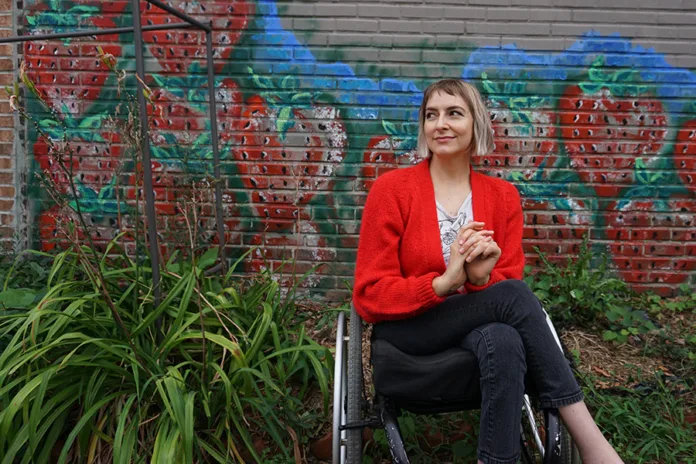
Rebekah Taussig, a Johnson County writer who shared her experiences of disability in the memoir, “Sitting Pretty,” co-authored the screenplay with the film’s director Siân Heder, writer and director of “CODA.”
“This story essentially tells the real life events of the wild, fierce fight for the very first bits of civil rights legislation for disabled people in the U.S.,” Taussig said.
How Taussig found her way
Growing up, Taussig said she didn’t have the innate belief that Heumann — who died in 2023 — did in the idea that the world should change to accommodate disabled people.
“I came to it in a very different way than she did. She always had that in her. I had to acquire that later,” she said.
It took Taussig a while to find her way. After graduating from Shawnee Mission South, she attended Johnson County Community College and the University of Missouri-Kansas City, finally getting a PhD at the University of Kansas. At KU, she discovered disability studies and merged it with her existing expertise in writing and literature.
Heder read Taussig’s 2020 memoir about her life as a wheelchair user and called her up to consult on the film.
“I completely dove in and became obsessed with the story of what happened but (also) the people who participated in it as well. I started just sending Siân pages and pages of notes and kind of creating character arcs that we could use throughout the whole story and pairs of character arcs, and eventually Siân just asked me if I wanted to co-write with her,” she said.
Taussig calls the story of the roughly 25-day sit-in a David and Goliath-type tale of protesters pushing against the federal government.
“It has so many interesting people who participated in it. The details of it, like [the] fact the government was trying to shut this protest down: They turned off the water supply. They cut off the phone lines. The deaf protesters realized they could send messages out the window signing messages,” she said, describing some of the scenes depicted in the film as well as news coverage from that time. “And it was people who needed to be turned in the night and needed back-up ventilators. It was just such a wild story.”
“Disability storytelling is human storytelling”
One thing that was important to Taussig was to show the full personalities of disabled people on screen and not flatten them into one-dimensional characters.
“Disability storytelling is human storytelling and not a niche side project,” she said.
Rounding out the portrayals of the protesters meant showing sides of them not often seen in film.
“I think what I was helping to bring in is notes of authentic humor. There’s a freight elevator scene where we see Judy is receiving care from a super hot guy in the building, and we get to see the ways that care and care work can be many things at once. It can [be] assistance, but it can be playful; it can be flirty. It can even be steamy or sexy,” she said.
Taussig herself appears in the film as an extra.
She will be doing a Q&A at a special screening at the Glenwood Arts Theater in Overland Park on Friday, Nov. 13. The film starts at 7 p.m. with Taussig’s segment following. You can also stream the movie on Apple TV, also starting on Friday.
Want to see the film? Buy tickets here.
Keep reading more arts and culture: Overland Park painter’s new project puts small businesses in focus
 Thanks for reading! If you value having an independent news outlet keeping tabs on local government, schools and taxes, we're asking you to contribute to our Education Reporting Fund.