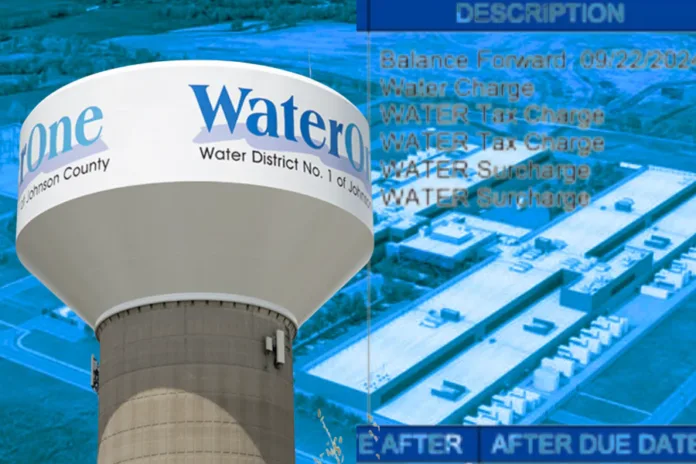
It hasn’t happened so far, but WaterOne officials believe the day is coming when a hyperscale data center may ask to hook up to the Johnson County water system and begin using more than 2 million gallons of water a day — more than any other user by an order of magnitude.
To that end, the public utility board and staff are working out how to charge such a big user without running into the problems that have cropped up in other cities around the U.S. where data center use has put a strain on water supply and affected quantity.
WaterOne’s seven elected board members have been discussing the possibility of an extra-large user for most of this year ever since officials learned of feelers that were put out to a city in its service area, said Mandy Wagner, assistant general manager at WaterOne.
Those inquiries are no longer active, but they alerted staff to the need to have a plan in place if a large potential user returns with a development plan, she said.
“It’s preparation. I think that’s the way I would describe it,” Wagner said. “I think there’s a general awareness in the water utility community broadly that data centers and what’s happening with their development these days in many places is causing a conversation.”
Why do data centers need water?
Data centers are typically large windowless buildings akin to a warehouse. Inside are banks of electronics that handle the computing load of artificial intelligence, streaming and financial services.
The massive amount of energy used in such facilities generates a lot of waste heat, and that in turn means data centers and other large users need continuous cooling.
Some data centers use a “closed loop” water system, which typically requires less water. Depending on local infrastructure, some data centers use recycled water. Often, though, data center operators turn to local drinking water supplies.
Experts list several ways the extra water use can negatively impact communities — depletion of aquifers, increased competition with agriculture and residential users, and pollution from anti-corrosion chemicals that are added to the water, for instance.
Water use by data centers has created controversies across the country, drawing pushback in communities where they have been built.

Moratorium on extra-large users currently in place
When 2026 began, WaterOne didn’t have a plan outlining how such large users would be charged for water usage.
In April, the utility board thought it was a good idea to hold off on any potential negotiations with big users until it had such a rate plan in place.
The board first set a six-month moratorium on service to extra-large users at its April meeting. It renewed that moratorium in October so members can consider a draft recommendation that creates a special tier in its rate structure for the largest users, as well as outlines other responsibilities for paying for pipe hookups and other water delivery infrastructure.
“This second moratorium gives our board time to review the regulatory environment and these projects so that any policy is comprehensive and uses our most precious natural resource wisely,” said Whitney Wilson, chair of the WaterOne board.
WaterOne and its board hope to be prepared for any future extra-large user by having rules in place that protect existing users from rate shocks ahead of any development proposal.
The emphasis has been on making sure the existing users are not picking up the tab for the extra costs associated with these large users, Wagner said, while also being careful not to shut down development.
Ideally, the rules will protect smaller users while still allowing development that expands the system, she said.

Proposed higher rate for extra-large users
The regulations under consideration are not specifically aimed at data centers. Instead, they apply to “extra large users,” which is defined as an entity using at least two million gallons a day.
Not every data center fits into this category, Wagner said, because some use less.
The extra large user would be billed monthly at the Block 2 rate. Block 2 is a higher rate charged for peak summer usage of up to and over 125% of average winter use.
The Block 2 rate is 50% higher than the Block 1 rate. For 2026, Block 1 is $5.60 per thousand gallons and Block 2 is $8.40 per thousand gallons.
Charging at the higher rate would have a big impact on the amount of money an extra-large user brings to the water system.
According to calculations by the staff presented at the WaterOne committee work session in September, a user of 2 million gallons a day would pay a monthly bill of $336,000 if charged at this year’s Block 1 rates, but $504,000 for Block 2 — an annual difference of just over $2 million.
The amount goes even higher if the facility uses 10 million gallons a day. At today’s rates, Block 1 would result in about $1.8 million a month, and Block 2, $2.5 million a month, a difference of over $10 million annually.
Extra-large users would also be assessed a service charge for other direct and indirect costs of infrastructure, pumping and storage. They would also be required to pay for pipelines, metering and other infrastructure costs needed to deliver water service to their locations.
Could a data center be too big for WaterOne?
The proposed regulations set the definition of an “extra-large user” at 2 million gallons a day, but they do not set a specific cap on how much water a facility would be allowed to consume. Nor do they limit how many extra-large users could hook into the system at once, although space for a hyperscale-sized data center would be limited within WaterOne’s service boundaries.
Any limit would come via an additional fee for exceeding the amount of water a data center estimates it will use at the beginning of its contract with WaterOne. The draft agreement requires an estimate of maximum usage in the user’s contract with the utility. The estimate would be based on an assessment from a Kansas-certified engineer.
A user demanding 2 million gallons a day or more would immediately become the district’s biggest customer by far.
Coca-Cola, WaterOne’s largest customer currently, typically uses 300,000 to over 400,000 gallons a day, according to a WaterOne chart shared at the committee meeting.
The Blue Valley School District, which is the district’s sixth-largest customer, doesn’t usually consume more than 80,000 gallons a day.
But to date, the board and staff have focused more on the equity of the rate structure than any potential for overdrawing the water supply.
WaterOne draws from both the Kansas and Missouri rivers and has a rated capacity of 180 million gallons a day, Wagner said. A two-million-gallon-a-day user would be just over 1% of the total capacity, she said.
The proposed regulations include extra-large users among the customers who would be called upon to cut use in the event of a water shortage. But, “it is not about scarcity or capacity. I think the right framing of it is about equity,” Wagner said.
WaterOne board member Jennifer Gunby said she isn’t concerned about multiple extra-large users joining the system.
“We have phenomenal water that is priced wonderfully, and I encourage all to use this product,” she said.
Gunby also trusts that the staff has run their calculations about what it would take for such a large water consumer to join the system.
“We want to make sure the current ratepayers are treated equitably,” and that “the cost would be borne by new customers and not existing ratepayers,” she said.

Changes in Topeka may impact WaterOne’s discussion
Board members extended the moratorium for another six months at their October meeting, saying they wanted more time to review the proposal. That would put the ending date of the moratorium in April.
Some members said they hoped to have a better idea of what the next Kansas Legislature would do by then. Last session, lawmakers approved a sales tax exemption for certain expenses for qualifying data centers but did not advance a bill requiring closed-loop cooling — a type of system that uses less water.
Kansas Governor-elect Cindy Holscher, an Overland Park Democrat, proposed a moratorium on data centers during her campaign.
Board chair Wilson said the proposal was “an excellent first-pass recommendation” and she is open to further refinement. She said WaterOne customers would likely see a rate benefit from having an extra-large user in the system.
She’d also like to see transparency that includes a prohibition of blanket non-disclosure agreements and utility oversight at the earliest stages of a project, as well as financial penalties for missing agreed-upon design and consumption milestones. Ideally, cities and the county could require local labor also, she said.
Gunby said she recognizes the concerns of communities about data centers.
“I do understand where those data center concerns are coming from, and they are not just limited to water,” she said. “One way or another, we need language to ensure we follow that growth-pays-for-growth philosophy.”
The proposed rules shouldn’t stop development, she said.
“Those projects take a long time to develop,” Gunby said. “We don’t want to discourage anyone from starting conversations with staff. It’s just going to take us a little longer to get terms in place.”
 Thanks for reading! If you value having an independent news outlet keeping tabs on local government, schools and taxes, we're asking you to contribute to our Education Reporting Fund.