By Johnson County Museum Education Assitant DJ Holzhueter
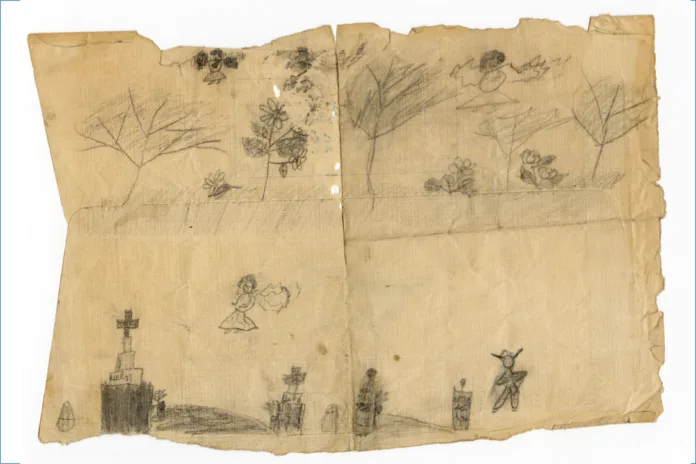
A recent donation to the museum included a history mystery: an envelope tucked into a book, yellow with age, and covered in tiny, strange pencil sketches.
At first glance, it looks like a child’s drawing, with unsteady lines depicting trees, flowers, and hovering human-like figures. Below is what appears to be a graveyard with a figure in a flowing robe flying above the graves and another shadowy figure looming nearby.
The mystery is this: were these images drawn by the living — or the dead?
A 1957 recollection from long-time Spring Hill, Kan., , resident, Mrs. Nina C. Dalzell, offers a clue:
“During the [18]80’s and 90’s a wave of Spiritualism swept Kansas and Spring Hill had a little more than its share… A good Spiritual séance was considered very good entertainment and ghosts and moving tables were a part of everyday living of some of the people.”
As the days grow shorter and colder, and the shadows get a bit longer, grab a cup of something warm, wrap yourself in a blanket, and read the ghostly tale of the Spring Hill Spiritualists.
Two Knocks for Yes: Origins of Spiritualism
On the night of March 31, 1848, in a small farmhouse in upstate New York, sisters 14-year-old Margaretta “Maggie” and 11-year-old Catherine “Kate” Fox heard a noise.
The girls called their mother to their bedroom and told her that a spirit was knocking on the floor and walls. Before long, Kate began communicating with the supposed spirit, asking it to knock the same number of times as fingers she held up — one finger, one knock, and so on. The sisters eventually developed a more elaborate system of communication with the spirit through the knocking, or “raps.”
Word spread quickly. Visitors flocked to the Fox house to witness the mysterious activity for themselves, in such numbers that the sisters’ older brother had to stand guard at the front door.
This strange episode might have faded into obscurity as a ghost story if not for the efforts of Amy and Isaac Post, a Quaker couple and close friends of the Fox family. The Posts vouched for the sisters’ character and spread the story among their own circles, which included abolitionists, suffragists, and progressive social reformers. Many would become associated with the movement soon known as Spiritualism.
Broadly defined, Spiritualism is the belief that people do not cease to exist at death; rather, their consciousness, or soul, leaves the body and can communicate through mediums, people believed to possess particular sensitivities to spirits.
Spirits might speak through a medium or communicate using objects such as spirit boards, trumpets, and writing implements. They might appear in visions or relay messages through the medium, often during a séance.
Spiritualism emerged during a period of enormous social, political, religious, and scientific change. With seemingly extraordinary scientific discoveries reshaping people’s understanding of the world, communication with the dead did not seem impossible to many Americans. Mary Todd Lincoln famously held séances in the White House, and Queen Victoria was said to have held a séance to speak to her late husband, Prince Albert.
It wasn’t long before Spiritualism reached Kansas.
The Aber Intellectual Circle
Spring Hill sits on the border of Johnson and Miami counties. By the mid-1880s, the area was a growing area as railroads arrived, farmers prospered, and rumors circulated about underground deposits of gas and oil.
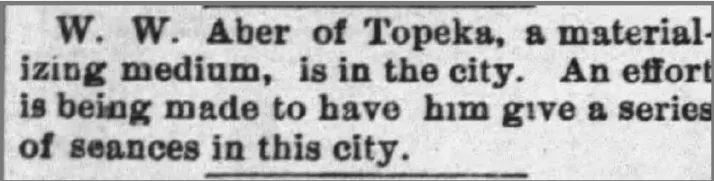
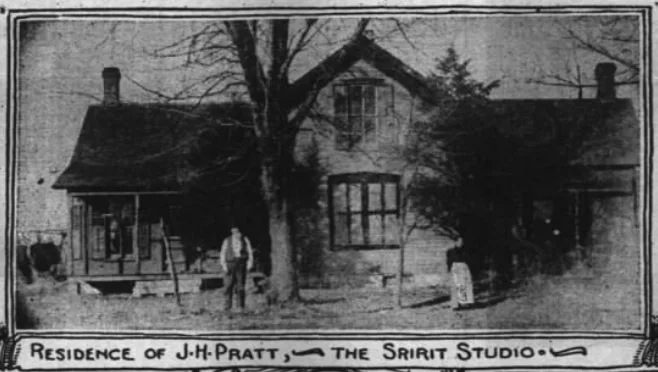
One local farmer and drugstore owner, Jonathan Howard “J.H.” Pratt, began noticing newspaper advertisements for a Topeka medium named William W. Aber. Pratt was himself a passionate Spiritualist. Known locally as the “Sage of Wea” — after the nearby community of Wea — he frequently published lengthy newspaper essays about political reform and his belief in spirit communication.
Pratt invited Aber to his Spring Hill home to give private and public séances.
William W. Aber was a self-proclaimed clairvoyant medium from the same region of upstate New York as the Fox Sisters. He had gained fame — and infamy —in Topeka and Kansas City for his elaborate “materializing séances,” during which he claimed to summon full-body apparitions of spirits out of a piece of furniture called a spirit cabinet.
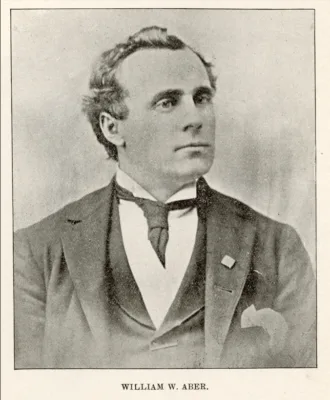
From the cabinet, spirits supposedly spoke through Aber, appeared independently, drew pictures, wrote on paper, and even played musical instruments. During these séances, Aber and his wife sometimes made a show of tying his limbs and blindfolding him — and even placing rice or flour in his hands — to demonstrate that he could not possibly be performing a trick.
As in Kansas City and Topeka, Aber’s séances in Spring Hill drew crowds. So many people wanted to attend that Pratt eventually limited gatherings in his home to 20 visitors.
The first séance was held in September 1888 and proved so popular that a regular group soon formed around Aber and Pratt. Within a few months, members were meeting two or three times a week. They called themselves the Aber Intellectual Circle.
Although they came from different backgrounds, many Circle members shared an experience that would have been familiar to countless Americans of their era: profound grief. Older men such as Pratt were Civil War veterans or had lost comrades, friends, or family in the war. Parents mourned children; children mourned parents. Epidemics of diseases like cholera, typhoid, and tuberculosis took people young and old.
Spiritualism offered reassurance about death. It promised that loved ones remained safe and content and, perhaps most powerfully, that the separation did not have to be permanent. For a few moments during a séance, members of the Circle believed they could speak once again with someone they loved in the “morning land”—the paradise they believed existed on the other side of the thin veil between life and death.
The Circle’s secretary, Jabez Hunt Nixon, kept detailed records of Aber’s séances. Nixon was raised a Quaker in the tradition that shared some of the progressive ideals associated with early Spiritualists. He was also a well-respected citizen of Spring Hill citizen and an elected judge.
According to Nixon’s records, the Circle communicated with the spirits of Jefferson Davis, John Brown, Joan of Arc, Thomas Paine, and many others. When members of the Circle themselves died — or underwent what the group called “the process called Death” — their spirits sometimes appeared at later séances.
Nixon also documented experiments conducted by Circle members. To them, Spiritualism was not simply a matter of faith; they viewed it as a form of scientific inquiry.
Nixon’s notes were eventually published as three books: “Rending the Vail” (1899), “Beyond the Vail” (1901), and “The Dawn of Another Life” (1910).
According to the Circle’s records, some of the spirits Aber regularly conjured — including Thomas Paine — told members that publishing the books would become their “great work” and bring both spiritual and earthly rewards.
To some extent, this came true. The books became known internationally and found their way into Spiritualist libraries, including the personal collection of famed magician and Spiritualist skeptic Harry Houdini, now held at the Library of Congress.
“Failed to Produce Ghost in Court”
Unfortunately, for the Aber Intellectual Circle, Aber’s past eventually caught up with him. He had already been exposed as a fraud in Topeka, Kansas City, and St. Joseph. He often left one city and established himself in another, sometimes styling himself “Reverend” or “Doctor” Aber despite being neither.
In December 1903, during a séance in Kansas City, two men captured Aber fleeing his spirit cabinet. Mortified, Aber locked himself in a bathroom until his wife chased the attendees away and he could escape.
Despite the incident, the Circle in Spring Hill continued to stand behind Aber.
Then, at a séance in Wichita in January 1914, a Pinkerton detective asked Aber to summon the spirit of his mother. When the “spirit” appeared, the detective grabbed it by the neck and shook it — revealing it to be, perhaps unsurprisingly, Aber himself in a costume.
Aber and his wife fled Kansas, and the Aber Intellectual Circle came to an end.
After relocating several times, Aber eventually settled in Portland, Oregon. In 1924, he was arrested and tried for fraud. Ordered to produce a ghost in court, Aber was unable to do so and instead fainted on the witness stand. Newspapers had a field day. Headlines included “Deserted by Spirits” and “Failed to Produce Ghost in Court,” and accounts of the trial appeared as far away as Belfast and London.
Aber was ultimately acquitted. He spent the rest of his life more quietly, operating Spiritualist churches throughout the Pacific Northwest.
J.H. Pratt did not live to see Aber’s final downfall. He died in the summer of 1906 at age 83, after suffering years of paralytic strokes, which he treated with magnetic therapy from a fellow Spiritualist.
His obituary in the “Olathe News” remembered him warmly: “He was a firm believer in the Spiritualist faith and was a man of high character, generous to a fault.” It listed “Rending the Vail” and “Beyond the Vail” as two of his accomplishments. The “Spring Hill New Era” was less generous, calling his religious views “eccentric,” while acknowledging that he had “some good and commendable traits.”
Jabez Hunt Nixon lived through the collapse of the Aber Intellectual Circle and died in the spring of 1915. Little was recorded about the Circle’s final days, but Nixon’s obituary noted that he remained a devoted Spiritualist until the end. His faith apparently had not been shaken by Aber’s exposure.
A Mystery Across the Veil
Not much remains of the Spring Hill Spiritualists today beyond their books and small pieces of ephemera like the drawing on the envelope.
And that brings us back to where our story began.
Was the drawing simply made by a child — perhaps one of the many people who attended Circle’s gatherings?
Or was it created during a séance by a medium — maybe even Aber himself — who claimed to be channeling the spirit of a child?
We’ll probably never know. Then again, the Spring Hill Spiritualists might say there’s still one way to find out…
Learn More!
Want to uncover more about Spring Hill and other Johnson County communities from the comfort of your own home? Go to jocohistory.org and do a keyword search. JoCoHistory is a collaborative resource that includes digitized photographs, maps, newspapers, yearbooks, oral history transcripts, past historical writeups, and more!
For even more history, visit the Johnson County Museum, Monday through Saturday, 9 a.m. to 4:30 p.m.. Go to JCPRD.com/Museum to plan your visit!