Overland Park officials are considering a slew of changes to the rules governing all kinds of signs – from digital displays to real estate and political signs.
The city’s planning staff presented the results of over three years of work overhauling the city’s sign ordinance on Monday to a joint meeting of city council and planning commission members.
The most noticeable change involves a new category of “incidental signs” that would include the ubiquitous leasing signs at apartment complexes. The proposed ordinance requires a permit for those types of signs and allows them to be 20 square feet, building or ground mounted and non-illuminated.
Existing signs that don’t meet the new requirements would have to be removed by Jan. 1, 2022, under the proposed new rules.
Governing digital signs
The rule is meant to give some uniformity to a type of sign that may have started out as temporary but ends up staying on display, said city planner Danielle Hollrah.
“We’re seeing some of these year after year. They are permanent but not necessarily maintained,” she said. The new rule would put some design standards on those types of signs.
Other rules under consideration would address the evolution of technology and the law. For example, the city would not categorize sign rules based on content and would no longer restrict the content or message on signs.
Changes in sign technology also were a factor. Over the past three years, council members and planners have struggled to decide what types of digital light displays should be allowed, since that technology didn’t exist when the current ordinance was written.
The brightly lit drive-thru menu boards at fast food restaurants, digital monument signs at the BluHawk development and the large light displays atop the City Place buildings were all subjects of prolonged debate before being approved.
The new proposed ordinance codifies those types of signs, with some restrictions. Building-mounted displays like those at City Place require permits, a setback from the highway and are limited to 10 percent of the façade, with other restrictions on movement and brightness.
Monument signs like those at BluHawk also would require permits, spacing and restrictions on the brightness and hold times.
Other proposed changes
Gas stations and residential developments also would have some new rules. The monument signs at gas stations would become a thing of the past, but they could be replaced by incidental signs, or a digital display on the canopy. Residential developments would no longer be able to have subdivision signs in entry medians.
Existing signs at gas stations and residential developments wouldn’t have to come down, though. Under the proposal, they could stay as “nonconforming” signs that must be maintained, but could not be replaced.
Other proposed changes:
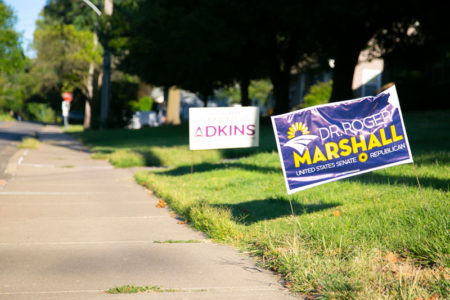
- Residents could have up to three “stake signs” (like a garage sale or political sign) for a total of nine square feet, with an additional sign possible for corner lots and a for sale or lease sign.
- Commercial and office buildings could have more signs on their façades, with more flexibility for whether the building is multi-story or multi-tenant.
- Billboards would get longer special use permits, going from the current three years to five. Overland Park has fewer than ten billboards, Hollrah said.
The meeting Monday was informational only. The Planning Commission is set to discuss the ordinance Nov. 9 and the full City Council is scheduled to take it up Dec. 7.