“There’s no Democratic or Republican way to fill a pothole,” the saying goes.
Even so, interest in which candidates the local Democratic and Republican parties recommend in nonpartisan elections for offices like city council and school board has been intense this year in Johnson County.
Earlier this month, a Leawood city council candidate publicly renounced his inclusion on the county Democratic Party’s list of recommended candidates after a dispute arose over his comments that were critical of other Democratic candidates and in support of a Republican.
Questions of party affiliation asked by audience members have also found their way recently into candidate forums hosted by the Shawnee Mission Post in Fairway, Lenexa and Shawnee, as well as for Johnson County Community College Board of Trustees.
At the heart of it all are the lists the two major parties put out each general election cycle that note which local candidates have partisan ties.
Party leaders say they are only doing what they’ve done for years – providing an easy way for voters to find which candidates they most identify with.
Municipal and local elections are technically nonpartisan
It’s worth noting that none of the municipal or school board candidates running this fall are going to have an “R,” a “D” or an “I” (for Independent) next to their names on the ballot.
Local elections are considered nonpartisan and party labels are not included on the ballots voters fill out.
But nothing stops a candidate from publicizing a party preference during the campaign and many say it’s one of the most common questions they get when knocking on doors.
The county parties help answer this by putting together lists of local candidates who are registered Democrats or Republicans and publicizing it for voters.
In addition to the lists, the county parties provide other forms of non-financial support that may be attractive, especially to first-time candidates.
The Johnson County Democrats, for example, provide some campaign training, a list of vendors, mentions on social media and “walk cards” handed out on the doorsteps of potential voters.
Support from the party also creates a network for people unused to campaigning, officials say.
See what candidates in your city are on which list:
A break with the party in Leawood
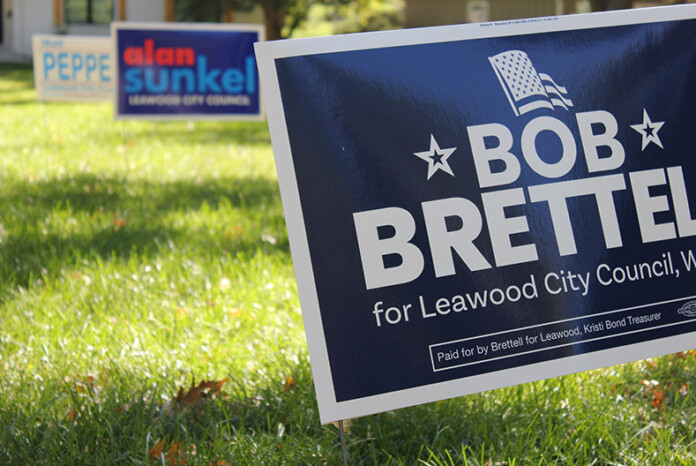
That support network was what Bob Brettell said he was signing up for when he talked to county Democrats after deciding to run for an open city council seat representing Leawood’s Ward 1.
There are two other candidates in that race: Alan Sunkel (backed by Democrats) and Matt Peppes (backed by Republicans).
Brettell considers himself more aligned with the Democratic Party because, as he puts it, “the Democrats have a brand wrapped around the idea of helping people, the poor, the handicapped, all colors of the rainbow.” He also cited “extreme political views” from the right as a turnoff.
Things went sideways, though, after Brettell posted a long critique of some other Leawood candidates on Facebook and NextDoor following a candidate forum hosted by the Post on Oct. 3.
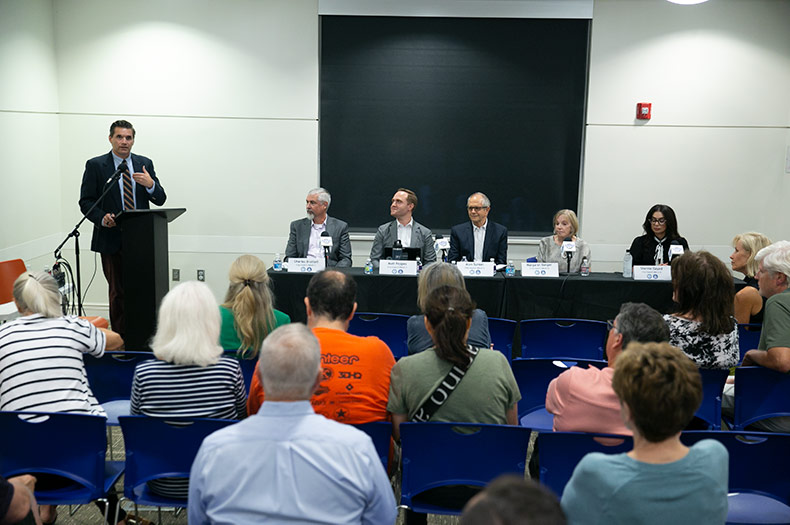
Brettell called out both mayoral candidates — Marc Elkins (who is on the county GOP’s list) and Steven Hentzen (on the Democratic list) — as well as another Democratic-aligned candidate running for city council in Ward 2, Sherrie Gayed. In turn, Brettell praised Republican-supported Ward 2 city council candidate Margaret Berger.
That post, he said he found out later, was in violation of an agreement with the Democrats that he would not slam fellow Democrats or publicly support a Republican running against a Democrat. That pledge is new this year.
Brettell could have taken down the post but chose instead to issue a press release announcing he would “sever ties” with the party after being warned that he might be removed from the Democratic list.
The conflict was over housing comments
Brettell identifies himself as a “change” candidate and said he was especially bothered by comments about affordable housing from Hentzen during the Post’s forum. Brettell said he couldn’t stand with a party that expects him to support Hentzen.
“I can no longer in good conscience stand with a party that condones the callous attitude of its mayoral candidate who feels our longtime, elderly residents should simply leave if they cannot afford to live in our city,” Brettell said in the release. “Nor will I give fealty to the Party over the citizens of our City where I feel those interests diverge – like supporting a Democratic Party candidate simply because of her party affiliation.”
Hentzen had said during the forum he wants to preserve Leawood as a “luxury lifestyle” city. “If you want affordable, it’s a skinny little city. Just jump on either side. We want to keep the luxury,” he said.
In response to Brettell’s announcement that he was cutting ties with the Democrats, Hentzen explained that he did not support providing property tax breaks to certain populations, including the elderly and lower income people.

“It’s just not an affordable housing kind of city. We’re not going to build affordable housing. I understand the need for it. I support it. But I don’t think subsidized housing belongs in Leawood,” he said.
Brettell also went after Democratic-supported candidate Gayed, calling her “part of the problem” and threw his support behind her opponent, Berger.
Gayed, for her part, said in response to the Post’s questions that she remains excited to run and is focused on her race. She urged voters to research candidates in their wards.
Partisanship has become a talking point in other cities
The pledge to only support Democratic candidates also has not sat well with Overland Park City Councilmember Faris Farassati, who is running for re-election against challenger Inas Younis.
Farassati chafed at the new agreement not to criticize the party’s other candidates and ultimately opted to forgo Democratic support rather than sign it. Hence Younis, not Farassati, is on the Democratic list for Ward 5 this year.
“They wanted us to sign away essentially our freedom of expression rights,” he said. “Serving the people the right way and supporting the right candidates for me is a concern that is ahead of loyalty to any party.”
He added that he has support from both Democrats and Republicans in the city.
For her part, Younis on her campaign website touts the endorsements she has received from a range of elected officials and public figures, including from the other current Ward 5 City Councilmember, Sam Passer, former Overland Park Mayor Carl Gerlach and former state representative Joy Koesten.
A question of party affiliation also came up during the Post’s forum for Fairway city council candidates last month.
All four candidates – Jason Rogers and Lee Story in Ward 1 and Jonalan Smith and Jerry Williams in Ward 2 – emphasized that it’s important to keep partisan politics out of municipal elections.
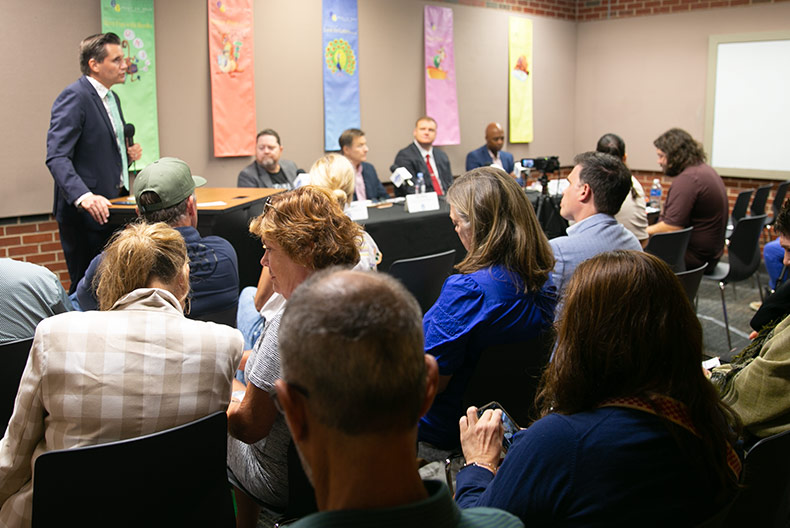
“Partisan politics have so infected every part of our society we have to do everything we can to make sure we keep that out of city government,” Story said.
On a follow-up question, all four men were asked if they were on either of the parties’ lists.
Only Williams in Ward 2 owned up to being on the Democratic list but he qualified it by saying he had only recently become aware of it and is not sponsored by the Democrats.
However, all three other men are also on party lists this year: Rogers and Smith on the Republican one, and Story on the Democratic one.
Prairie Village housing debate sparks partisan rift
In Prairie Village, the political parties’ lists reflect deep divisions that have emerged in that city over the past year as Prairie Village debates how it should address rising housing costs.
Six city council candidates who are each running on a platform opposed to proposed changes to zoning or density in single-family neighborhoods have all been included on the county GOP’s list.
Five other candidates, including four incumbents who all voted for a series of housing recommendations meant to address housing affordability, are all on the Democratic Party’s list.
But some candidates are trying to make the case that the housing debate crosses party lines.
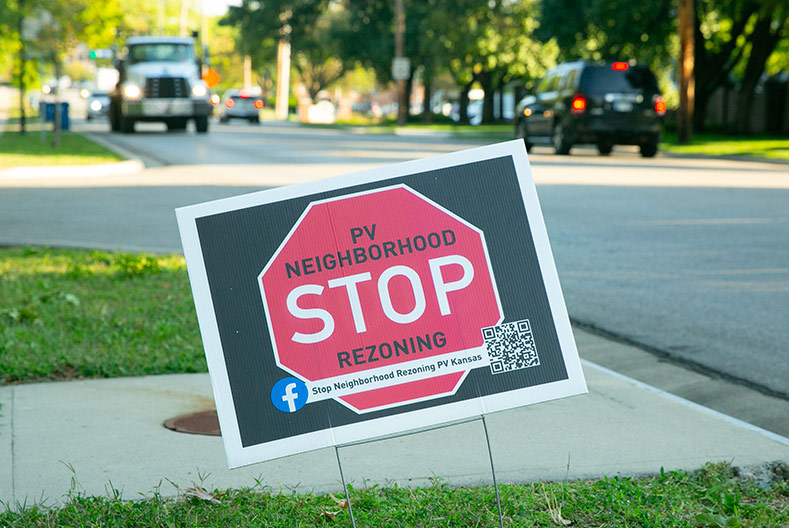
On her campaign website, Ward 3 candidate Lori Sharp, who has been leading the opposition to the city’s housing recommendations, touts her campaign as “nonpartisan” and above the “petty squabbles in Topeka and Washington, D.C.”
Campaign mailers for Sharp recently sent out to some Prairie Village residents also say she is “supported by key Democrat leaders.”
Still, she appears on the county Republican Party’s list of endorsed candidates, while her opponent, Councilmember Bonnie Limbird, is on the Democratic Party’s list.
In response to the Post’s inquiries for this story, Sharp said she didn’t ask to be on the county GOP’s list and has had “no communication with them.” Furthermore, she promised “several former Democrat elected officials” would be publicly endorsing her next week.
“I’m running my own campaign and don’t believe partisan politics has any place at city hall,” she said in an email Tuesday.
Deann Mitchell, the Johnson County Democratic Party chair, said Sharp is “not in any way supported by the Johnson County Democratic Party” and added that she was not aware of any Democratic leaders who support Sharp.
Meanwhile, Brettell, the Leawood city council candidate who disavowed Democratic Party backing, weighed in this month on the Prairie Village races, wishing “good luck” to the six GOP-backed city council candidates on his Facebook page.
“We’re fighting a different fight down here in Leawood, but similarly want more control in the hands of our residents and less in the hands of our Lords & Ladies of the City Council,” Brettell wrote. “I feel like it’s a pretty good sign that I’m on to something if both parties and the establishment are freaking out like they are.”
The parties’ have similar process for including candidates
The party recommendation lists are nothing new in Johnson County local elections. Both parties have been doing them for years and both have similar processes for including candidates’ names.
A candidate who registers as a Republican or Democrat is offered help after filing for an office.
For the GOP, every registered Republican candidate in good standing gets the opportunity to upload their campaign assets to the county Republican Party website and be listed on the party’s voter guide, said Maria Holiday, county chairwoman.
Candidates are only approached after they’ve filed for office, she said.
For Democrats, the process is similar. County party chair Mitchell stressed that candidates must opt in to be included on the list. Some candidates, for example, may have employers who forbid them to advertise with political parties.
The other side of the bargain is that — Democrat or Republican — the candidates on the list are expected to support the other candidates on the parties’ lists.
“Republican candidates are expected to uphold our platform,” Holiday said in a written explanation. “It is expected that Republican candidates will support Republican candidates in races other than their own.”

Party officials say the lists help voters make choices
Neither party makes specific demands on how candidates should vote on city policies, if they are elected.
Holiday and Mitchell both said there’s room for disagreement on policies, with Mitchell adding, the party just asks they support its mission to elect Democrats.
Both party leaders say their candidate lists are a service for voters.
“Voters, in my experience, want to know what candidates share their values, and the easiest way to determine that is to look at party affiliation,” Mitchell said. “Does that mean they’re going to line up on everything? Unlikely.”
Holiday called the party lists a transparency issue.
“There is no such thing as a nonpartisan race. Just races that lack transparency for the people. Candidates come from a belief system and that should be made available to voters,” she said.
“Nonpartisan races have a habit of making some candidates pretend to be something they are not to try to appeal to everyone. This is unfair to voters,” she continued.
Alexandra Middlewood, political science department chair at Wichita State University, said the party lists are very common and helpful to voters as a mental shortcut so they can make judgments when information may be lacking.
The candidates also benefit from party help, she said.
“So it is unsurprising that a Democratic candidate in a nonpartisan race calling out other Democratic candidates in nonpartisan races upset the local Democratic Party who want their candidates to get elected and not publicly clash with each other,” she said.
Roxie Hammill is a freelance journalist who reports frequently for the Post and other Kansas City area publications. You can reach her at roxieham@gmail.com.
Post editor Kyle Palmer also contributed to this report.