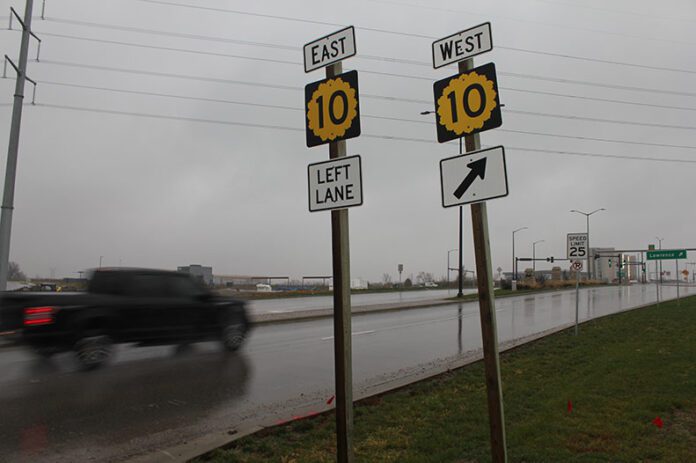
A plan to make Kansas Highway 10 safer and less congested — with options for road widening, an added express toll lane and overpasses or interchanges at Clare and Lone Elm roads — was presented to county commissioners last Thursday as part of a process that state highway officials estimate will result in a decision a year from now.
Changes to the highway corridor running from the Douglas County line to Interstate 435 in Johnson County have been studied since May 2005. But rapidly increasing growth along the 16-mile corridor has brought about a new urgency among state and county officials.
The corridor improvement timeline was presented to commissioners with proposed solutions to be offered in spring 2024 and design and construction work to begin as early as the fall of 2024.
How bad is K-10 traffic congestion now?
While traffic counts on the western end of the corridor are at about 30,000 vehicles per day, the eastern portion from roughly Renner Boulevard to I-435 sees traffic exceeding 80,000 vehicles per day, said Cameron McGown, director of the project for engineering firm HNTB.
As a result, there are currently moderate and severe areas of congestion from K- 7 to I-435.
If nothing is done, the traffic tie-ups could become uniformly severe on that stretch by 2050, with moderate slow-downs reaching as far west as Kill Creek Road.
The corridor also has several problematic bridges with weight restrictions or lacking vertical or high-water clearance, said Steven Cross of the state department of transportation.

Several options to fix congestion are on the table
Highway officials are looking at a number of options which focus on the eastern part of the corridor closest to its junction with I-435 in Lenexa.
The idea with perhaps the highest visibility is to add a tolled express lane similar to what’s being done on U.S. Highway 69 in Overland Park.
The two existing lanes would remain free, but drivers in the express lane would be charged, possibly with technology similar to K-tags in use on the Kansas Turnpike.
But there are other options as well. For example, the highway could be widened without toll or metered entrances, and message boards about traffic could be used.
Another possibility is enhancing alternative routes that would get traffic away from the most heavily traveled eastern end, McGown said.
Overpasses or interchanges at Clare Road could improve access by connecting areas north and south of the highway, McGown said. Lone Elm Road also currently dead ends at K-10 on both the Lenexa and Olathe sides.
The county has yet to make any decisions
Commissioners asked questions last week but took no action during the informational meeting.
Commissioner Janeé Hanzlick asked whether the state had considered HOV (high-occupancy vehicle, sometimes known as car-pool) lanes. In cities that use them, HOV lanes are meant to decrease vehicle traffic by requiring a certain number of passengers.
McGown said that option was considered for U.S. 69. The problem is that if usage is low, the cost of enforcing it outweighs the benefits, he said.
Commissioner Becky Fast asked whether the changes could have a negative impact on development as drivers try to avoid the tolls.
McGown responded that most of the area under consideration is already developed. He also pointed out that two of the lanes each way will remain toll free.
Highway officials are planning extensive community outreach with focus groups, public information meetings and surveys as well as social media posts.
You can keep track of them at the K-10 corridor project page.
Roxie Hammill is a freelance journalist who reports frequently for the Post and other Kansas City area publications. You can reach her at roxieham@gmail.com.