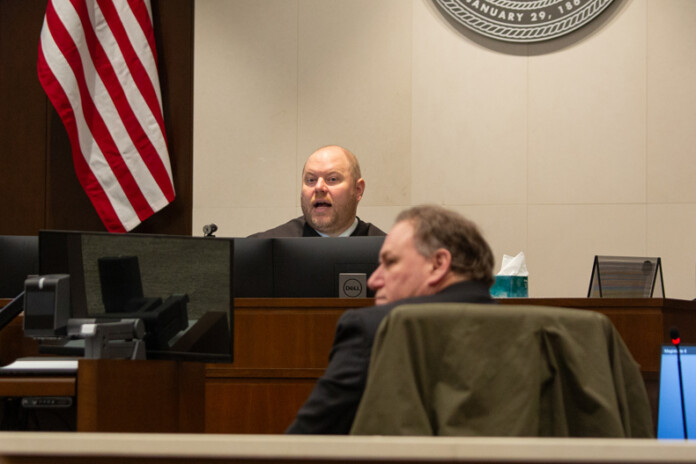
The mood is somber in Magistrate Judge John McEntee’s on a recent Friday morning. It’s 8:30 a.m. and the courtroom is filling up. Waiting on hard wooden pews are people, many of whom have fallen thousands of dollars behind on their rent and are now wondering where they will go next.
Also in attendance are their landlords hoping to either get their rent checks or their property back.
“This is your opportunity to determine your future,” McEntee says, as he begins to explain the rules.
The tenant and landlord for each case will be assigned an impartial, court-certified mediator. They will be sent to individual conference rooms down the hall to work out some arrangement that both landlord and tenant can manage.
The mediators are not to show favoritism, McEntee explains. Everyone has until 11 a.m., when the courtroom is booked for other purposes.
An experiment with early success
McEntee’s eviction mediation courtroom is still a relatively new experiment for Johnson County. Its purpose is to find compromises between landlords and tenants in rental disputes, most of which involve non-payment.
The hoped-for byproduct of those compromises is fewer judgments that go on a tenant’s credit record and can send them toward homelessness, says Commissioner Becky Fast, who was instrumental in getting the court started.
The county commission originally approved a three-month run for the court as a pilot project. But it has proved so successful since it began in September that its time frame was extended to the end of 2024. There’s even talk of making it a model for other courts in Kansas, say some of the people involved with mediation.

“Not a move out — a get out”
Avoiding a default judgment is difficult, given the deadline structure of eviction in Kansas. Compared to other states, Kansas has an accelerated eviction process, McEntee said.
Here’s an example of how it works in a typical case where rent is not paid on time:
- After the due date and whatever grace period the landlord allows has passed, a notice is posted on the apartment or house door demanding full payment in three days.
- Three days later, if rent is still outstanding, the landlord can file suit for eviction of the tenant, payment of the back rent or both.
- If the tenant disputes the landlord’s claim, a trial is ordered to take place within 14 days. If the court rules for the landlord, the tenant could be removed in another 14 days.
- If there are no delays, the whole process is designed to be complete in no more than six weeks.
“We don’t have a lot of time to do anything,” McEntee said. The first decision the court makes is whether the tenant has the right to remain on the property. If the tenant loses, a sheriff’s deputy will show up on the doorstep to remove the tenant.
“I tell them this isn’t a move out. It’s a get out,” McEntee said. At that point, “you’re getting your purse, you’re getting your wallet, your car keys and your kids. You’re not getting your furniture, your clothing or anything else. Many times the landlord is standing right there and they’re changing the lock on the door so the tenant cannot go back in.”
The pain for tenants doesn’t end there, though. A court judgment for money owed can have a negative impact on credit reports for about seven years, McEntee said. Being evicted stays on a rental history, making it tough — if not impossible — to find another rental.
Commissioner Fast pointed out that according to a recent point-in-time study of people experiencing homelessness by United Community Services of Johnson County, recent evictions were a factor in their loss of a home 23% of the time.
A deck stacked for landlords
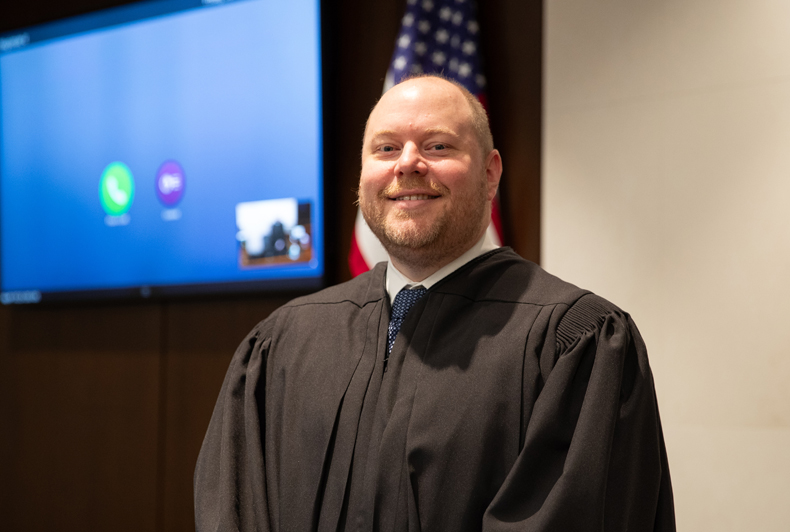
McEntee started handling evictions when he became a judge about a year ago. What he saw distressed him.
Landlords would usually have a lawyer when they came to the court. Not so the tenants.
After the first couple of dockets explaining the law and timeline, “I was realizing that it’s January and I am giving people no option and having them removed from these properties,” he said.
So McEntee started an informal mediation process before trial, asking landlords and tenants to go outside the courtroom and see if they could come to any arrangements.
Most of the time they did, he said. But in many cases, the arrangements devised with the landlords’ attorney’s help were not much different than what would have happened in a trial anyway, he said, with the tenant forced out in a narrow window of time. In some cases, tenants asked for a trial just to buy a few extra days and in others, they agreed to an eviction because they didn’t know another option.
As it happened, the judicial, social service and elected officials were beginning to converge on the eviction issue at the same time. An ad hoc committee of the Kansas Judicial Branch studied it and made voluntary eviction mediation one of its recommendations.
The COVID-19 pandemic also brought the issue into sharper focus when the Kansas Emergency Rental Assistance program ended last year.
Late last spring, Fast reached out to McEntee and others in social services about finding some way to improve the system in which a car breakdown or missed paycheck can result in homelessness, McEntee said.
Johnson County gets 2,200 to 2,600 cases a year, said McEntee, whose court handles every one. The county is responsible for about one-sixth of the evictions in the state. Add Wyandotte and Sedgwick counties, and that comes to two-thirds of the state’s evictions, he added.
Evictions dropped during the pandemic due to the rental assistance. But now they are back up to pre-COVID levels, he said. McEntee added that he sees no people evicted in Johnson County bouncing back for repeat evictions. “Most of the people, life has just caught them in a bind.”
Commissioner Fast convened judicial and other stakeholders interested in housing issues to brainstorm a mediation court. What’s been implemented has so far proved to be an unqualified success.
How the new eviction court works
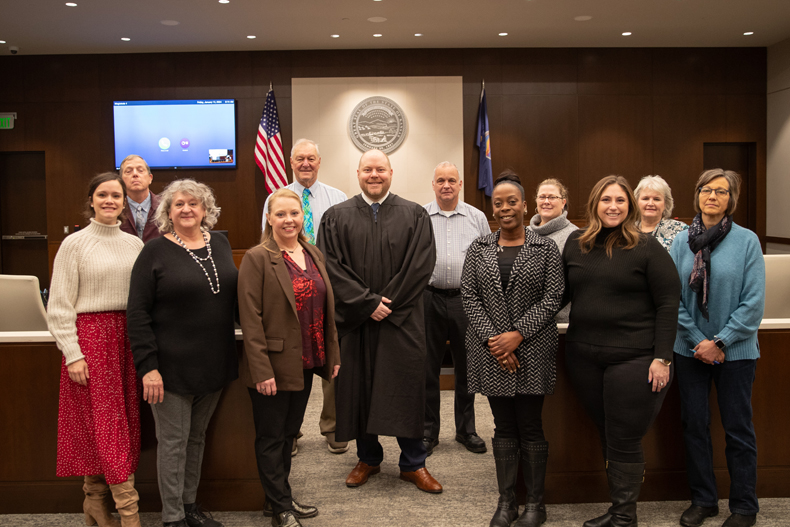
The new eviction court has some important differences from McEntee’s informal mediation sessions. The biggest one is the impartial, court-certified mediator who oversees the negotiations between landlord and tenant.
At first, there was some skepticism, but as the system has been in place, there’s been more willingness to bargain so the court judgment stain on rental and credit records can be avoided, said retired Judge Robert Scott, one of the mediators. Increasingly, landlords are willing to let the tenant try to pay off what is usually thousands of dollars in back rent through a series of smaller payments or some other arrangement, he said.
The mediation can get the job done with less money, hassle and time invested, he said. It also removes some of the emotion from the process.
“For landlords, now you’ve got someone else standing in there. For tenants, you’ve got someone coming in and they actually have a breath of hope that they can work something out,” Scott said. They may not be able to stay on the property, but they might avoid that black mark against them and have a chance to find another place to stay, he added.
The new court has so far had clear success. From September through all but the last couple of weeks of 2023, there were 67 cases referred to mediation. Out of those only six resulted in a judgment, McEntee said.
“To say that we are having very good success is accurate. It’s probably phenomenal but I don’t want to use that word. I feel it’s phenomenal, personally,” he said.
Fast was ecstatic during a commission meeting in November, when the decision was made to allocate $134,000 to extend the program through the end of 2024.
“I just want to jump for joy,” she said.
The next step is to find out why people are falling far behind on rent and begin to point human services and health resources toward early help with the problems, Fast said. The county health department is beginning to compile data on that, gathered from a survey of tenants in court.
Evictions are on the radar of local governments throughout the area, McEntee said. Sedgwick County has a mediation program that is voluntary so it has limited participation. Wyandotte County is also considering one, he said. “A lot of people outside our county and state are watching this,” he said.
Mediation comes to Johnson County at a time when awareness has been increasing across the river due to the work of groups like KC Tenants, Scott said. Commissioners were wise to look at the problem, “before we start getting that much front page news,” he added. “Just because we didn’t have the front page news here didn’t mean we didn’t have numbers similar.”
Other court success coverage: Overland Park combat veteran feels ‘redeemed’ by county Veterans Treatment Court program
Roxie Hammill is a freelance journalist who reports frequently for the Post and other Kansas City area publications. You can reach her at roxieham@gmail.com.