County commissioners did not violate the state open meetings law when they went into closed session to talk about the pay of three of the county’s top executives last summer, the Kansas Attorney General has ruled.
However, there was a pattern of technical shortcomings with the motions commissioners used to go into executive sessions on that and other occasions, wrote Assistant Attorney General Amber Smith in a letter dated April 12.
As a result, the commission must take some remedial steps to correct those problems.
A commissioner filed the complaint
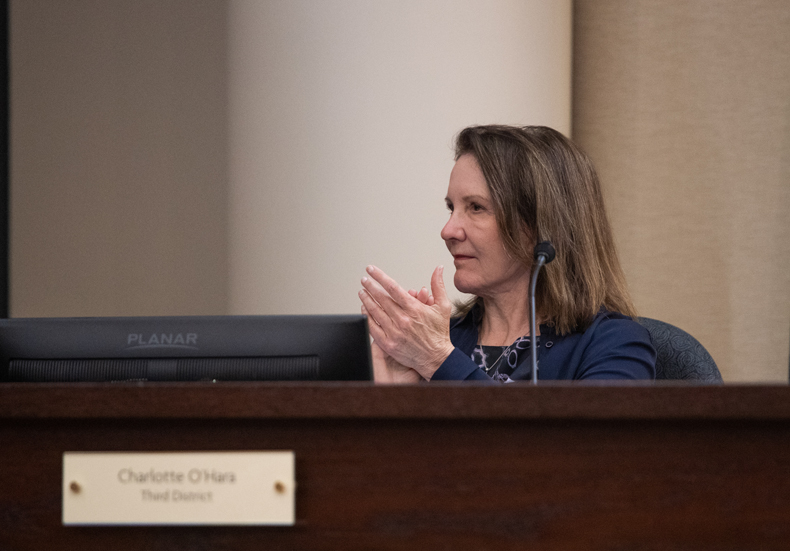
The opinion was requested in a complaint filed by Commissioner Charlotte O’Hara last August.
It stemmed from a meeting June 29, 2023, during which commissioners used an executive session to discuss the pay of County Manager Penny Postoak Ferguson, Chief Counsel Peg Trent and County Auditor Harry Heflin.
The session came as commissioners were making market adjustments to employee pay tables. Heflin and Trent are included on the pay table, but Postoak Ferguson’s pay is determined by her contract.
The executive session was called just before a vote on the adjustments, sparking concerns from O’Hara, and commissioners Becky Fast and Michael Ashcraft, who all voted against going into closed session.
AG’s report noted “technical violations”
The attorney general’s report focused on whether commissioners used the closed meeting to talk about policy, which is a prohibited use of a closed session under Kansas law.
The AG’s office found that although the executive session last June included references to the pay tables, they were generally brief and related to the pay of Haflin, Postoak Ferguson and Trent.
Although there were some inconsistencies in evidence, “it is clear that the executive session discussion included information, facts and details specific to individual performance,” Smith wrote.
However, the AG’s investigation into meeting recordings and minutes from 2023 turned up some smaller, recurring problems that were not included in O’Hara’s complaint.
Those problems were labeled “mere technical violations” that did not affect the public’s right to know.
“Notwithstanding this conclusion, however, the pattern [italics Smith’s] of deficient motions shows a need for remedial action,” Smith wrote.
What should the commission do differently?
The commission routinely went into closed session without adequately stating what they were going to talk about, and improperly combined different discussion topics into one motion, which is not allowed under the Kansas Open Meetings Act, Smith said.
Commissioners also should have made a complete motion before voting to extend the executive sessions, Smith wrote in her opinion.
Rather than simply voting to extend the session, commissioners should have given the subject matter, justification and place of the meeting, the opinion said. That way the public knows the reason for the closed session and what will be discussed.
“It is easy to see how falling into the habit of merely ‘extending’ executive sessions increases the risk of negatively impacting the public’s right to know,” Smith wrote. “This is a red flag the commission must heed to ensure it remains compliant with the (open meetings law).”
The commission did comply with other requirements, even though the motions were technically deficient, she wrote, and there was nothing to suggest that other unallowed topics were discussed during the extensions or that there was any attempt to deliberately evade the open meetings law, the opinion said.

Commission received open meetings training
There won’t be formal action against the commission, but the AG’s office asked for at least one hour of open meetings training within 45 days of the opinion.
That training already happened on April 25, said county spokesperson Andy Hyland.
O’Hara said she was happy with the guidance from the attorney general and with the information shared at that training.
“Clarity on receiving information only and not making decisions in executive sessions will be tightened, in my opinion, due to this training. A very positive outcome for the good folks of Johnson County,” she texted the Post in response to questions about the AG office’s opinion.
The commission also must provide documentation of that training, a copy of training materials for the attorney general’s review and a protocol for transparency on executive sessions in the future.
Once those requirements are met, the case will be considered closed, Smith wrote.
 Thanks for reading! If you value having an independent news outlet keeping tabs on local government, schools and taxes, we're asking you to contribute to our Education Reporting Fund.