About 22% of signatures collected in Johnson County last year on a petition aimed at declaring No Labels an official political party in Kansas were rejected after a review by county election officials.
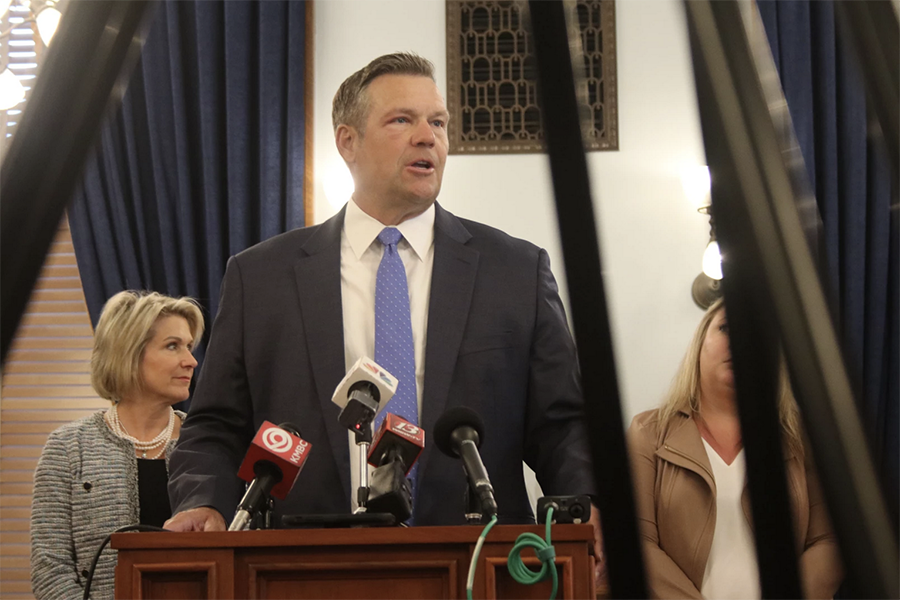
It’s not clear whether some of those 1,784 rejected signatures will be used as evidence in cases pending against two paid petition circulators that Kansas Attorney General Kris Kobach is pursuing.
At least one of those cases has been filed in Johnson County District Court, and the high number of problematic signatures on the petition may be a reason the county will be a venue for the case.
Still, more details about the legal case against the two petition circulators have been hard to come from both state and county officials.
Kansas AG announced charges against two signature gatherers
Kobach has announced that two Florida residents have been charged with multiple counts of forging signatures on a petition that certified No Labels as a political party that could put candidates on the ballot.
According to press releases from Kobach’s office, George Andrews III and Jamie Johnson, both of Dade City, Florida, are each charged with multiple counts of election forgery and election perjury.
Kobach announced in February that Andrews had been arrested in Florida on two counts of election perjury and 28 counts of election forgery. At that time, Kobach said Andrews would face the charges in Johnson County District Court, pending extradition.
Kobach made a similar announcement last week regarding Johnson, who the AG’s office said is being charged with one count of election perjury and 18 counts of election forgery and is also set to appear in Johnson County District Court, pending extradition from where she was taken into custody in Nebraska.
No case files available at JoCo District Court
Press releases aside, details about the two cases have proved difficult to come by.
Neither shows up in a search of current cases at Johnson County District Court, but a court official confirmed a case number provided by the attorney general’s office for at least one of the cases.
Johnson County District Attorney Steve Howe said his office is not involved in the prosecution.
The attorney general’s office has not yet responded to an open records request seeking more information about the charges against Andrews and Johnson.
What is No Labels?
No Labels bills itself as a bipartisan centrist movement seeking common ground and avoiding extremism in politics.
The group had sought to run a third-party presidential candidate and was officially recognized as a political party in Kansas through a petition earlier this year.
The party dropped its national presidential efforts this spring after it failed to attract a high-profile candidate to challenge the two main parties’ presumptive candidates, Democratic President Joe Biden and former Republican President Donald Trump.
Still, the group has been in the news in Kansas over the past week for another controversy after a Republican strategist elected himself chairman and nominated two candidates — a Democrat and a woman who said she did not consent to be a candidate — to Kansas Senate seats.
Kansas Secretary of State Scott Schwab rejected those nominations and has referred the matter to the attorney general’s office for criminal prosecution.
JoCo rejected more than 1,700 No Labels signatures on local petition
No Labels needed to gather signatures statewide equal to 2% of the total votes cast in the 2022 state gubernatorial race — or more than 20,000 total — in order to qualify as a political party in Kansas.
The cases against Andrews and Johnson appear to be centered on signatures gathered and allegedly forged in Johnson County.
Once petitions are submitted to the county election office, they are examined in much the same way as mailed-in ballots, said Johnson County Election Commissioner Fred Sherman.
Election workers look at whether a petition signer is registered to vote, that the signature can be verified and that the signer is qualified to vote on the issue at hand. For instance, a resident of Lenexa would not be able to vote on an Overland Park city question.
County election officials then accept or reject the signatures.
In the No Labels case, the Johnson County Election Office accepted 6,257 signatures, rejected 1,784 and left 19 as “pending.”
The signatures are then sent on to the Secretary of State’s office to be reviewed again.
If those reviewers see something questionable — such as a high number of rejected signatures — the office can alert the attorney general’s office to investigate.
A Kobach press release credited Schwab’s office with forwarding information, although it did not say whether the Johnson County signatures specifically were included as evidence against Andrews and Johnson.
Petition signature gatherers can be paid for their work
Since it can be hard to find enough volunteers to ask for signatures in a statewide campaign, organizers commonly turn to companies that pay petition circulators to gather signatures.
No Labels strategist Ryan Clancy told the Associated Press that the Kansas cases involved a subcontractor of a former vendor.
Petition circulators in Kansas are supposed to witness the signatures they collect and must sign an affidavit attesting to this. But they are allowed to get paid for their work.
In many cases, circulators get paid per signature. This has been a problem in some states because of the perceived incentive to forge signatures. In Michigan two years ago, five Republican candidates were removed from the ballot due to fraudulent petition signatures.
Kansas allows payment per signature, but some other states – mostly those with statewide ballot initiatives – have begun to crack down.
According to Ballotpedia, nine states with ballot initiatives have banned payment per signature, with Arkansas and Utah being the most recent. The Arizona Supreme Court last year ruled that state’s ban is constitutional.
A check on ZipRecruiter shows petition circulator jobs in the neighborhood of $15 to $25 an hour, with some advertising an added commission or per-signature rate.
A look at affidavits of signature collectors filed with the Kansas Secretary of State office shows few, if any, from Kansas.
Many were from Florida, but circulators also came from Colorado, California, Nevada, Texas, Oklahoma, Arizona and Arkansas, among other states.
 Thanks for reading! If you value having an independent news outlet keeping tabs on local government, schools and taxes, we're asking you to contribute to our Education Reporting Fund.