Editor’s note: This story has been updated to include comments from AG Kobach’s office and additional comment from Jennifer Williams.
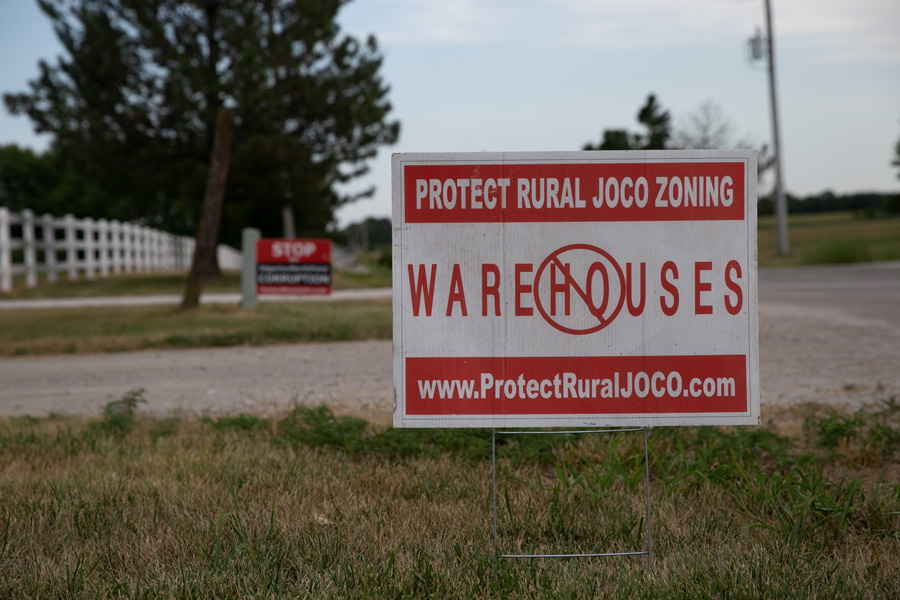
Rural neighbors of a massive warehouse project near 199th Street and Gardner Road have lost a court case that sought to declare the city of Edgerton’s 2020 annexation of more than 600 acres near their homes illegal under Kansas’ “narrow corridor” law.
Johnson County District Court Judge David Hauber issued a ruling Wednesday in favor of the city of Edgerton, delivering a disappointment to neighbors who have been fighting the NorthPoint warehouse development for five and a half years.
“It’s disappointing, obviously, when citizens have waited this long for a decision and fought so hard to protect our homes,” said Jennifer Williams, one of the residents and organizer of Protect Rural JoCo, which has been fighting the annexations. But she said there’s still an opportunity for appeal, noting that Hauber has been overturned in the past.
Kansas AG Kobach sued Edgerton on behalf of residents
The suit was brought by the state Attorney General Kris Kobach’s office on behalf of the residents, who had failed previously when a different judge said they lacked standing to sue. The attorney general’s office has not indicated whether it will pursue an appeal.
In a press release Wednesday, Edgerton officials said the city “scrupulously follows the legal requirements for annexation and zoning of property in its jurisdiction.”
Mayor Don Roberts was quoted in the same release: “Edgerton has followed and will continue to follow state laws regarding annexation. The Attorney General’s suit was without merit and we’ve known that for years. I’m happy to see this wasteful abuse of taxpayer dollars finally come to an end.”
Below is a full copy of the judge’s ruling.
 Loading...

 Reload document
  Open in new tab
 On Monday afternoon, Spencer Taylor, first assistant attorney general, said Kobach’s office is planning to appeal the decision. Below is Taylor’s full statement:
“Recently, Judge David Hauber of the Johnson County District Court ruled in that the narrow corridor touching at only 13.2 feet that connects the City of Edgerton to 600+ acres of land held by NorthPoint Development, LLC, the nation’s #1 industrial developer, did not in fact constitute a narrow corridor. The State believes that this finding is not supported by the evidence presented at trial or the law.
“Allowing narrow corridors of this type opens the door to potential development of industrial and other uses anywhere throughout rural Johnson County and in Kansas generally. Judge Hauber’s decision threatens farming, rural lifestyles, orderly development, and land values. Farms next to warehouses is the consequence of Judge Hauber’s decision.
“Attorney General Kris Kobach plans to appeal this ruling expeditiously to protect the people of Johnson County and of the State of Kansas. The rule of law is threatened by rulings of this type.”
Williams, the resident, said she was pleased Kobach’s office will appeal.
“Without the narrow corridor peninsula access, we would have had an island annexation public hearing, and the decision would have been made by the residents’ elected representatives at the County Commission, and not by a city council in a neighboring city who are buffered from the industrial park and were not elected by the residents who were harmed by the city’s actions,” she said in an emailed statement to the Post.
Land annexed through mutual consent of city and company
The court case is the culmination of years of legal wrangling that had its roots in a 2019 series of land sales that brought NorthPoint land east of Gardner Road into contact with the Edgerton city limits.
The company then sought to have 600 of its connecting acres to the south annexed to Edgerton, which could then rezone it for warehouse use.
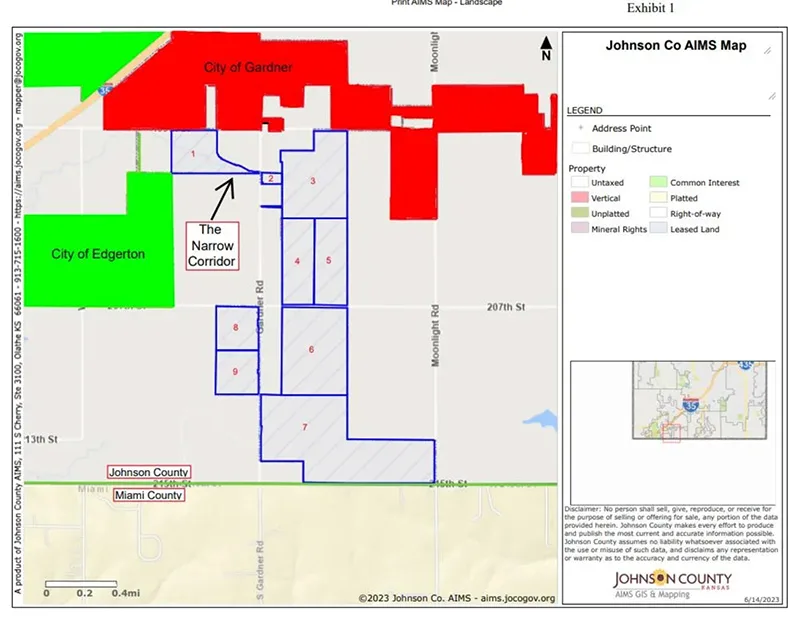
Rural residents near the project said they were blindsided because NorthPoint officials bought the land under the names of agricultural affiliates that offered no hint of their warehouse plans.
They objected further because the “consent annexation” process allowed the city to absorb the land under mutual consent with the company.
Consent annexation can proceed without the exacting legal notification and hearing requirements in other types of annexations.
Neighbors objected, saying the process shut them out, even though they would be affected by the warehouse traffic and noise. Since they were not within the city limits themselves, they also could not express themselves at the ballot box, they said at the time.

Arguments came down to one parcel of land
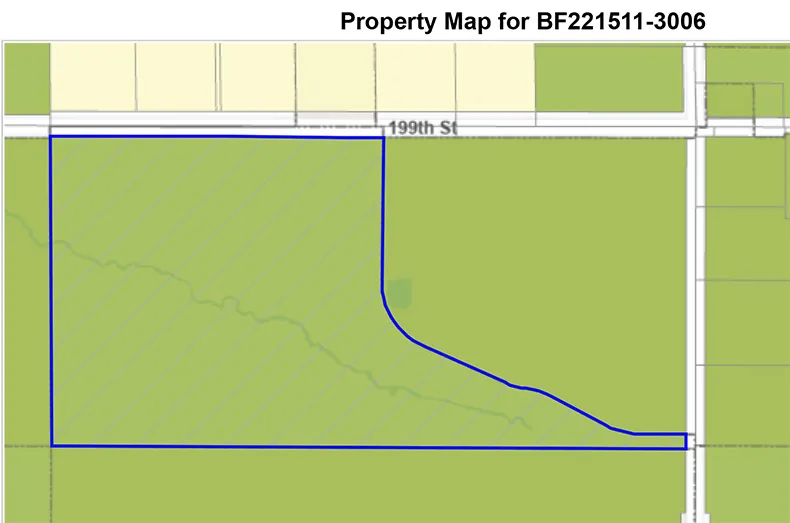
During a three-day trial this summer, Hauber made it clear that he would focus on the question of whether the boot-shaped piece of land was actually a narrow corridor, which is expressly forbidden by Kansas law.
Under state law, strips of land like the boot-shaped land at the heart of the trial must have tangible value beyond setting up the annexation.
Edgerton City Attorney Todd Luckman had argued in the trial that the piece of land may have had value to developers because of the potential for running sewer and utility beneath Gardner Road, where the two parcels met.
Below is an image of the boot-shaped parcel of land, which Kobach’s office argued was a narrow corridor as forbidden by state law, while the city described it as a triangle allowable under state law.
In his ruling, he acknowledged that the legislative language on a “narrow corridor” is vague, but concluded that the connecting piece of land in Edgerton did not align with previous court cases in which the connecting land was valueless, or with legislative comments on “snake annexations” when the law was passed.
“If the legislature wanted to expand the definition of ‘narrow corridor’ to include odd-shaped contiguous properties, it knew how to do so,” he wrote. “If it wanted to ensure that the touching was ‘substantial’ it also could have done so.”
Williams said she’s working with state legislators, the League of Kansas Municipalities and the Kansas Association of Counties to come up with a clearer wording, “so other homeowners aren’t put into the position of having to spend so much money out of their pockets.”
The neighbors would have been better served by another type of annexation that allowed the neighbors a voice, she said. “If they can’t find better wording, maybe at some point consent annexations aren’t (allowed because they are not) fair to surrounding neighbors because they don’t get a public hearing.”
Leah Wankum contributed to this story.