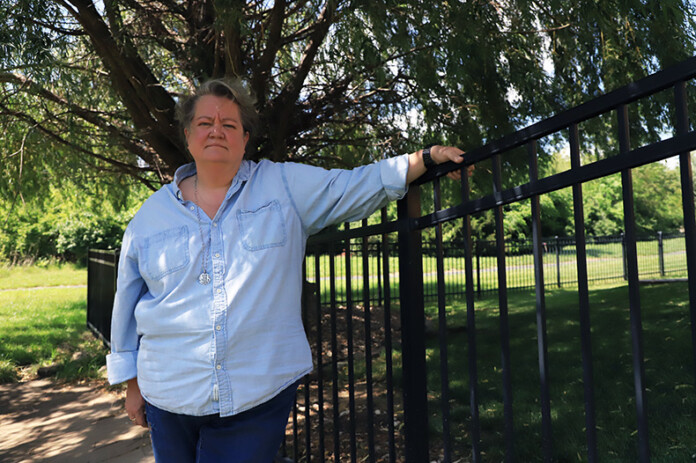
Two Olathe homeowners are continuing to seek a solution after their homes flooded again this summer, the latest incident in a years-long struggle over who’s responsible for fixing the problem in the College Meadows neighborhood.
As it happens, both Kate Guimbellot’s and Max Cook’s properties in the subdivision near College Boulevard and South Woodland Street suffered damage from flooding caused by heavy rains in July, just weeks before the city rejected the pair’s claims for damages from years of previous flooding.
Guimbellot and Cook filed tort claims, a type of civil claim that alleges one party harmed another, paving the way for possible compensation. The claims were filed after three floods at Guimbellot’s property between 2017 and 2024, which she says have cost her and her family at least $15,000, and another flood at Cook’s property.
Both families fear flooding will keep happening until the local stormwater system is fixed.
“That makes two families at two different locations experiencing the same catastrophic failure,” Cook told the Olathe City Council meeting on Sept. 2. “I am immediately downstream from Kate’s flood problem. It’s even more telling that this is not an isolated incident. It’s systemic.”
The city maintains that the original developer of the subdivision, Ron Vanlerberg, bears the responsibility to fix the system, which was built incorrectly on top of faulty calculations, according to a 2022 study of the neighborhood conducted by HNTB at the behest of the city.
City rejected tort claim in August
The city officially denied Guimbellot and Cook’s tort claim Aug. 8, weeks after their properties flooded for the latest time.
“Based on the city’s investigation, the claim is denied. While the city is sympathetic to your situation, the claim and the underlying circumstances were not caused by the city. Additionally, please understand the city has an obligation to all its residents not to use tax dollars to fix a problem created by third parties not under the city’s control,” City Attorney Ron Shaver wrote in the city’s letter denying the tort.
The city declined further comment beyond the letter.
Guimbellot was not surprised when she got the letter, but she says she remains frustrated with the lack of action in her neighborhood. That frustration is made more acute by a $4.7 million stormwater improvement project in the nearby Briarwood neighborhood off 135th Street and Brougham Drive, which hasn’t experienced significant flooding.
“Frustration — that’s all there can be,” Guimbellot said. “It sounded as if it was an older brother saying, ‘You need to file a tort claim so that we can do something about this.’ That’s literally how it was presented. So, in good faith, we did it. And then, literally 120 days, four months, of nothing, only to then find out that it was the city lawyer who got to make the decision.”
A tort claim is required before a lawsuit can be filed in Kansas. During a period of 120 days, during which the claimant and the city cannot discuss matters pertaining to the claim, the city investigates the claim before making a decision.
Independent engineer finds issue with property’s design
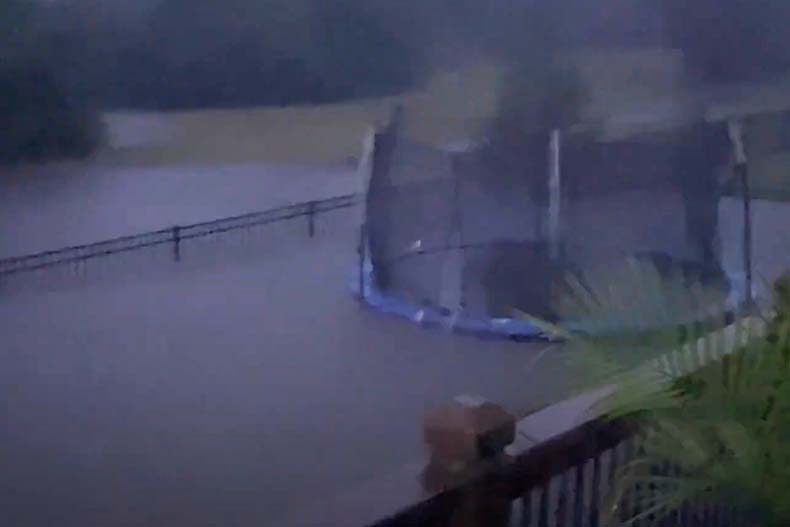
When her property floods, Guimbellot sees water reaching all the way up the top of her backyard fence, she says. She has also waded through ankle deep water in her basement, which leaves behind drain flies and mold concerns.
David Silverstein, an independent retired engineer who has worked for cities in Missouri, assessed the stormwater drainage system over the summer. He found the stormwater plans the city approved showed Guimbellot’s property was always designed to flood, and that a subsequent (and unrelated) widening of College Boulevard has exacerbated the problem.
Guimbellot’s home, as well as a neighboring one, should never have been developed, Silverstein concluded.
“The home is located in a former drainage way that receives runoff from nearly 100 acres upstream from the home,” Silverstein said at the Olathe City Council meeting Sept. 2. “A large inlet and 48-inch pipe were installed to convey the flow, but the pipe cannot handle the flow that it receives. During the major storm events, the inlet and pipe are overwhelmed and water floods the entire front and backyards of her home, up against the home — five feet deep before flooding across Race Street.”
The city-commissioned HNTB study from 2022 found that Guimbellot’s foundation contributed to the flooding issue. So, Guimbellot and her wife, Julie, paid half the cost for the foundation to be fixed in 2023. The home builder, Taylored Homes, paid the other half.
Their home flooded again in 2024 and, most recently, this July. Much of the repair work moving forward will be minimal, Guimbellot said, adding that it’s only “a matter of time before it floods again.”
Looking back and looking forward
The first two floods, which happened in 2016 and again in 2021, Guimbellot said could be explained by extraneous factors, including a 100-year flood event.
However, after repairing their foundation and raising their window wells, the more recent floods the last two years show a still-persistent pattern of poor drainage on the property.
Even during the flooding in 2021, Guimbellot said she noticed the water wasn’t pouring over the foundation but seeping up from the ground, suggesting her property isn’t draining properly.
After receiving the city’s tort claim denial, both Guimbellot and Cook say they have met with lawyers to discuss next steps, including possibly filing a civil lawsuit. In the meantime, Guimbellot said she’ll be at city council meetings, making her voice heard.
“It’s not about flooding,” she said. “It’s about accountability.”