By David Markham
A chance to learn more about the interconnectedness of trees with other living things and how dependent humans are on them is what drew Elaina Wendt Michalski to this year’s JCPRD Natural Resources Residency.
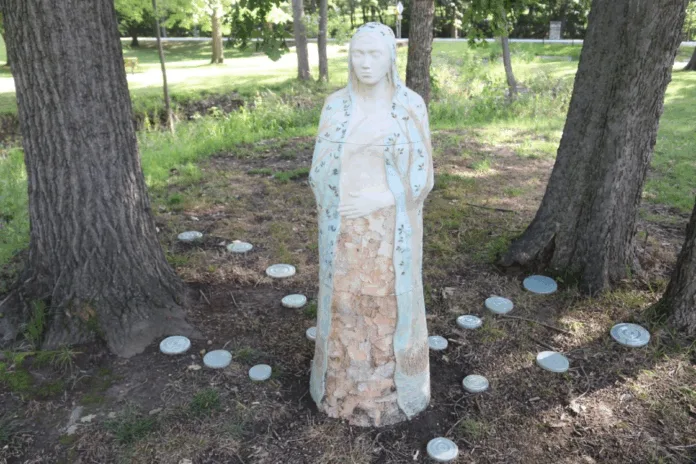
Since mid-April Michalski has engaged with the JCPRD Natural Resource Team for the residency, which this year focuses on the importance of trees within the regional ecosystem. In mid-July, she installed her resulting temporary artwork, “Between Earth and Sky” on the north side of the road just past the Helen S. Cuddy Rose Garden in Antioch Park, 6501 Antioch Road, Merriam. The statue, which fills a circular space in a small grove of six trees located about 75 feet from the main Access Road, will remain in place until the end of the year.
“I created a life-size standing figure of a lady, sort of wrapped in a cloak of trees surrounding her,” Michalski said. “And around her are a number of tiles that look like raindrops. I built the figure and the tiles out of stoneware clay, and they were fired to 2232 degrees Fahrenheit. On the surface of the figure, it’s got a lot of textures, with some soft colors that represents the trees and some leaves that are kind of shiny. The rest of it is sort of matte finished. At the bottom, it’s supposed to represent water, so you’ll see the trees, you’ll see the leaves that are kind of shiny, and then you’ll see the land, and you’ll see the texture of the roots sort of visually over the surface of the ground.”
Michalski said the figure isn’t meant to represent a particular woman, but she used visual references of Native peoples who would have lived in this area, including images of Kaw women. She added that she found it challenging to hand-build the figure and tiles over about six to seven weeks.
“Between Earth and Sky” intentionally relates to trees in several ways. There’s birch bark on the front the piece, and there are six trees on the figure’s back, which mirror the six trees of the grove in which the piece sits.

“It’s kind of like those trees are surrounding her, but she’s also connected to them within herself, so that’s kind of the feeling of being surrounded by trees, like how that feels,” the artist said. “I hope it’s meaningful to people. I hope that they can see the interconnectedness of nature and how we are inseparable from nature. A few years ago, an artist who was mentoring me said “if you can change people’s hearts, you can change their minds.” And that’s stuck with me over the years.”
JCPRD Natural Resources Manager Matt Garrett talked about why trees were selected as a topic for this year’s residency.
“Antioch Park is such a foundational park experience for so many people in Johnson County,” he said. “We think of it as more of like an urban parkscape, but those of us who work and recreate here know that there are herons here, and there are deer that are moving through this park. There’s a lot of natural resource ecosystem services that are really important. This is one of the largest green spaces in northeast Johnson County, and I think this really showcases the importance of this park and the importance of the mature trees in this park landscape. A lot of our previous projects have been out in forested areas and prairies where folks had to drive to the western end of the county. This will be a really accessible, engaging experience, so I think being able to tell the story of trees in northeast Johnson County is a really awesome experience.”
Beyond their natural beauty, trees play a large, and often unseen, role in water management.
“Trees, and especially native trees, are an important part of urban stormwater management,” said Johnson County Stormwater Water Quality Specialist Leslie Rigney. “Within an urban system, trees slow the amount of water that actually hits the ground, and their roots and a diverse understory also take up water and are able to create healthy soils that can store and filter stormwater as it enters into an urban system. A forested watershed can absorb and hold so much more water than an impervious watershed, which is a paved with lots of streets, lots of rooftops. So just imagine the difference between a forested watershed with healthy soils that can soak up water versus a watershed that’s primarily paved. So when we talk about urban tree canopy and urban stormwater, we’re trying to kind of mimic that natural watershed.”
A Kansas City native, Michalski holds a bachelor’s of fine arts in ceramics from the Kansas City Art Institute and a master’s in multimedia art from the University of Florida. Her sculptures are featured in Lark Books’ “The Figure in Clay and 500 Figures in Clay Volume II.” In 2022, she spent five weeks at the International Ceramics Studio in Hungary with a group of fellow artists, educators, and students. Her awards include a 2024 residency at Eureka Springs (Ark.) School of the Arts, a Charlotte Street Foundation Studio Residency in Kansas City, Mo., an ArtsKC Inspiration Grant, and a Park University Distinguished Humanities Faculty Award. She has taught studio art for the Metropolitan Community Colleges, Park University, Kansas City Art Institute, Rockhurst University, Paseo Academy of Fine and Performing Arts High School, and other non-profit arts organizations. One of her previous installations included highlighting unhoused youth as part of the Lawrence Outdoor Downtown Sculpture Exhibition.
This year’s residency is supported by the Johnson County Stormwater Program and The Parks and Recreation Foundation of Johnson County. Partners for this year’s effort that that specialize in this year’s subject matter include: Kansas Forest Service, Bridging the Gap, Heartland Tree Alliance, City of Overland Park Forestry Department, and the JCPRD Natural Resource Team.
Now in its fourth year, the art and natural resource residency program strives to fuse art and conservation to create curiosity and appreciation for the efforts required to create a more resilient ecosystem. More information about the residency and its outreach components can be found at JCPRD.com/1759.
JCPRD launched its Public Art Program in 2019 to activate park spaces in a new way. As part of this program, the short-term residency program engages local artists to embed with the JCPRD Natural Resources team to learn, respond artistically, and amplify the importance of this work. In 2022, Kirsten Taylor was selected as JCPRD’s first artist in residence, focusing on woodland restoration; specifically, the removal of the invasive species bush honeysuckle. In 2023, artist duo of Cydney Ross and Alix Daniel was selected to focus on prairie restoration at Kill Creek Park. In 2024, Matthew Dehaemers focused on the role of water. More information about previous residencies can be found at Art and Natural Resources Residency | Johnson County Park & Rec, KS (jcprd.com).
Goals of the Art and Natural Resources Residency are to create interactive, artistic experiences which allow park visitors to learn about the water protection, land restoration, ecology, and natural systems that make up JCPRD parks; provide a platform for artists to create new, engaging art projects that grow out of an exploration of the work of the JCPRD Natural Resources team; increase community engagement, awareness, and appreciation related to the JCPRD Natural Resource Plan and the efforts made to maintain the health of the natural ecosystem; and support the growth and development of Kansas City regional artists.