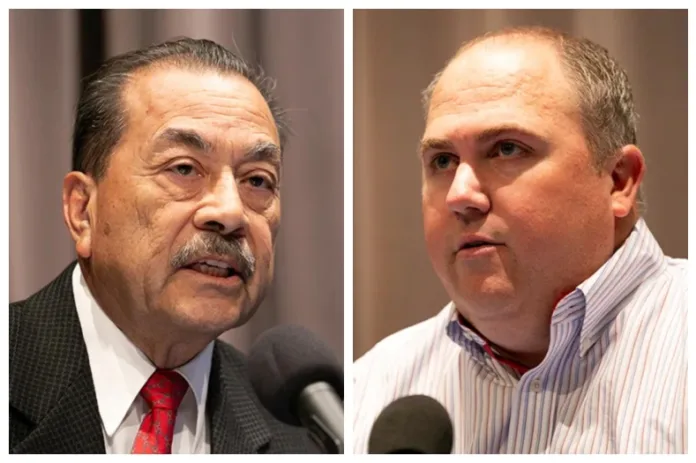
Spring Hill’s two write-in mayoral candidates addressed their priorities — including restoring trust, attracting new business, and lowering taxes — at a forum Tuesday night hosted by the Johnson County Post.
The two candidates, retired university administrator Rodolfo Arevalo and current Spring Hill City Council President Chad Young, are pursuing write-in campaigns after the lone registered candidate, current Councilmember Kristin Feeback, announced in July that she will be unable to take the role after accepting a job that will require her to move out of the city next year.
Still, because her decision came after the deadline for candidates to withdraw, her name will appear on the Nov. 4 ballot.
On Tuesday, both Arevalo and Young agreed they’d like someone to be elected outright to the post, rather than be appointed, which is what happened four years ago when the winning mayoral candidate resigned before taking the job.
Watch the Post’s candidate forum in full below.
On rebuilding trust
The candidate who won the mayor’s race in 2021, then-Councilmember Tyler Graves, announced his resignation just two weeks after his victory. He and his family moved to Florida and he never took the mayor job, sending the city and its newly elected councilmembers into a period of chaos at the start of 2022.
From their ranks, the city council elected Joe Berkey in January 2022 to be mayor. However, the appointment was met with resistance from Councilmember Steve Owen, who accused the other councilmembers of lacking transparency and shirking the city’s ordinances.
Berkey, operating under city ordinances at the time, served all four years of what would have been Graves’ term.
The turmoil, the write-in candidates this year said, broke down residents’ trust in the electoral process and city government. That’s something both Young and Arevalo say they want to improve.
“One of the things I will focus on really has to do with creating a more open and transparent government,” Arevalo said. “One of the obvious things that this current city council did is to really limit the ability of the citizens to talk about issues that are concerning them.”
Arevalo said he’d like to make the process easier for residents to address the council, including adding annual neighborhood meetings.
“In addition to that, I will take a look at how we use social media to inform the citizens of Spring Hill about what’s coming up, what’s important, what’s long-term, why the council is doing what it’s about to do,” Arevalo said.
Young agreed that there’s room for improvement with the city’s transparency and use of social media platforms to inform residents.
“One thing I’ve already tried to do is help change some of the charter ordinances where we’ve limited how long an appointed member on the governing body can stay,” Young said.
He that after Berkey was appointed in 2022 to serve a full four-year term as mayor without having been elected by residents, the city council changed city code to limit similar future appointments to half of an elected positions full-term, or two years.
“I want to make sure we can get the trust of the citizens back on board,” he said Tuesday. “For me, if I was to become the mayor, I have another process I’d like to enter where I include the councilmembers a lot more than what we’ve done in the past.”

On managing growth and infrastructure
Spring Hill, one of the fastest growing cities in Johnson County, has the space for new industries, businesses and residences. But, as the city grows, so will the need for added infrastructure.
Both Arevalo and Young plan to bring in new business while planning for new infrastructure.
Young said he’s already started advocating for companies to make their home in Spring Hill, specifically in areas meant for industrial growth.
“I want it to be low impact to the neighbors, but with high job growth,” Young said. “Outside of large industrial, the issue that I’ve come across from restaurant owners and retail owners is that there’s not enough daytime traffic.”
When new businesses come in, Young said he’d like to see necessary infrastructure improvements included in the incentive plans — outlining costs for building and improving roads, adding stoplights or whatever is necessary to update the area around the business to make it more safe and accessible.
Arevalo, the current chair of the city’s planning commission, is working with the commission and city on a new comprehensive plan, identifying “where certain business and industry and zoning would be available for residents.” (A copy of the current plan from 2010 can be found here.)
His other priority is the establishment of an economic development council, “a group that would, in essence, be working to attract businesses to Spring Hill,” Arevalo said.
As new businesses come to the city, Arevalo said he believes there’s strategic ways to plan for it that keep costs down.
“I believe there’s ways of locating certain large industries as well as small commercial facilities in different sectors of the city,” Arevalo said. “I would try to make sure that the appropriate venue or locations would be identified within city limits and beyond as we begin to look at expansions of the city.”
On taxes
On Sept. 11, the city council voted 3-2 to approve the 2026 budget, which included a mill levy reduction of .75, or a roughly $34 reduction in the city’s portion of the average homeowners property taxes.
“I think it’s (the reduction) appropriate because it’s growing at a certain rate,” Arevalo said. “To be very honest, I don’t think you can continue to grow the city and do some of the infrastructure things that need to be done without a minimal increase in the property rate.”
Arevalo said that with the city’s current resources, the mill levy could’ve been reduced further.
“There’s at least three major housing developments that are already building and currently beginning to sell their property,” Arevalo said. “That means that there’s a potential within the next three or five years to have an additional 700 or 800 more homes that could be taxed and provide more money to the city.”
Young voted against the proposed budget because he wanted to see a larger 1-mill reduction. He agreed with Arevalo that the mill levy could’ve been reduced further.
“To me, the most important thing is making sure the current residents here don’t see an increase or see, somewhat, a big decrease, which is what we’re able to do,” Young said. “It was appropriate in that sense that we were able to, at least, get some dollars down for everybody. It’s not a huge impact because we’re one of the smaller entities on the tax bill outside the school district and the counties and things like that.”
“Outside of that, growth-wise, we’re going to need to see growth,” he added. “The 700 to 800 houses, those are probably happening, but it’s not going to be anything in the short-term.”
What happens if neither write-in wins?
If Feeback is still elected mayor in November and does not accept the job as she has said, then whoever is elected city council president in January 2026 will then become mayor for a shortened two-year term before the next regular city election in 2027.
That’s the procedure spelled out in a city ordinance approved in October 2024, which was in response to the crisis that occurred after Graves’ resignation following the 2021 election. Berkey has served the full four-year term under the previous ordinance.
Additionally, Arevalo has filed to run for city council. His name will appear in two separate city council races:
- a five-person contest for two open at-large seats,
- and a three-person contest to fill out the final two years of a separate at-large city council term, the vacancy for which was created when former councilmember Chip VanHouden was elected to the Kansas House last year.