Editor’s note:
This story is the second of a four-part series about housing challenges in Johnson County. Read our first part introducing the county’s housing shortage here.
Later this week, we’ll explore other factors that contribute to high housing costs and low availability of homes, as well as some small-scale solutions communities across Johnson County are working on.
Local officials, prospective homebuyers and industry experts largely agree that Johnson County doesn’t have enough housing, which often squeezes prospective homebuyers or puts renters in unsustainable living situations.
Johnson County’s 2021 housing study painted a concerning picture of the situation, and in the intervening years, the county’s housing shortage has only gotten worse. The Post found that through 2024, there was a 3,500-unit deficit in new housing development across Johnson County, compared to the housing study’s goals.
And, the process of getting new housing projects planned, approved and eventually built can be so cumbersome that such developments are functionally dead on arrival.
The 2021 Johnson County Housing Study touched upon all these more unseen forces that can impact housing inventory. The study also acknowledged a barrier to more housing that more often makes the news: neighbors’ opposition to new housing projects, or NIMBYism.
This story details some of the less visible barriers to new housing — the cost to build, the lack of available land in some communities, zoning regulations, etc.
The process: Picking land to city approval
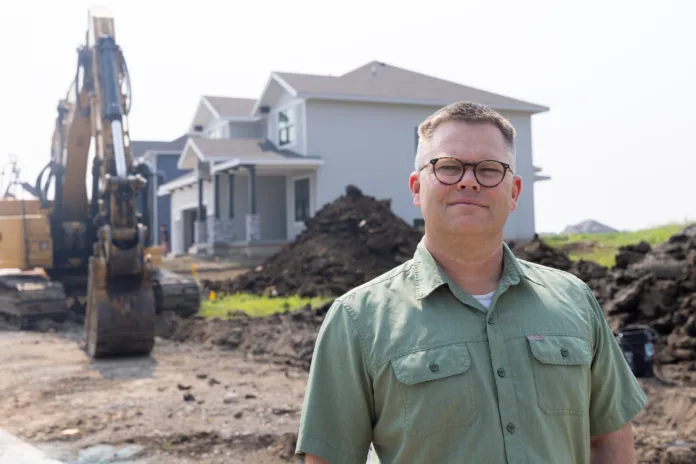
Travis Schram, a local developer, said building housing is a multistep process, complicated by the cost of developing anything and the declining availability of land.
It all starts with finding the right piece of land. From there, you have to figure out what will work at the site and what kind of infrastructure is needed to make it work. That leads to a basic idea of a site layout.
Next, a developer will go meet with the city to have discussions before they submit a formal application to go through the planning process.
“We’ll meet with the city, see what their temperature is, as far as, are they interested in more housing or a specific price point,” said Schram, who is the president of Overland Park-based GRATA Development.
After that, the developer will have a better idea of what kind of expectations the city might require for a housing project to move forward, like possible road improvements or utility upgrades, all before a project has even gotten a formal hearing before the city governing body.
But say, after all of that, the project is potentially ready to start working through the formal process, which could include a neighborhood meeting if the site needs rezoning, approval from the planning commission, and the final green light from the city council.
Every layer of that process can be expensive, though exactly how much it costs depends on the project and its scope. Plus, it can take months to get through, Schram said, and construction hasn’t even begun yet.

Cost is a barrier to housing development, officials say
Industry leaders and local officials, in a series of interviews with the Post, agreed that cost is a chief barrier to building more housing.
Escalating values of land, less availability of land, labor shortages, breakdowns in supply chains that raise the cost of materials, and a myriad of other variables all contribute to making it more expensive to create new housing, they said. Those spiraling costs, in turn, raise prices down the line on those looking to own or rent once something hits the market.
“There’s just a lot of things that work together or conspire together to make it challenging to build affordable housing,” said Kevin Walker, chief policy officer for the Overland Park Chamber of Commerce.
And, a lot of those extra costs are not going away at this point, said Will Ruder of the Kansas City-area Home Builders Association, because they’re locked in.
“If the goal is to produce a four-bed, three-bath house with a three-car garage for less than $250,000, we have to kind of reset the expectations; that’s not going to be a possibility,” he said. “It’s not that people don’t want to; it’s that they can’t do it for that.”
Infrastructure costs make housing projects more expensive
Infrastructure investment has also gotten more expensive over the past few years as construction costs escalate. That issue can be particularly pronounced in areas with limited utility access, like when it comes to building out sanitary sewers to accommodate new development in southern Johnson County or parts of De Soto.
Schram said it can be one of the biggest contributors to cost that can be overlooked in discussions about housing costs.
“As a developer, all that utility and roads, storm sewers and sanitary sewers, even though they end up being owned by the city, we pay for that and put it in,” he said. “So there’s a lot of expense of building the roads and getting all the utilities in place.”
A city’s building and development codes also stipulate architectural standards, minimum lot sizes and other requirements for housing, which are heavily influenced by the zoning of a building site and the type of housing planned for it.
For instance, the city of Overland Park recently started requiring developers to build new residential streets with concrete as a way to cut down on the cost to maintain the roads long term. But that’s more expensive upfront, Schram said.
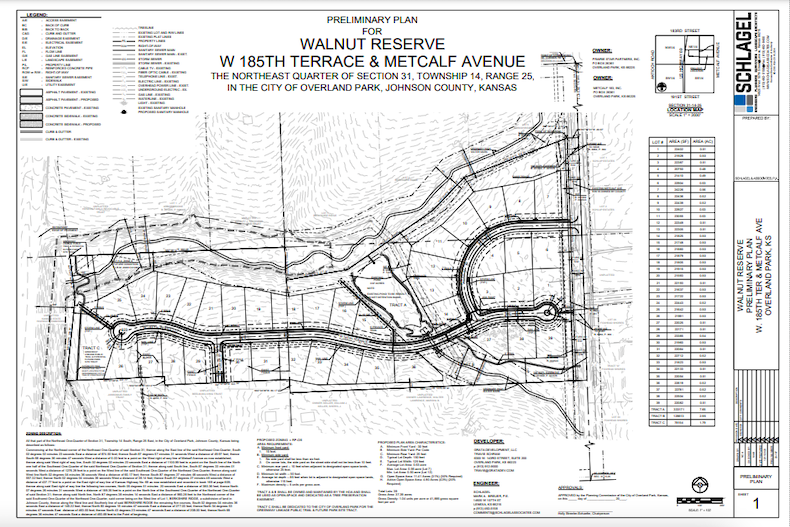
In the Walnut Reserve neighborhood, a larger-lot subdivision on a recently annexed pocket of land near 183rd Street and Metcalf Avenue, Schram’s company spent about 80% more on building the roads under the new standard compared to what the cost would have been under the old standard.
When that trickles down to each individual lot, Schram said it’s adding at least $40,000 to the sticker price. In the end, any extra costs get baked into the price of the lot even before a home is built, which makes for a more expensive final product.
Other factors make homes more costly, too
At the same time, Schram said the cost of building a home on these lots needs to be factored in, too.
To sell a home for $250,000 on a $100,000 lot — if you could even find a lot valued at $100,000 after all the site preparations are done — you’d need to build the home for $150,000 just to break even. That’s something Schram said is practically impossible.
“That doesn’t leave you with much house left because materials and everything else are pretty expensive,” he said. “That becomes the hard part.”
Material costs for construction — after rising due to supply chain challenges in the pandemic — remain high. That means things like insulation, parts of electrical systems, masonry, and building materials themselves are more expensive, adding to the cost of building housing.
The Trump administration’s tariffs on some of these materials, like steel, wood and other goods, stand only to make that worse, experts have warned.
Some JoCo communities are completely or nearly built out
While costs to build amplify the supply issue, there’s also the matter of having enough space.
Though some cities, particularly out west and down south, still have space for more development, some communities in the northern and eastern portions of the county have no greenfield left for development of any kind, let alone anything zoned for housing.
Officials from Merriam and Roeland Park both cited the lack of space as a primary challenge, plus the fact that their cities lack the benefit of fringe areas to annex like some other Johnson County cities, such as Overland Park and De Soto.
That leaves redeveloping as the only option for building new housing, but such projects can be cost-prohibitive to tackle or take years to come together — not to mention face pushback from neighbors who are sensitive to changing land uses.
Roeland Park City Administrator Keith Moody, in an emailed statement to the Post, said any sort of new development would require the removal of something else that already exists, which “makes it challenging.”
In Roeland Park, the city long sought a developer for what is now The Rocks mixed-use project at 4800 W. Roe Blvd. The project contains upwards of 200 apartment units with a specific carve-out for affordable units, on a property that was once a city pool.
As for Merriam, Drake Development redeveloped the former K-Mart site with several hundred new multifamily units alongside some restaurants and retail at Shawnee Mission Parkway and Antioch Road.

Zoning 101: The legal framework for planning communities
Zoning is a type of legal, local planning framework that designates specific areas of property for particular uses and outlines associated development patterns within those districts. However, zoning can be altered through a legally prescribed rezoning process.
Pete Heaven, a real estate attorney with Spencer Fane who previously served as the city attorney for Merriam for about 20 years, said zoning has allowed communities to develop sensibly.
“You get a better development pattern of consistent and compatible uses,” he told the Post. “Zoning protects the neighbors, it protects the developer who’s going to invest money in the city to develop residential or whatever it’s going to be, and of course, it protects the city so that it has a consistent growth pattern.”
For instance, Johnson County cities are largely zoned for single-family residential uses, and have been developed as such over the years, with some light retail or pockets of commercial uses popping up to complement those enclaves.
However, zoning can be limiting or prohibitively restrictive when investment or experimentation may be warranted. (Zoning laws have also, historically, been used to discriminate against people of color and groups of people who have been excluded from suburban communities on the basis of class. The impacts of that linger today.)
In Johnson County, widespread single-family residential use and its pervasiveness can make it difficult to address a shortage of places to live or set up roadblocks for developers who want to think outside the box with housing options beyond the typical neighborhoods that make up much of the county.
“There are areas that are designated as single-family, and it might be a good idea to mix in some multifamily, but that starts with the city,” Heaven said.
He said looking at long-range development plans, called comprehensive plans, can be a good place to start to look at potential changes to these patterns.
“Some developers are very innovative and want to sort of step outside the box, and the zoning just won’t permit it,” Heaven said. “The city staff generally will go along with what is status quo and not be innovative with the developer.”
“Creative” solutions may help address housing costs
But at the same time, elevated costs at all points in a project, from land prices to building materials and labor to remediation in redevelopment, can make it hard for cities to see new housing developed in their respective jurisdictions, even if they welcome it.
“We’re relying on the private market to bring housing to the community,” said Leslie Karr, Overland Park’s planning and development director, in an interview last year.
At the end of the day, though, Schram said he still thinks a $350,000 home in Johnson County could be possible, but only if cities and other jurisdictions make way for them or accept out-of-the-box ideas.
“They have to be creative,” he said.
Keep reading: A Johnson County couple feels squeezed by housing market. Data shows they’re not alone.