In February 1950, the owner of the land that is now Porter Park in Prairie Village created a single rule for that land: No Black people were allowed to use, own or occupy it.
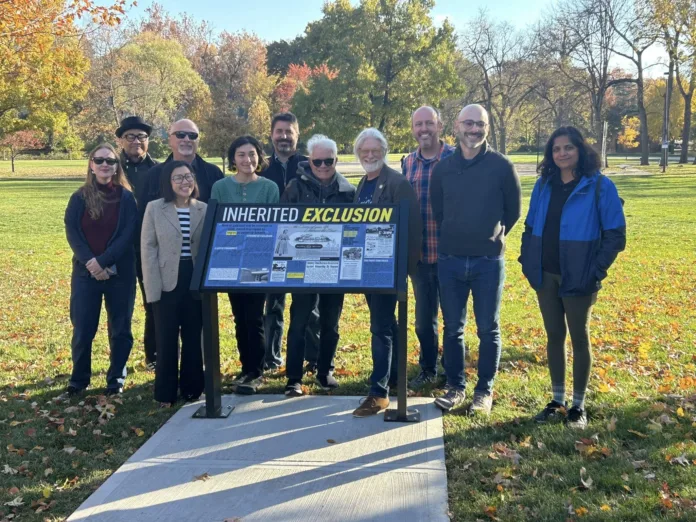
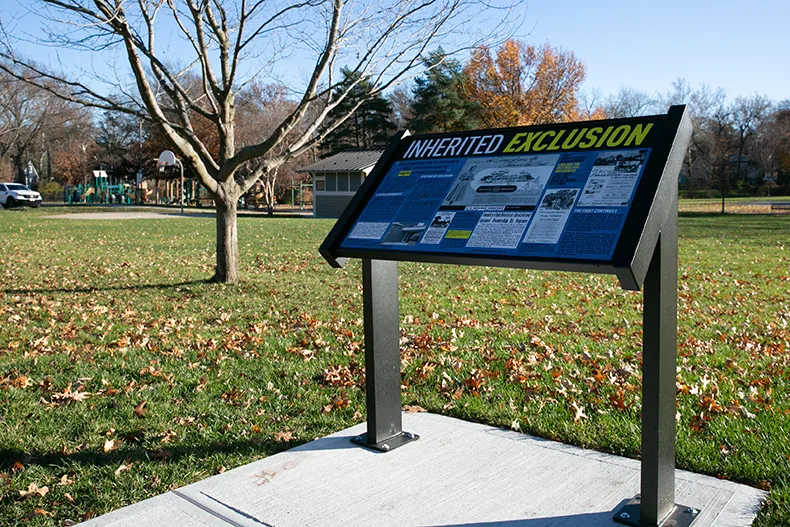
Now, 75 years later, Porter Park is officially home to an interpretive panel, entitled “Inherited Exclusion,” that publicly recognizes the park’s history defined by a racist covenant and also details Prairie Village’s broader history as a community founded in part on racist deed restrictions.
Racist covenants like the one created for Porter Park date back to the city’s inception in the 1940s and 1950s, with developer J.C. Nichols explicitly excluding Black families from buying his homes in Prairie Village — and other neighboring communities he developed.
The city of Prairie Village’s diversity committee dedicated the interpretive panel — the brainchild of resident David Magariel — at Porter Park earlier this month after a five-year effort to create the educational landmark.
Prairie Village’s history with racist deed restrictions
In the middle of the last century, racist covenants were common in Johnson County as suburban areas grew and white residents left Kansas City, Missouri.
Racist language that specifically prevented Black and Jewish homebuyers from buying property in emerging Johnson County municipalities back then can still be found on property documents in Prairie Village and other Johnson County cities like Roeland Park.
That racist language has been unenforceable federally since the 1948 Supreme Court case Shelley v. Kraemer, which invalidated racist deed restrictions.
And just last year, Kansas Gov. Laura Kelly signed a law making that vestigial racist deed language unenforceable at the state level and providing ways for cities to more easily remove it from property records.
When Nichols first built homes in Prairie Village in the 1940s and 1950s, he included the racist covenants prohibiting Black ownership and tenancy on each one of his properties.
Advertisements for these Prairie Village homes boasted “protective restrictions,” according to the new Porter Park interpretive panel.
More than 20 years after Prairie Village was officially incorporated, the Fair Housing Act of 1968 outlawed racist housing covenants.
Decades later, following a 2006 state statute allowing homeowners associations to remove racist covenants, the Prairie Village Homes Association passed a resolution calling such restrictions “abhorrent.”
But the impacts of those polices can still be viewed today in Prairie Village’s demographic makeup: just 1% of Prairie Village residents today are Black, according to the latest U.S. Census.
How the interpretive panel came to be
Magariel said he was inspired by the work of Bryan Stevenson, executive director of the nonprofit Equal Justice Initiative that, among other efforts, combats racial and economic injustice around the U.S., particularly in the South.
This includes EJI’s Legacy Sites, three places that educate visitors about the history of slavery in the United States and memorialize enslaved people or victims of racial lynchings.
While not the same history, Magariel said he knew about the racist covenants in Prairie Village deeds and saw value in publicly acknowledging that history here.
Stevenson’s books and podcast also discuss how the treatment of Black people in the United States has been justified by a false narrative that Black people are lesser or are not full human beings, Magariel said.
“Inherited Exclusion” is one “small” way to push back against that false narrative, Magariel said.
“I think it’s important that we accurately put the full history out and that we don’t pretend like that history is not true because it’s hard,” Magariel said.
After pitching it to the city’s diversity committee and Mayor Eric Mikkelson, Magariel spent the next five years working on the interpretive panel.
Councilmember Inga Selders, who was the diversity committee chair at the time of Magariel’s original pitch, came up with the idea to place the panel at Porter Park.
Selders said she discovered the racist restriction in the Porter Park deed when she was researching property documents during a separate debate about the city’s backyard chicken ordinance five years ago.
Selders said she discovered Porter Park’s declaration of restrictions had just one restriction: no Black people could live there or use the land.
Unlike other plats with additional restrictions, this specific piece of land had just that racist restriction, she said, and that restriction was created just before Porter Elementary was built. That school eventually closed in the mid-1980s. (See the restrictive covenant in the embedded document below.)
“That really caught me off guard, so that’s kind of where at least the idea of it being installed in Porter Park came from,” Selders said.
 Loading...

 Reload document
  Open in new tab
 Magariel wants readers to dig deeper
In the roughly two weeks since the panel was unveiled on Nov. 8, Magariel said he has already seen several Porter Park patrons reading “Inherited Exclusion.”
Magariel and Selders both said they hope readers of the panel are inspired to continue learning about racist covenants, redlining and the lasting impacts of both on Prairie Village.
“I think a lot of people don’t realize this part of our history, and I mean, it’s not comfortable, it doesn’t make you feel good, but it’s a really important part of our history,” Selders said, adding that she hopes people will reflect and research on their own after reading the panel.
While both Magariel and Selders said they’ve heard mostly positive responses to the interpretive panel, Selders has heard some critiques about the specific placement inside the park.
Magariel said he has had conversations with a couple of people who feel like it is best to leave the city’s history with racist covenants in the past.
They are concerned it is a “bad look for Prairie Village,” Magariel said.
Magariel’s response to that is that he hopes people “dig a little deeper” and realize that “it wasn’t that long ago” that these racist covenants were in effect.
“I guess I understand that instinct because it’s a hard history to grapple with, but I hope people would maybe think about it a little bit more and be open to the idea that these aren’t things that went away in 1968 or whatever,” Magariel said. “There’s a legacy connected to them.”
Keep reading community issues news: Overland Park homeowner’s new pickleball court is legal. Neighbors ask if it should be.
 Thanks for reading! If you value having an independent news outlet keeping tabs on local government, schools and taxes, we're asking you to contribute to our Education Reporting Fund.