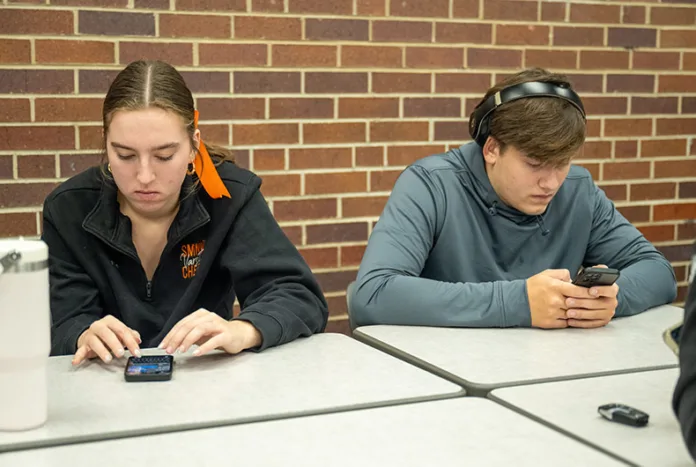
A bipartisan bill in Topeka that aims to institute a statewide cellphone ban in K-12 schools is drawing criticism from Johnson County’s biggest school districts.
Senate Bill 302 would bar students from using their phones from the start of the school day until dismissal. During that time, students would have to turn off their phones and store them in a secure, inaccessible location.
The bill already has the support of more than two-thirds of the Kansas Senate and also has the backing of Gov. Laura Kelly, who advocated for the phone ban during her State of the State address last week.
But Johnson County school district officials are pushing back.
Blue Valley, Olathe and Shawnee Mission schools all say a statewide phone ban would undermine local control and supersede rules the districts already have in place regarding students’ use of personal electronic devices.
“At this point, we believe the policy our Board of Education voted on over a year ago has met the needs that our greater community has asked for regarding cell phone usage in the classroom,” Olathe district spokesperson Erin Schulte said in an emailed statement.
“We do not believe that it is appropriate for the legislature to tackle this issue with a broad ban that may not reflect the varied needs of each local school district and communities they serve,” she continued.
What are JoCo districts’ current rules?

All six Johnson County public school districts currently have rules in place limiting students’ use of cellphones during the school day, but none of them go as far as Senate Bill 302.
Johnson County school districts generally require students to have their phones silenced and stored away during class time, but rules can vary depending on the grade level.
All Johnson County districts prohibit students in elementary grades from using cellphones at school, and those restrictions loosen as students get older.
In middle school, local districts require students to keep their phones in their lockers, though they can access them between classes in most districts.
In high school, Johnson County districts allow students to keep their phones, though they generally must be stored away and silenced during class. Students are then allowed to access phones between classes or at lunch.
Gardner Edgerton is the only district whose phone policy explicitly mentions students having to turn their phones over to a teacher or storing them in a carrier off their person or backpack when they enter class.
Aliyah Carter, a senior at Shawnee Mission Northwest High School, said she hasn’t noticed much of a difference in students’ phone use in classes since Shawnee Mission instituted its phone policy at the start of last year.
She said some teachers don’t enforce the phone restrictions as much as other teachers do, and “a lot of the students don’t take it very seriously,” with the result being students appear to be on their phones just as much as they were before the current policy took effect last January, she said.
Still, Carter said she would personally not be in favor of a stricter phone ban, saying students would still find a way around it.
“I think there are so many other things that they could be doing to distract themselves as well. So I don’t think that the phone is necessarily the problem, but just students’ attention span,” she said.
Worries about distractions, academic performance
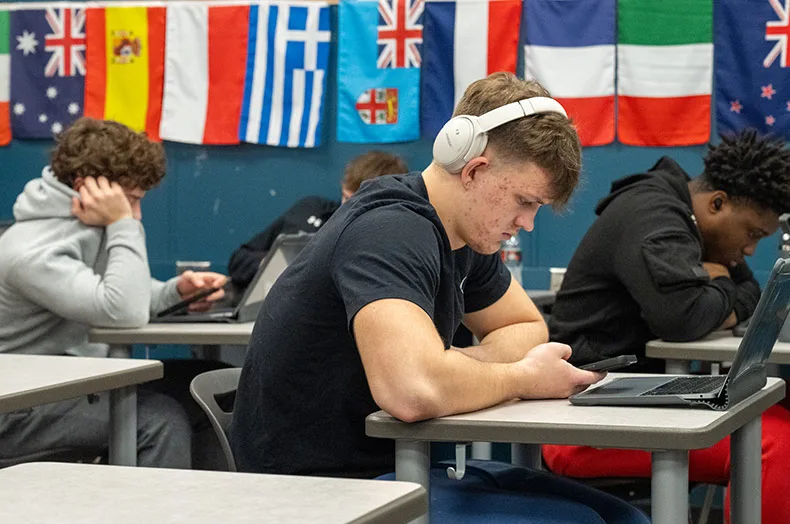
Kansas’ debate over a statewide phone ban in schools comes as more states adopt bell-to-bell bans, where students cannot access their phones from the start to the finish of the school day.
Education Week reports at least 23 states, including Missouri, Nebraska and Oklahoma, plus the District of Columbia, currently require K-12 schools to adopt bell-to-bell policies, that is, all-day prohibitions against cellphone use at schools. Another nine states require schools to adopt policies restricting phone use during instructional time.
Advocates for such bell-to-bell policies warn of the negative impacts phones can have on students’ academic performance and emotional and mental well-being, in addition to being disruptive to classroom learning.
Kim Whitman, a Shawnee Mission parent who is also co-lead for the nonprofit Smartphone Free Childhood U.S., a group that advocates for bell-to-bell phone policies, said it’s a “relief” that Kansas lawmakers are taking up a measure that would result in a “phone-free school day.”
“The research is clear, and the anecdotal evidence from schools that have already put in place all-day phone policies is overwhelmingly positive,” Whitman said in an emailed statement.
“There is tremendous parent support for bell-to-bell phone-free school policies,” she added. “Students deserve a distraction-free learning environment, and teachers do as well. Not having phones accessible to students will restore focus, engagement and social connection in our schools.”
Local control and “unfunded mandates”

Still, Johnson County districts say their current phone policies are working and that a blanket statewide ban on phones in schools would take away districts’ local control.
It might also force districts to spend money on equipment or systems for collecting and storing students’ phones during the day, officials said.
(Yondr, a California-based company, makes magnetic-sealed neoprene pouches that some schools are using to store students’ phones during the day. The Los Angeles Times reported last year that many educators praised the pouches but that some students also found ways around them.)
Blue Valley spokesperson Kaci Brutto said current phone rules in that district already had “strong community support.”
“Because these safeguards are already working well for Blue Valley, SB 302 is unnecessary for our district and risks imposing unfunded mandates while limiting the authority of locally elected school boards,” Brutto said.
Shawnee Mission spokesperson David Smith echoed that sentiment.
“We strongly believe that our community has already made the decision that is best for their schools and their children with regard to personal electronic device use,” Smith said, noting that the rules the district adopted last year came from a “community-developed strategic plan” and “included broad community input.”
In 2024, a Blue Ribbon task force recommended a “bell-to-bell” ban to the Kansas State Board of Education. The board then sent that recommendation on to local districts but stopped short of mandating that districts adopt all-day phone prohibitions.
Alvie Cater, assistant superintendent for USD 232 in De Soto, said “limiting the use of personal communication devices during instructional time can support student learning.”
Still, he encouraged lawmakers to “consider existing local policies and the value of providing some flexibility for school districts.”
A Gardner Edgerton school spokesperson referred the Post to the district’s current phone policy. The Spring Hill School District declined to comment on the phone ban bill, but a spokesperson included a screenshot of the district’s current phone rules.
Testimony for and against bill at Senate hearing
During a hearing on Senate Bill 302 last week, lawmakers heard testimony from both supporters and detractors of an all-day phone ban.
Gretchen Shanahan, an Overland Park parent who has long been critical of the Shawnee Mission district’s approach to screen time, including on district-issued devices, referenced a National Association of School Resource Officers statement supporting a bell-to-bell cellphone ban.
“They state that during normal days, phone access promotes social media drama, cyberbullying and easier planning for physical altercations. This hinders student safety,” she said.
Kailey Howell, a senior at Spring Hill High School, testified in opposition to the bill, calling it “extremely broad and all-encompassing.”
“As a 4.0 student involved in a variety of extracurriculars, phone usage was always secondary to my education. And while I understand this isn’t always the case for every student, I am confused as to why I have to bear the consequences for things that were never meant for me,” Howell said.
The Kansas National Education Association officially took a neutral position on the bill.
Speaking for the teachers’ union at the hearing, Tim Graham, KNEA’s director of governmental relations and legislative affairs, said teachers had voiced concerns with him about the cost and training necessary for implementing an all-day ban.
 Thanks for reading! If you value having an independent news outlet keeping tabs on local government, schools and taxes, we're asking you to contribute to our Education Reporting Fund.