
Olathe Mayor John Bacon addressed the City Council Chambers at the beginning of last night’s City Council meeting.
“The Chiefs are moving to Kansas,” he said.
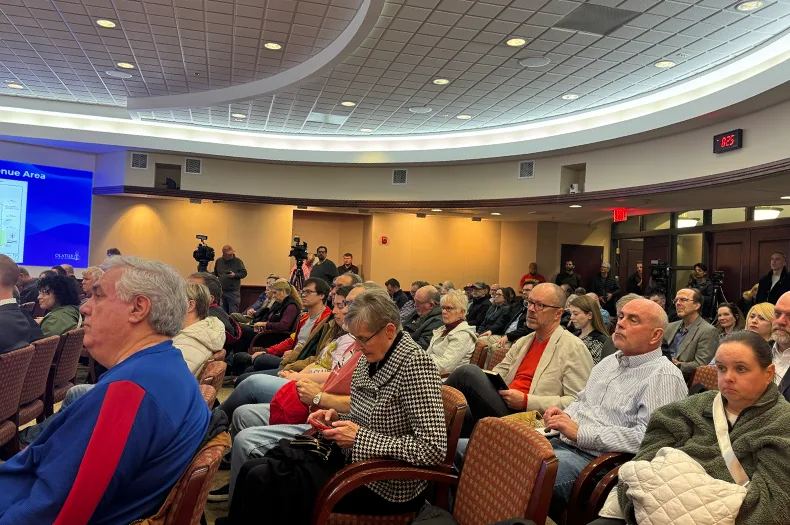
A mixture of claps and boos came in response.
Every seat was taken, and dozens more residents stood in the back of the room. The meeting’s attendees were lively — sometimes interrupting city councilmembers who spoke in favor of the partnership with the Kansas City Chiefs.
Ultimately, the Olathe City Council voted 7-0 to approve local tax incentives to help fund the Chiefs’ new headquarters and training facility, set to be located at Ridgeview Road and College Boulevard.
The decision marks Olathe’s first formal action connected to the Chiefs’ broader relocation plan announced in December, which includes a new $3 billion domed stadium in Wyandotte County. (The Wyandotte County Commission is set to vote on its own local incentives for the stadium on Thursday.)
Before the hearing, City Attorney Ron Shaver gave a presentation about the project, which included new details about what else will sit on the 165-acre site.
Shaver said that on top of the $300 million for the headquarters and training facility, another $100 million will go toward “ancillary developments” like restaurants and hotels.
How it works
The approved ordinance allows Olathe to pledge certain local sales and hotel tax revenues generated within a defined “base revenue area.”
Those revenues would help repay STAR bonds issued by the Kansas Development Finance Authority.
Under the ordinance, the city pledges:
- Its 1% general sales tax not already committed to other uses, that is raised on the 165-acre site.
- Its share of county sales tax generated on the site.
- 7% of the city’s 9% transient guest tax on hotels within the area.
Voter-approved street and park sales taxes and taxes tied to other special taxing districts are excluded.
City officials emphasized the bonds would not be a debt obligation for Olathe and would be repaid only through new tax revenue generated within the 165-acre project area.
“If the bonds don’t get paid off or something goes sideways, it is investor risk. We are not on the hook,” Councilmember Robyn Essex said. “I’m going to say that a couple more times — this is not taxpayer risk.”
Olathe’s participation applies only to the 165-acre headquarters site at College and Ridgeview, not the broader STAR bond district being considered by the state, which encompasses all of Wyandotte County and a big chunk of Johnson County, including nearly all of Olathe.
That means municipal sales tax revenue raised in other parts of the city would not go toward the project, though the state’s portion of future sales tax growth in the city could.
“That area is currently empty,” Councilmember Matthew Schonoover said, referring to the site at College and Ridgeview. “We are not currently generating any sales tax on this otherwise empty spot of land. There’s really nothing to lose here.”
Shaver told the city council that the site currently generates little to no sales or guest-tax revenue and that only future revenue growth would be pledged.
“Insulting to the citizens of the city”
Most of the two dozen speakers at the public hearing urged the city council to vote against the ordinance, citing a lack of transparency in the process.
“I feel like it’s a little insulting to the citizens of the city that all of this is not already out in the open,” Jeremy Thurston said. “If you make this commitment, you’re going to be losing that money that could go into some other effort, such as housing.”
Other speakers said the project doesn’t actually benefit the city and argued that the money could be better spent elsewhere.
Some said the city council is only supporting the move because of the allure of being involved with the Chiefs.
“We get no benefits, as I see from this, except bragging rights,” Dianne Killian said. “Bragging rights don’t feed people, and they don’t put roofs over people’s heads.”
In an interview with the Post last month, Geoffrey Propheter, an economist and expert on sports facility financing at the University of Colorado, Denver, criticized the deal, sharing a similar sentiment.
“The political benefits to lawmakers approving this are photo ops, chances to rub shoulders with athletes,” he said. “There’s a legacy and ego-building component.”
But Propheter said the economics of the Chiefs deal don’t work in favor of the city.
“It’s the diversion part that people need to focus on because all that money above the baseline amount, it doesn’t go into general fund for general services, it goes to debt,” he said. “So what happens to all the expenditures that would be funded by that additional revenue?”
“Once-in-a-lifetime opportunity”
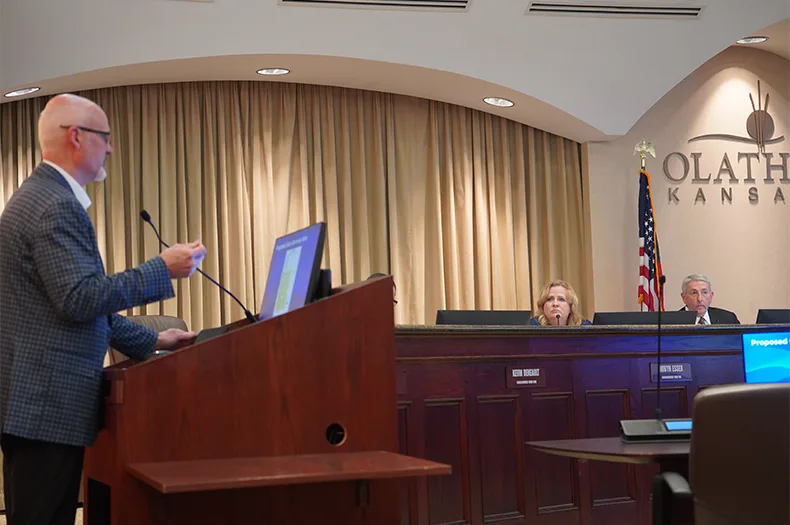
Even though 20 of the 26 speakers in attendance were against the city pledging local tax incentives, some residents spoke in favor of the move.
“Local businesses will have more opportunity for growth. Jobs will be created. Businesses will be started. Tourism will come to Olathe,” Jib Felter said. “This is a great opportunity economically for all of us, a once-in-a-lifetime opportunity.”
Several councilmembers said they had also received hundreds of emails before the meeting that were overwhelmingly in favor of the deal.
Councilmembers said the Chiefs deal will ultimately be a great opportunity for Olathe and pointed to the limits of the ordinance.
“This is money that’s coming from new taxes only,” Councilmember Jeff Creighton said. “We are not diverting current taxes.”
Councilmember Dean Vakas said the ordinance contains “guardrails to protect the city,” and said the bonds do not affect the city’s credit.
“We’re not giving away the farm at this stage,” Vakas said. “We’re taking an incremental step that allows us to move to the next phase where things do become more serious.”
What happens next
Tuesday’s vote does not authorize construction.
Any specific plans put forward by the Chiefs for the Olathe site will still require the city to approve things like site plans, rezoning and development agreements.
Dates have not been set for those items.