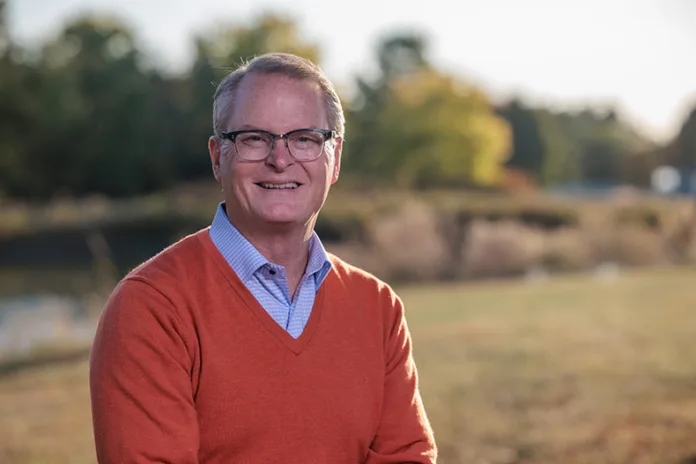
Adam Hamilton, a prominent pastor at one of the largest churches in Johnson County, is exploring a run for the U.S. Senate as an independent candidate, which would position him to potentially challenge Republican incumbent Sen. Roger Marshall.
Hamilton, who leads the Leawood-based Resurrection, A United Methodist Church, announced last week the formation of an exploratory committee for a Senate candidacy, telling both his congregation and in a subsequent video posted on the church’s website.
His announcement that he’s considering a run for the U.S. Senate adds a degree of uncertainty to a race that is already somewhat of a mystery as U.S. Rep. Sharice Davids, a Johnson County Democrat, also signals continued interest in running.
Hamilton and other candidates who have thrown their hats in the ring to challenge Marshall could face an uphill battle.
Kansas has elected only Republicans to the U.S. Senate for nearly 100 years, one of the longest single-party streaks in U.S. history, said Bob Beatty, professor and chair of political science at Washburn University in Topeka.
Even beyond that, independent candidates seeking partisan offices can struggle to mount successful campaigns in a political system controlled by two dominant parties, the Democrats and Republicans.
Though he’s not the first independent to seek this seat in recent memory, Hamilton would be the first to win a Kansas statewide office in generations.
Hamilton is no stranger to politics
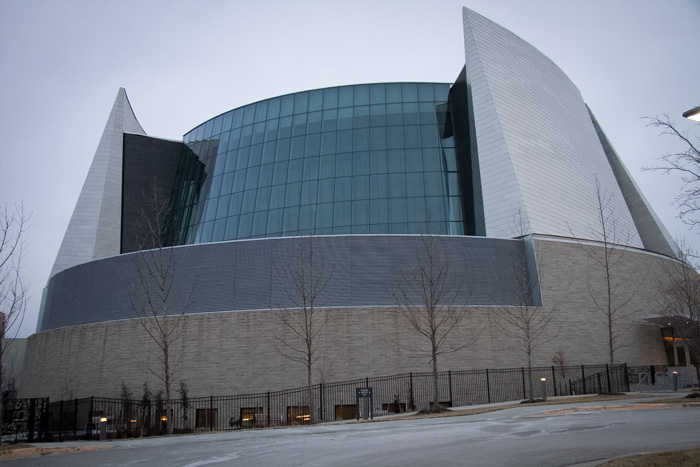
Hamilton started United Methodist Church of the Resurrection nearly 40 years ago in a funeral home chapel, according to the church’s website.
Today, the church he started now boasts a roster of more than 20,000 members, with several locations around the Kansas City area and beyond. Now rebranded as Resurrection, A United Methodist Church, it’s considered to be the largest church in the United Methodist Church denomination in the United States.
At the same time, Hamilton’s personal reach has grown as he’s published dozens of books and launched a podcast called “Making Sense of Faith.”
Though he’s never held elected office, Hamilton has dipped into political waters before.
In 2013, he participated in the National Prayer Service ahead of President Barack Obama’s second inauguration and later served on President Obama’s Advisory Council on Faith-Based and Neighborhood Partnerships.
Additionally, in the lead-up to the 2024 election, Resurrection did a multi-week sermon series and campaign called “Do Unto Others,” which touched on the divisive state of American politics and saw thousands of yard signs with messages of faith displayed across the Kansas City area.
“Our country needs both liberal and conservative leaders who are willing to work together for the good of all people,” Hamilton said in a September 2024 video posted to his Instagram.
Hamilton also spoke in favor of including members of the LGBTQ+ community in the church as early as 2017, and his church stayed with the United Methodist Church amid a schism over the denomination’s lifting of policies banning LGBTQ clergy and members.
According to his note to his congregation and his video last week, Hamilton has previously been approached about running for elected office, though he has never taken the leap.
However, recently, Hamilton said his perspective has changed as he’s watched “the polarization in our country reach new heights, with kindness, compassion and common decency often lost in national politics, as well as government policies that seem to widen rather than close the gap.”
“Every week it seemed there was another news story in the last year where I would find myself shaking my head and thinking, ‘We have to do better,’” Hamilton said in his video.
Kansas has elected only Republican senators since 1930s
If he does ultimately decide to run, Hamilton would enter a race with some interesting political calculus.
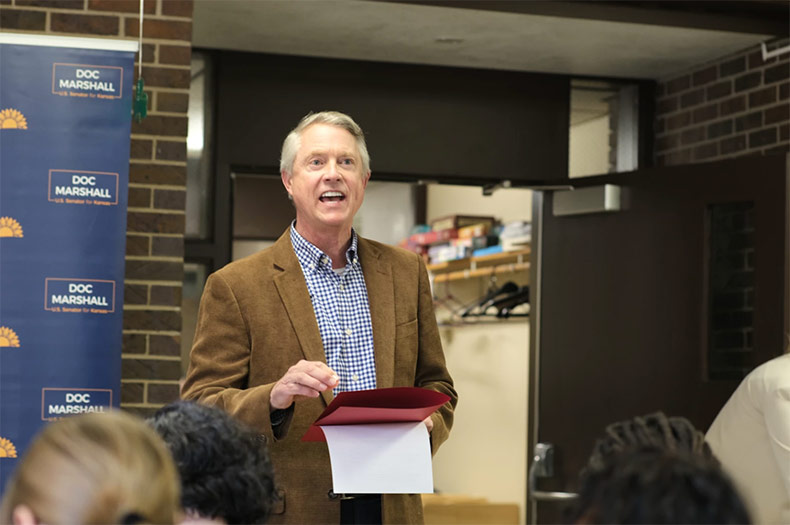
Marshall is an incumbent who first won the seat in 2020 by a comfortable margin over former Johnson County state lawmaker Barbara Bollier, despite Bollier easily out-fundraising him.
Marshall also has a significant amount of party momentum behind him, as Republicans have held onto both U.S. Senate seats from the state of Kansas since the 1930s. The last time a Democrat won a U.S. Senate seat in Kansas was 1932, when Sen. George McGill, a Democrat, held onto his seat. He would lose his reelection bid in 1938 to a former Republican governor.
It’s likely going to take more than just “a great candidate” with a “great campaign” to break that streak, said Beatty, the Washburn University professor.
“The history in Kansas is the longest period of time in the U.S. Senate elections with one party being elected every time in the entire country,” Beatty said, “so that’s not something that can be ignored.”
“Past is not prologue, but we just can’t ignore this streak in Kansas that no other state has,” he continued. “To break that streak, probably it can’t be an ordinary election.”
Possibly the “biggest Senate race in Kansas history”
So far, no other Republican candidates have filed to challenge Marshall in the primary. That could give him a head start on an increasingly crowded field of prospective candidates from the Democratic Party that currently includes former USDA official Christy Davis, Kansas Sen. Patrick Schmidt, Sandy Spidel Neumann, Erik Murray, Anne Parelkar and Michael Soetaert.
At the same time, Davids, a four-term Congresswoman, a Roeland Park Democrat, has reportedly pondered a possible run for the U.S. Senate herself if the Republican-controlled state legislature tries to again redistrict her congressional district in a way that’s designed to unseat her.
If she were to enter the race — given her own popularity, her lengthy tenure representing the northeast part of the state in the U.S. House and her electoral record of defeating strong Republicans, including an incumbent and subsequent challengers — Beatty said it could be “the biggest Senate race in Kansas history.”
For starters, the sheer volume of money raised by any candidate in the general election would likely be much bigger, as would the amount of attention and outside forces it could draw.
“If Davids runs and Hamilton’s running, at that point, we have no idea what’s going to happen,” Beatty said. “All sides would think they can win. … It’s beyond our Kansas politics comprehension how big that race would be.”
Plus, 2026 is a midterm election year. American voters have a history of punishing the political party in the White House during midterms, granting control of one or both chambers of the U.S. Congress to the opposition party.
In that case, Democrats or potentially successful independent candidates stand to gain a lot during this even-year election. Other political factors — like President Donald Trump’s shrinking popularity, the cost of living rising, a prolonged war with Iran and more — could also play into that.
“Now, just generally, 2026 is looking like it’s not going to be a great year for Republicans,” said Greg Vonnahme, associate professor and chair of political science at the University of Missouri-Kansas City. “Every Republican nationwide kind of has that in the back of their mind that this is probably not going to be the best electoral environment for them generally.”
“A very difficult path” for independents
Historically, in a two-party political system, independent candidates have struggled to get elected to partisan offices, like the U.S. Senate. Those who do usually find themselves caucusing — that is, organizing with — a certain political party.
Notably, Sen. Bernie Sanders of Vermont has been an independent U.S. Senator since 2007, though he caucuses with fellow Democrats. Sen. Angus King, Jr. is an independent U.S. Senator from Maine, who also caucuses with Democrats.
Generally, though, it can be a challenging road for independent candidates.
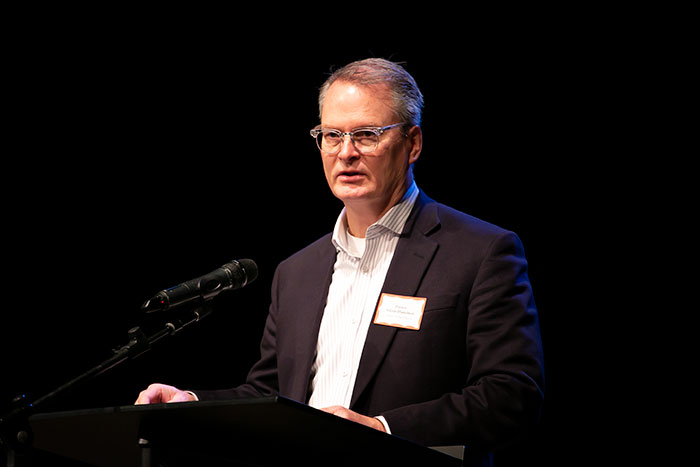
“Independents, third-party candidates; it’s a very difficult path for them to even effectively compete and get on the ballot,” Vonnahme said.
Beatty agrees, saying that “the difficulties often do outweigh the advantages” someone might derive from running an unaffiliated campaign.
In Kansas, Greg Orman — who was previously registered as a Republican and a Democrat at different times — sought both the offices of U.S. Senate in 2014 and governor in 2018 as an independent.
He was unsuccessful both times, but Beatty said he did “shake up” at least the U.S. Senate race in 2014, earning more than 40% of the vote against longtime incumbent Sen. Pat Roberts.
“It was probably more competitive than it would have been if it had just been Democrat-Republican,” Beatty said. “We did have an independent that waged a very, very strong campaign, but in the end, he didn’t win.”
But still, the state of Kansas has not elected an independent to a statewide office in modern election history, he stressed.
“It would simply be groundbreaking, and that’s why it’s a tough thing to do, because it is so unfamiliar to both voters and Kansans,” Beatty said.
Would Hamilton have advantages other independents haven’t?
Additionally, in a country that sees many voters choose based on party affiliation alone and not necessarily with much consideration given to candidates and their policies, independents can be at a disadvantage, Vonnahme said.
“The number one thing that is shaping voters’ decision when they cast a ballot, they’re going to be looking for that party identification,” he said.
Beyond that, candidates from both the Republican and Democratic parties benefit from the support of national, state and local parties, as well as established campaign infrastructure, something an unaffiliated candidate simply lacks access to.
That said, Hamilton himself wouldn’t be the typical independent candidate.
For one thing, he brings local popularity into the race, as well as name recognition in at least the northeastern part of the state, a potentially wide range of resources and experience leading a large organization.
All of that could help him break the mold, so to speak. Vonnahme said all of that could “lend him a credibility and a base of support that the vast majority of independent candidates aren’t going to have.”
Plus, there has been a recent wave of people not identifying themselves with either political party, or basing their voting decisions about the party a candidate is unaffiliated with. Research on that, as well as increasing interest in independent political identification, is still fairly nascent, Vonnahme said.
“There’s not a stable base of academic knowledge or understanding or agreement about is that something that is just kind of an ephemeral thing that we’re going through right now, or is this kind of a durable trend in party politics,” he said.
But those factors could help Hamilton too, as could changing party dynamics as moderate voters move between the two parties.
Those factors combined could make Hamilton something of a “wild card” heading into the 2026 election, Vonnahme said.
Looking ahead:
As of Tuesday morning, Hamilton had not officially filed to run for U.S. Senate, and in his correspondence with his congregation, he suggested he wouldn’t make anything official until after the Easter holiday, which falls on April 5 this year.
He has launched an exploratory committee and says he will be having a “conversation” with Democrats, Republicans and Independents in coming weeks to discren what he wants to do.
As an independent candidate, Hamilton would have until noon on Aug. 3 to make his candidacy official, according to the Kansas Secretary of State’s Office.
He would be required to file by petition, through which he would need to gain 5,000 signatures from registered voters in the state supporting his candidacy. (Find out more about that process here.)
In the meantime, Hamilton said he’s “testing the waters” of a potential run, both spiritually and in the traditional campaign preparation sense with a planned trip around the state in the next month. He also indicated that he’s trying to gauge what kind of support there could be out there for his potential campaign.
Still, he stressed in his message to his church that it’s still hypothetical at this point.
“I am not a candidate, nor am I announcing a candidacy. But only strongly considering this,” he said.
In the future, if he were to run for the U.S. Senate and win the seat, Hamilton said he would continue to lead Resurrection.
Keep reading: Leawood’s Church of the Resurrection expands into southern JoCo
 Thanks for reading! If you value having an independent news outlet keeping tabs on local government, schools and taxes, we're asking you to contribute to our Education Reporting Fund.