Prairie Village is the first Johnson County to reject the 25-foot buffer law the state enacted earlier this year.
The Prairie Village City Council during a committee meeting on Oct. 19 voted 11-0 to reject the Halo Act, making it the first city in Johnson County to reject the controversial state law.
In Kansas, the Halo Act makes it illegal to come within 25 feet of a first responder, including local and federal law enforcement, in certain situations. Violators face a misdemeanor, including the potential for jail time and fines.
Councilmember Shelby Bartelt was absent from the Oct. 19 meeting.
Other cities like Merriam, Overland Park, Olathe and Shawnee adopted the law into its Uniform Public Offense Code. Known as the UPOC, the manual “parallels state criminal code” and is published annually by the League of Kansas Municipalities, according to the city of Mission’s website.
City leaders in Overland Park and Olathe reluctantly adopted the Halo Act into their city codes earlier this year with the idea that cities can handle these cases in municipal court similar to the process for a traffic violation.
This option, for cities like Overland Park and Olathe, keeps some local control within the city as, without the Halo Act on the books, anyone charged with violating the Halo Act in a city would be prosecuted in Johnson County District Court.
In Prairie Village, despite the city council’s rejection to adopt it into city code, the Halo Act remains a state law.
That means any first responder — including Prairie Village police or other law enforcement agents like those of the federal Immigration Customs Enforcement Agency — can invoke the Halo Act, and any potential charges will be prosecuted through district court.
Still, the argument that it is better to prosecute potential Halo Act charges in municipal court wasn’t enough for the Prairie Village City Council.
Councilmember Betsy Lawrence said at the Oct. 19 meeting that the city’s existing ordinance makes it illegal to interfere with first responders no matter the distance.
Lawrence said she has yet to hear any arguments that the Halo Act will make first responders or the public any safer, and that the argument about keeping cases in municipal court is “flawed.”
“These laws face serious constitutional challenges, which, I think, is dubious for us to pass a law that we may believe is unconstitutional,” Lawrence said. “I think passing a local version … it needlessly exposes Prairie Village taxpayer dollars to have to defend what is likely to become litigation.”
Here’s a look at why Prairie Village rejected adoption of the Halo Act, and whether other Johnson County cities have adopted it or considered it yet.
The Halo Act’s 25-foot buffer

The Halo Act took effect on July 1 in the state of Kansas after surviving a veto attempt by Gov. Laura Kelly.
Under the Halo Act, it is unlawful for a person to knowingly approach or stay within 25 feet of a known first responder while that first responder is engaged in their duties and after receiving a signal not to approach or stay within that 25-foot radius.
Additionally, first responders can invoke the Halo Act if someone is distracting them from performing their duties.
Other states like Florida and Kentucky recently passed similar buffer zone laws for first responders. Kentucky’s Halo Act “explicitly protects the right” to record law enforcement, 14 News reports.
In Tampa Bay, Florida, one woman is challenging the use of the Halo Act during a July 2025 traffic stop and raising “constitutional questions” about its application in her case, Tampa Bay 28 reports.
Logan DeMond, director of policy and research for the American Civil Liberties Union of Kansas, in an Oct. 19 letter to the city council, opposed passage of the Halo Act into Prairie Village City Code.
In that letter, which is effectively identical to opposition letters DeMond wrote to the cities of Overland Park and Olathe, the ACLU of Kansas identifies challenges to laws similar to Kansas’ Halo Act in Indiana, Louisiana and Arizona.
“Prairie Village should not expand enforcement authority by adopting an unnecessary, duplicative and arbitrary law that raises significant concerns regarding civil liberties, enforcement, and due process, and exposes the city to unnecessary legal risk,” DeMond said in the Oct. 19 letter.
The duplication DeMond mentioned in the letter refers to how the Halo Act is a state law that is being folded into the UPOC for adoption on a city-by-city basis.
“We’re being manipulated as a city”
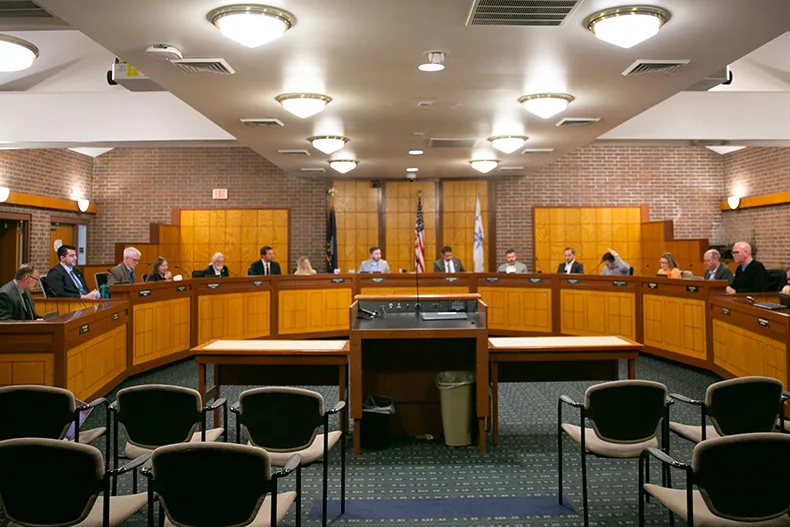
The Prairie Village City Council discussed the Halo Act over two council committee of the whole meetings, first on Oct. 5 and again on Oct. 19.
No formal action is taken during committee meetings, though items can be pushed to future council meetings for final consideration.
On Oct. 5, the city council largely weighed the benefits of prosecuting Halo Act violators in municipal court against the potential for legal challenges and the need to defend a state law.
Police Chief Eric McCullough said on Oct. 5 that there are other options to use when an individual is interfering with first responders on duty, but he and staff recommended adoption to keep control if a police officer or other first responder used the Halo Act in Prairie Village.
“Then (without adoption of the Halo Act into city code), we have to send it to the district attorney’s office, to the state level,” McCullough said. “We don’t have that local control here in our city court, and the city court can manage the court process as well as the consequences at the end.”
Councilmember Inga Selders, who is running for mayor, on Oct. 5 said adopting the Halo Act into city code “gives officers discretion.” Selders said the city wants to be able to control the potential outcomes if the Halo Act is invoked within city limits.
“This is the most humane of an inhumane law moving forward,” Selders said.
Councilmember Cole Robinson, who is running against Selders for mayor, urged the city council in talks on Oct. 5 to consider pushing the item to a future meeting. At that time, Robinson said he wanted to give the community an opportunity to share their thoughts on it, as it was unclear that the Halo Act was up for discussion that night in the agenda.
Councilmember Ian Graves said adopting the act into city code is the equivalent of doing “the state’s work for it.” Graves said “ we all know … this Halo law is about ICE, it’s not about first responders.”
Ward 6 Councilmember Jim Sellers shared similar concerns to that of Graves.
“It angers me that we are being manipulated as a city to provide air cover in a Faustian bargain for something that is clearly unconstitutional,” Sellers said. “It even angers me even more that, if this would ever make it through the court system, it might not even be found to be unconstitutional.”
Bartelt also signaled opposition to the proposal on Oct. 5.
Two weeks later, on Oct. 19, the city council voted 11-0 to reject the adoption of the Halo Act.
How they voted
• Councilmember Cole Robinson: Yes
• Councilmember Terry O’Toole: Yes
• Councilmember Inga Selders: Yes
• Councilmember Ron Nelson: Yes
• Councilmember Andy Logan: Yes
• Councilmember Shelby Bartelt: Absent
• Councilmember Nathan Vallette: Yes
• Councilmember Tyler Agniel: Yes
• Councilmember Nick Reddell: Yes
• Councilmember Betsy Lawrence: Yes
• Councilmember Ian Graves: Yes
• Councilmember Jim Sellers: Yes
Since this vote happened during a committee meeting, the item will be on a future council agenda for final consideration.
Selders, who originally supported adoption of the Halo Act, said she “wanted as many tools in the toolbox” for Prairie Village police officers.
Evidence of constitutionality challenges against similar laws in other states is largely what led her to change her mind, Selders said.
On Oct. 19, Robinson said that he agreed with Lawrence’s concerns around the Halo Act regarding its legality and how it would be enforced.
Robinson said he spoke with an unnamed Prairie Village police officer after the Oct. 5 meeting who said he feels it is “far easier and .. preferable” to use the city’s existing interference with a law enforcement officer law. That officer said that the existing law, Robinson said, gives him more flexibility in the field.
“He didn’t really feel like the Halo Act gave him that same type of control over the situation,” Robinson said.
Where other cities stand
In Overland Park and Olathe, the Halo Act has been on the books for a couple of months.
The public information officers in both cities say the Halo Act has yet to be invoked by a police officer in either city.
The cities of Fairway, Merriam, Shawnee, Spring Hill and Westwood have also adopted the Halo Act into their respective city codes through the UPOC. Those cities largely adopted it through the UPOC.
In other cities like Roeland Park and Leawood, the Halo Act has yet to come before the city council. Roeland Park City Administrator Keith Moody told the Post via email last week that consideration of the UPOC is scheduled for its Nov. 19 meeting.
Nearby, the Mission City Council has signaled opposition to adopting the Halo Act into its city code during a committee meeting in September.
Councilmembers in Mission largely opposed the argument that adopting the act allows for more local control.
City Administrator Laura Smith told the Post last week that the item will come back before the city council for formal consideration, likely with a recommendation to reject it given previous council discussion.
For Prairie Village, without the Halo Act on the books, police officers or any other agency operating within the city can still enforce it.
Instead of any cases being charged in municipal court, the district attorney would review any case and determine if it meets the threshold for charging, similar to other cases, according to city documents.
Keep reading local government news: Shawnee proposes ban on watching videos while driving
 Thanks for reading! If you value having an independent news outlet keeping tabs on local government, schools and taxes, we're asking you to contribute to our Education Reporting Fund.