Editor’s Note: This story is part of our series “Helping Hands”, which aims to spotlight Johnson Countians doing good in the background of their community. If you have an idea for someone to spotlight in a future “Helping Hands” story, email us at [email protected].
When many kids arrive at a new foster home in Kansas, they often do so at a stranger’s doorstep with their belongings stuffed into a trash bag — if they have anything with them at all.
That’s what Jessica Silvey learned while running a daycare out of her Lenexa home back in 2017. After applying for a lower-income license so she could accept state funding, her daycare was placed on a short list of providers serving children in the foster care system (as well as children staying with biological parents under state supervision).
As more and more foster care children began showing up at the daycare, she began to see the same scene playing out. A child would show up at her daycare the next morning in borrowed clothes, with a foster parent apologizing.
“They’d come to me the next day, and their foster parents would be like, ‘Hey, I got them at 11 p.m. last night, but I haven’t had time to go shopping for them yet,’” Silvey recalled. “So I started having a little storehouse of supplies in my basement. But it didn’t make sense to me why these kids didn’t come with what they needed for that first initial period.”
To learn more, Silvey worked closely with social workers and families involved in the foster care system. This helped her gain “a very unique perspective” on the system: everyone was overworked, everyone was under-resourced, and everyone seemed to be looking for someone or something to blame.
“In a bad situation, human beings really like to label a bad guy,” she said. “We can point fingers all day long and gripe about it, or we can get up and we can do something about it.”
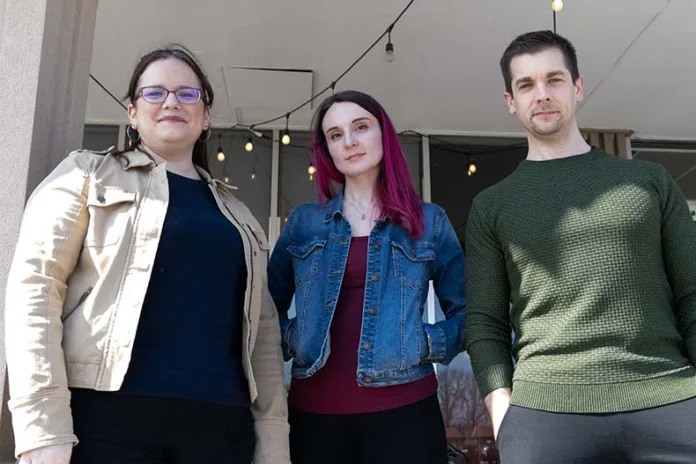
So that’s what she and Chris Youngdale, co-founder of Lenexa-based Care Package Inbound, decided to do. Their project places pre-packed bags of essentials with kids for their first 48 hours at a new foster home.
Care Package Inbound provides bags for kids of varying ages
Care Package Inbound provides backpacks for children entering foster care or police protective custody in Kansas and Missouri — from children ages 5 through 12, to teens and young adults.
CPI partners with police departments, hospitals like Children’s Mercy, mental health facilities and foster care agencies — which serve as distribution points for the bags.
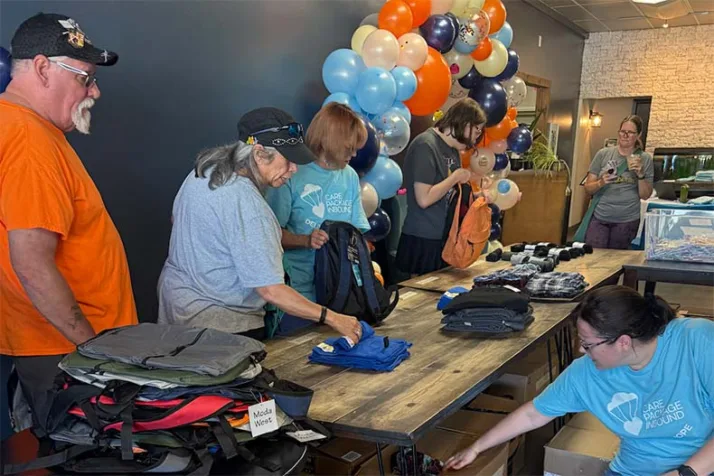
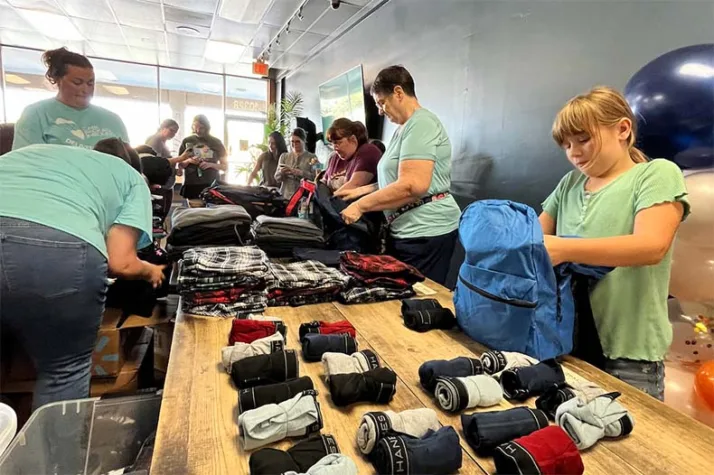
From the outside, a bag might look simple: a backpack, some clothes, toiletries, a blanket, a few comfort items. But getting that bag into a child’s hands is an intricate, weeks-long process.
Once bags are packed, the bags are sorted again, loaded into bins, and taken to a network of prayer partners who individually pray over each bag. Only then are they ready for distribution.
Business partnerships are also key for CPI. Any business that donates $15,000 can sponsor a “bag building day,” where employees pack 210 bags as a team-building activity.
Though these events are productive, Silvey said they’re far from an assembly line.
“We always say we’re packing these bags with intention,” she said. “It’s not an event where you’re trying to get as many bags packed in (as little time) as possible. We’re like, take your time. Be slow. If you do this right, the next person opening this bag will be a child, and they can feel it.”
CPI was born out of a community need
Back in 2019, Silvey said, she assumed there must be a resource out there that could provide kids with what they’d need in the first 48 hours.
When she went looking for one, though, she mostly found only organizations that shipped bags on request, often taking several days.
Occasional donation drives with churches or schools provided bags for foster children by dropping them off with local agencies. But instead of easing burdens, Silvey said, those projects often created more work.
“(The bags) would sit in a pile until a social worker who’s already overworked has enough time to go through that particular bag,” she said. “They would take out all the things that (the packers) didn’t realize were dangerous. The heart was there, but the practicality, the research wasn’t there.”
Because of this, building trust and rapport with agencies who could benefit from Care Package Inbound’s work took time. Silvey and Youngdale would join virtual calls with agencies, pitch their mission, and be met with silence.
“They’d been receiving bags that they have to disassemble all the time, and then they’re just not used,” Youngdale recalled. “It just felt like a lot of work.”
Slowly, he said, social workers started to realize that these bags didn’t need to be unpacked, inspected or supplemented — and they wouldn’t require workers to spend their own money to fill in the gaps.
That’s when word began to spread, and once-wary agencies began calling back. CPI began steadily adding more bag distribution points, and their warehouse grew emptier as demand surged.
Today, CPI has 25 active bag distribution points. Last year, CPI packed 840 bags. In 2026, they’re aiming for 2,000.
On average, children entering foster care in Kansas move to new homes seven times while in the system. The bags are meant to meet a child’s basic needs quickly enough that caregivers can focus on the emotional fallout of the child’s abrupt change.
“When a child comes into care and they don’t have anything, the foster parent and the social worker are scrambling for the necessities,” Silvey said. “They’re scrambling so much for necessities because of the physical need that they’re not able to focus as much on the emotional toll that this takes on the child.”
Each bag has basic essentials
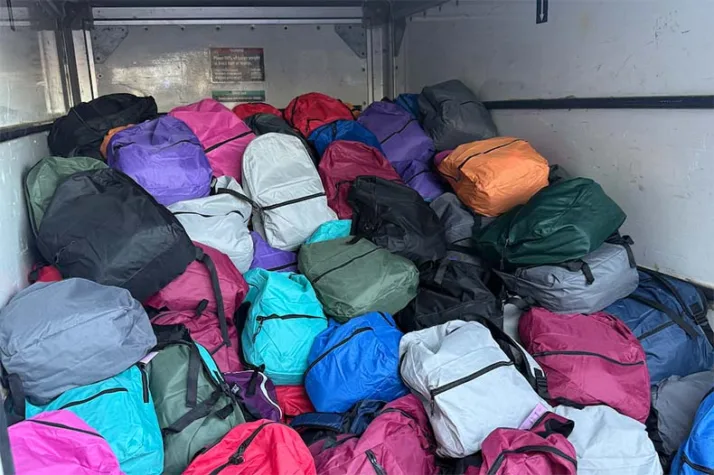
Every bag that’s packed through Care Package Inbound is organized with practicality and safety in mind. The Care Package Inbound team have consulted doctors, psychologists, social workers, current and former foster youth to refine each item.
Clothing is durable and wearable year-round (joggers, loose-fitting pajama pants, and gender-neutral T-shirts, for example).
The bags exclude spiral notebooks that could be dismantled into sharp wire, as well as the types of caps on pens that could be swallowed or misused. Included hairbrushes work for all hair types.
Even the bags themselves were designed intentionally; they don’t carry the CPI logo, so the children carrying them aren’t exposed to their peers as being in the foster care system.
“We have a very big base of information coming in so that we’re constantly improving our bags,” Silvey said. “We want to make sure that our helping doesn’t hurt.”
CPI could continue to grow
In its early days, Youngdale said, he and Silvey tried to do what many nonprofits try to do at their start: everything. Nationwide shipping, aging-out programs, you name it.
“We had our hands in too many cookie jars,” Youngdale said. “We had to pull that back and say, ‘Let’s really make sure that we get these bags exactly where we need them, so that social workers don’t have to go through them, so that they can actually be used.’”
With more time and experience now under their belt, Youngdale and Silvey said they’re hoping to try expansion again — but this time, they aim to expand by helping others start CPI “chapters” in other cities, like potentially St. Louis, Missouri.
“If there’s anybody who wants to do what we’re doing, we’ll give them the blueprint,” Youngdale said.
Silvey and Youngdale still remember when their project existed only as a handful of oversized plastic bags. Today, those early efforts have turned into thousands of fully realized backpacks, and a growing network of agencies that depend on them.
The impact shows up in quiet but personal ways. It’s in the enthusiasm and eagerness that Silvey recalls seeing during a recent bag dropoff — on the faces of teens who have been labeled “dangerous” by the community at large.
As a mother herself, that hits close to home for her.
“When I see these kids, I can’t help but see my 8-year-old son go, ‘Mommy, look,’” she said tearfully. “They just want someone to see them.”
That dropoff isn’t something Silvey and Youngdale get to see for themselves often, due to privacy reasons. But it’s something they get to hear about secondhand from social workers from time to time, and stories like that keep them going.
In fact, Silvey said, she’s heard stories from social workers about kids who receive bags and can’t believe that everything in the bag is all for them.
The two of them look at their work as planting seeds that they might not see the fruit of. Whatever difference they can make in the numbers — the disproportionate pipeline from foster care to prison, homelessness and trafficking — will matter generations from now.
“If this helps one child, then all the work is worth it,” Silvey said. “We know it’s helped way more than that now, but we would do it all again for one.”
More Helping Hands: This JoCo mom’s nonprofit wants kids to have companions in healing