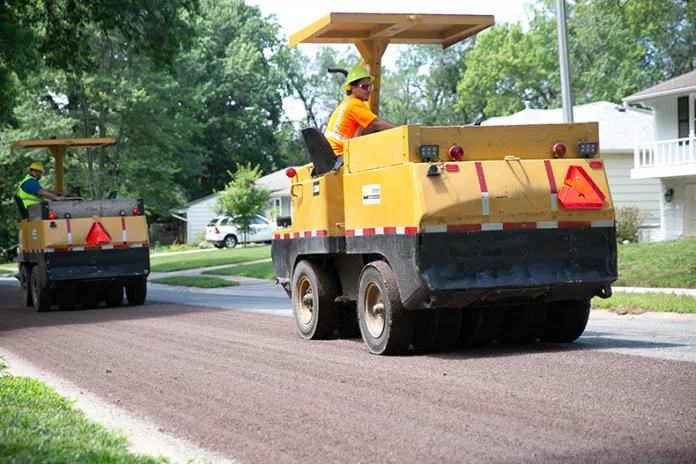
Overland Park has identified roughly 200 lane miles of roads around the city for its annual road resurfacing and neighborhood street reconstruction work scheduled for this summer.
All told, the street preservation work planned for this year will cost $23 million, using a mix of methods, including ultrathin bonded asphalt surface, chip seal and mill and overlay.
Overland Park has also earmarked $8.9 million for residential street reconstruction in the Westbrooke South neighborhood.
Last week, the Overland Park City Council’s Public Works Committee voted unanimously to advance the final round of bid tabulations for this year’s street preservation and rehabilitation work.
Westbrooke South street work already underway
As part of its annual Neighborhood Street Reconstruction Program, Overland Park will rebuild some residential streets in the Westbrooke South neighborhood and conduct other surrounding improvements, including sidewalks, streetlighting, ramp and stormwater replacements and repairs.
The work will be concentrated between 91st Street and 95th Street, between Switzer Road and U.S. Highway 69.
Within that area, Goddard Street, 93rd Terrace, 92nd Place, Larsen Drive and Westbrooke Drive will all be rebuilt. Additionally, part of Reeder Drive will be rebuilt.
The Westbrook South work will cover 3.8 lane miles. These streets, built between 1962 and 1966, are all at least 60 years old.
Overland Park uses concrete in its neighborhood street reconstruction program instead of asphalt, in line with street standards in new neighborhoods.
For the Westbrooke South neighborhood, some of the work may already be underway and is expected to wrap up in October.
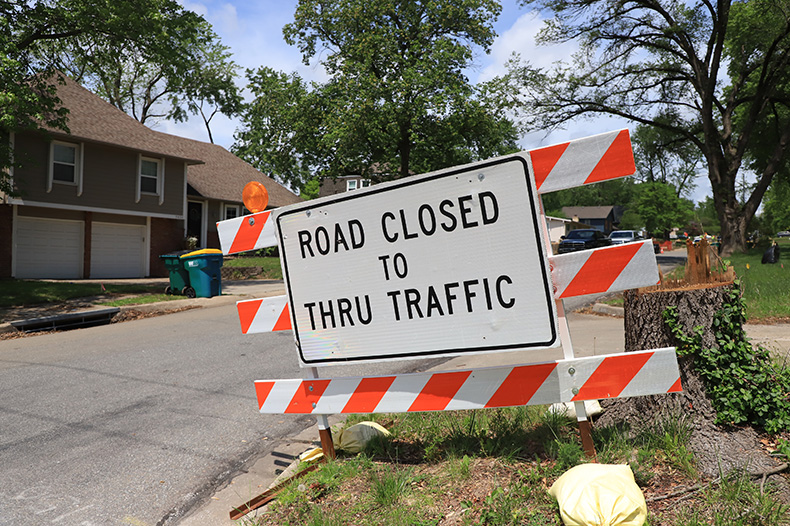
Overland Park will use chip seal on 137 lane miles
Overland Park has earmarked about $5.9 million for two combined treatments of chip seal work that will cover 137 lane miles of residential streets around the city.
One portion of the work will occur primarily in northern and central Overland Park, north of 143rd Street. A second portion of work will be south of that.
The chip seal process occurs when crews lay “liquid asphalt to seal the road” and follow that up with “a thin layer of rock” that serves to “protect the [asphalt] seal,” according to city documents.
Some residents have complained about the use of chip seal, particularly worried about the quality of the treatment in some years, creating hazards, including small rocks damaging vehicles when they are kicked up.
Still, chip seal is one of the most cost-effective street preservation tools available to the city, officials have argued.
The city has started reducing its reliance on chip seal in the past few years as it enacts some of the recommendations from a special infrastructure group with the help of an expanded sales tax approved by voters in 2023 that brings in more money for infrastructure.
The size of the program this year — 137 lane miles — is on par with the 139 lane miles the city preserved in chip seal last year, but less than in previous years, when Overland Park had completed up to 200 lane miles using the method.

Metcalf in southern Overland Park to see work done
Overland Park will use another street resurfacing method, ultrathin bonded asphalt surface, or UBAS, on Metcalf Avenue between 135th and 151st streets. That will cover 14.8 lane miles for a total cost of $3.7 million.
Originally, the city had planned to use UBAS on Metcalf between 135th and 143rd (about 10 lane miles), but decided to extend that due to additional money in the budget.
According to McAnany Construction, the city’s contractor for UBAS work this year, crews complete the process by “spraying emulsions while laying hot mix asphalt” at the same time.
Construction is expected to begin in the next couple of weeks and wrap up in the fall.
Some neighborhoods will see streets get mill and overlay work
In 2026, $14.8 million will go toward another street resurfacing method, mill and overlay, on some neighborhood streets, located primarily in central and southern Overland Park. That includes:
- Neighborhood streets between 127th and 135th streets, and between Pflumm Road and Quivira Road.
- Neighborhood streets between 151st and 159th streets, and between US-69 and Metcalf Avenue.
That work will touch 36 lane miles, and the projects will also include curb, ramp and stormwater repairs as needed.
For mill and overlay work, the top layer of a road is milled off, and then a new asphalt mix is laid over the road.

Looking ahead:
- Overland Park usually does its street preservation and reconstruction projects in the spring and summer months.
- Some project timelines might be affected by the World Cup since the city has indicated its intent to delay some projects in order to cut down on excess traffic headaches during the tournament.
- Road rehabilitation projects in Overland Park typically wrap up in September and October.
Keep reading: The clock is ticking for many of Overland Park’s aging bridges. What’s the city’s plan to fix them?
 Thanks for reading! If you value having an independent news outlet keeping tabs on local government, schools and taxes, we're asking you to contribute to our Education Reporting Fund.