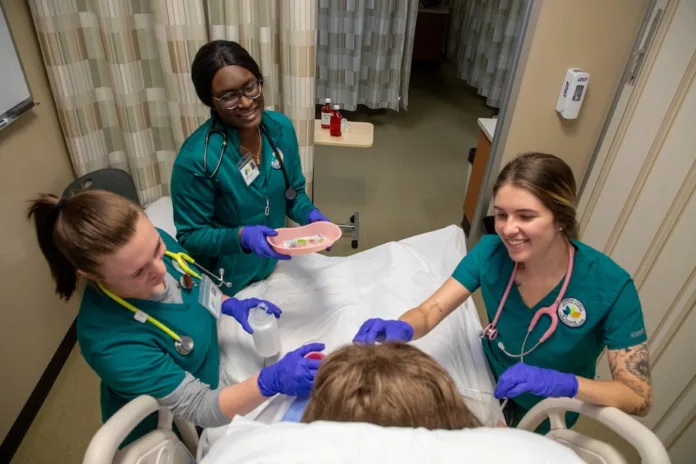
As residential and long-term care facilities in Johnson County face increased patient volumes and growing clinical demands, a credential from Johnson County Community College (JCCC) is helping area healthcare providers meet the need. From medication accuracy to timely patient support, Certified Medication Aides (CMAs) play an increasingly critical role in maintaining safe, high-quality, and consistent patient care.
CMA helps employees stand out
Certified Medication Aides are trained to safely and properly administer medications to patients—under the supervision of nursing staff—making them valuable employees and caregivers in long-term healthcare facilities. Through the CMA program at JCCC, students can earn a credential in just 12 weeks (80 classroom hours) while building a strongpharmacological foundation in key areas, including:
- Commonly used drugs and interactions with food and other medications
- Legal implications and regulations related to medication administration and recordkeeping
- Biological effects of medications on the elderly
- Basic safety principles and techniques to safely prepare and distribute medications
For individuals already working in healthcare, earning a CMA credential expands the range of responsibilities they are qualified to perform beyond those associated with a Certified Nurse Aide (CNA) credential alone. As a result, CMAs often become more valuable employees, with increased opportunities for higher wages and advancement.
From an employer perspective, increasing the number of CMA-trained staff provides greater flexibility in responding to shifts in patient volume and care needs. With more employees qualified to support medication administration, facilities are better positioned to manage growing demands while maintaining high standards of patient care.
Succeed in nursing school
In addition to strengthening the workforce, the CMA program also serves as a strong academic foundation for students planning to pursue nursing degrees. The coursework builds healthcare knowledge and clinical confidence that can increase students’ chances of success in competitive nursing programs.
Many JCCC students, including Rada Lewis, pursue the CMA certification as a stepping stone toward long-term nursing goals. Lewis began in JCCC’s Certified Nurse Aide (CNA) program, a 96-hour course focused on basic client care in long-term and acute care facilities. After earning her CNA certification in just a few weeks, she qualified for the next step: JCCC’s CMA program.
Following completion of the CMA program, Lewis quickly advanced into JCCC’s nine-month Licensed Practical Nurse (LPN) Certificate program. According to Lewis, the pharmacological knowledge and hands-on experience gained through the CMA coursework made the transition into the highly selective LPN program much more manageable.
Today, Lewis is a Licensed Practical Nurse working at the University of Kansas Medical Center. She plans to continue her education through JCCC’s LPN-to-Registered Nurse (RN) Bridge program before pursuing a Bachelor of Science in Nursing through JCCC’s partnership with the University of Kansas.
Prerequisites, costs, and scholarships
The State of Kansas requires CMA students to earn a CNA certification before enrolling in the program. CNA certification is also required for acceptance into JCCC’s LPN and RN programs, making the CNA-to-CMA pathway an important first step for many nursing students.
Both the CNA and CMA programs offer flexible scheduling options, including A.M. and P.M. courses and hybrid formats, designed to accommodate working students.
The CMA program consists of 4 credit hours. For Johnson County residents, tuition for the program is $404. In addition to JCCC financial aid and scholarships, the CMA program is Kansas Promise–eligible, meaning qualified students may complete the program at no cost to them.
Many students may also qualify for partial or full tuition reimbursement through their employers. Students are encouraged to explore all available funding options to maximize the financial benefits offered by both their workplace and JCCC.
Learn more
To learn more about the Certified Medication Aide program and requirements, visit jccc.edu/CMA.
Additional information about nursing education pathways at JCCC is available at jccc.edu/nursing.