Last month, we asked readers what you wanted to hear local candidates talking about as they vie for your vote ahead of the Nov. 3 election.
We received nearly 90 responses, and based on that input, we’ve developed questionnaires for candidates running in federal, state and local races, from Congress to the county commission chair.
We are distributing these questionnaires to the candidates this week. We’ll begin publishing their responses on the Post’s site on Monday, Oct. 12, publishing a response to one question per day through Oct. 16, right before early in-person voting begins in Johnson County on Saturday, Oct. 17.
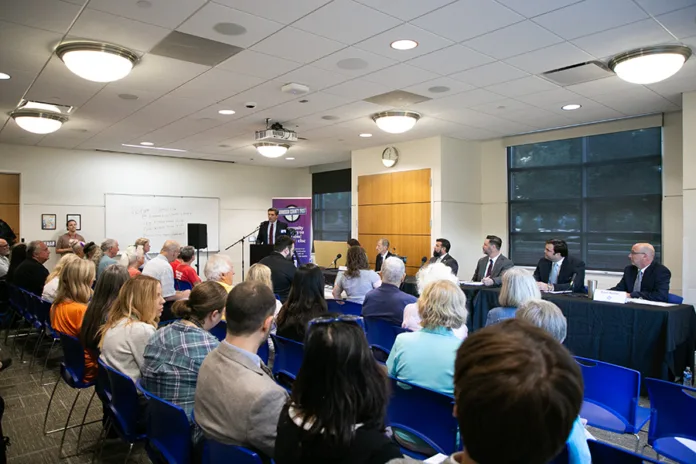
The Post is also hosting seven live in-person forums for races on the November ballot, including for Kansas House, county commission and Prairie Village mayor.
See the questions below that we’ll be asking candidates, broken down by contest.
U.S. Senate
- Prices and tariffs. Rising everyday prices remain readers’ top worry, from groceries and beef to insurance and rent. Several readers also asked where candidates stand on tariffs, which some blame for exacerbating inflation and farm losses. Name one vote you would cast next year that would lower a specific household cost for Kansans. Should Congress, rather than the president alone, have to approve new tariffs?
- The war with Iran. The U.S. has been at war with Iran since February without congressional authorization, and the House has now voted three times to end U.S. involvement. Readers asked what the mission is and what it costs Kansans, including at the gas pump. Would you support a Congressional resolution authorizing this war to end? What do you consider a successful outcome of this conflict?
- How ICE operates. Readers remain split on immigration. Some want ICE reined in and to see improved conditions at the detention center in Leavenworth. Others want faster deportations and mandatory E-Verify for employers. What, specifically, would you change about how federal immigration enforcement works? Do you support reducing or increasing legal pathways to immigration?
- Medicaid and rural hospitals. Gov. Laura Kelly estimates last year’s federal budget law will cost Kansas at least $150 million in lost health care funding. In addition, an analysis of the One Big Beautiful Bill Act by Manatt Health projects Kansas hospitals will lose $2.7 billion over 10 years under the law. Should Congress reverse any of those Medicaid cuts? If not, how would you keep rural hospitals open?
- Checks on the executive branch. Readers from both parties asked how Congress should respond when the White House ignores court rulings or acts without congressional approval, and one reader asked whether federal officials who break the law should be prosecuted. Where is the line for you? Name a specific time you would vote against, or have voted against, a president of your own party.
U.S. House
- Housing affordability. The ROAD to Housing Act, which became law in July without the president’s signature, limits purchases of single-family homes by large investors and funds ready-made designs for duplexes and townhomes. Readers say buying a home in Johnson County remains out of reach for many young families, and some worry the area is adding too many apartments instead of single-family homes people can actually afford. What should Congress do next when it comes to housing affordability?
- The war with Iran. The House has now voted three times to end U.S. involvement in the war with Iran, which Congress never authorized. Readers asked what the U.S. should be doing there and whether Congress has given up its war powers. What should the U.S. goal in Iran be, and would you vote to cut off funding if the war continues without authorization?
- Immigration enforcement. Readers still disagree sharply on ICE. Some criticized members of Congress, including Democrats, who backed the Laken Riley Act and other enforcement measures. Other readers say they want every person here illegally to be deported. What specific limits, if any, would you place on ICE? What, if any, immigration enforcement would you expand?
- The safety net. Last year’s budget law tightened work requirements for SNAP and cut future federal Medicaid spending. Readers asked whether those changes should stand, and how Congress will make up for coverage Kansans may lose. Would you vote to keep, change or repeal those provisions? What would you do about rising health insurance costs?
- Independence and partisanship. Readers want to know to whom you’d answer in Congress. Some asked whether candidates would break with President Trump; others asked where they stand relative to their party’s most left-leaning members. Other readers said they’re tired of party loyalty over constituents. Give a specific example of where you might break with your party’s leadership on an issue and why.
Governor
- Property taxes. Many readers who wrote about property taxes are older adults or retired and on fixed incomes, who say rising appraisals are taxing them out of homes they’ve owned for decades. Some want a freeze for homeowners over 65; others want the state to roll back business exemptions that they say shift more of the burden to homeowners. What specific property tax relief would you advocate for?
- Special education funding. Four Johnson County school districts have hired lawyers to prepare a possible lawsuit against the state, arguing that Kansas hasn’t fulfilled its mandated obligation to fund 92% of the excess cost of special education services since 2011. This year lawmakers added $6 million, but the districts say fully closing the gap would take about $225 million. As governor, would you fight that lawsuit or work to settle it by closing the funding gap? Explain why.
- Medicaid and federal cuts. Kansas remains one of the few states that hasn’t expanded Medicaid, and outgoing Gov. Laura Kelly estimates last year’s federal budget law, the One Big Beautiful Bill Act, will cost the state at least $150 million in lost health care funding. Where do you stand on expansion now that the federal bonus for expanding is gone? How would you respond to cuts that may come as a result of the federal budget?
- The state budget. Readers worry that tax cuts, the Chiefs STAR bond deal and federal cuts together will squeeze the state budget. Several asked what spending candidates would give up to pay for what they promised. If revenue falls short of your plans, what comes first: spending cuts, tax increases or drawing down reserves? Name one program you would protect no matter what.
- Sheriffs and ICE. This year the Legislature overrode Gov. Kelly’s veto of a bill that lets sheriffs sign 287(g) agreements with ICE without county commission approval. The same law created a 25-foot buffer around first responders, including federal agents — something ICE agents invoked during immigration enforcement operations in Olathe earlier this year. Would you keep this law as is, change it or seek to repeal it? Why?
Attorney General
- What the job is for. One reader asked what the primary purpose of the attorney general’s office is, and many readers in both rounds said they’re tired of partisan fights. How should the office divide its time between multistate lawsuits and policy fights, and supporting local prosecutors, police and crime victims? What is the most pressing problem you’d tackle over the next four years?
- Immigration enforcement. Immigration was readers’ most-raised topic, and they’re sharply divided. Some want Kansas to back ICE fully. Others want state officials to hold ICE accountable for how it treats people, including at a Leavenworth detention facility. What role should the attorney general play in immigration enforcement? Should the office ever investigate complaints about federal agents’ conduct in Kansas?
- Prosecuting voter fraud. The attorney general’s office is now prosecuting noncitizen voting cases referred by the secretary of state after checks against a federal citizenship database. Three cases had been filed as of May. Some readers want aggressive enforcement of potential voter fraud. Others note that courts found noncitizen voting rare and worry such actions will deter voting. What evidence should it take to bring charges? How would you make sure legal voters, including naturalized citizens, aren’t intimidated?
- Scams, fraud and privacy. Readers asked about deed fraud, in which scammers steal ownership of homes, as well as AI-driven scams, data breaches and the fact that Kansas has no comprehensive consumer data privacy law. Others worry about license plate reader cameras and what social media does to kids. Which consumer threat would you prioritize? Should Kansas pass a data privacy law, and what would you do with the office’s existing power?
- Transgender policies. Readers come at this from both directions: Some support limits on transgender people’s access to restrooms and the sex listed on their IDs, while others want to see the state taking proactive steps to protect LGBTQ Kansans, especially young people. This year’s Senate Bill 244 restricts bathroom use in public buildings by sex assigned at birth and invalidates driver’s licenses that had been changed to match transgender Kansans’ gender identity. Do you support this law? How should the office handle disputes with school districts over parental notification and students’ gender identity?
Secretary of State
- Early voting sites. Johnson County’s election commissioner, who is appointed by the secretary of state, cut eight early voting sites before the August primary, and 21 local elected officials urged the office to restore them for November. Some readers called it voter suppression, expressing concern it could lower turnout. Do you support this decision? What standard should decide how many early voting sites a county offers?
- Voter data and Washington. The U.S. Justice Department has asked states for sensitive voter information, including driver’s license and Social Security numbers, and has said Kansas already handed it over. The state says it shared only the public voter list. What voter data would you give the federal government, and what, if anything, would you refuse to share?
- Proof of citizenship. On Nov. 3, Kansans will vote on a constitutional amendment stating that only U.S. citizens can vote. Supporters say the move is necessary to clarify who gets to vote, while critics say it’s redundant and could open the door to new hurdles for voter registration. Do you support this amendment? If it passes, would you seek to require proof of citizenship at registration again? How would you protect eligible voters?
- Impartial administration. This is a partisan race, but the job of secretary of state is to ensure elections are run fairly for all regardless of party affiliation. How would you assure voters of all parties of your impartiality in running state elections and certifying results?
- Mail ballots under pressure. President Trump has called for ending mail voting, and a new Kansas law now requires mail ballots to arrive by Election Day. (That law is currently being challenged in court, and a three-day grace period for mail-in ballots still applies for the Nov. 3 election.) If federal officials moved to restrict mail ballots, how would you respond? What would you do to make sure ballots mailed on time are counted?
State Board of Education
- Special education. Blue Valley, De Soto, Olathe and Shawnee Mission have hired lawyers to prepare a possible lawsuit against the state over special education funding. Some readers asked why districts should have to go to court for money state law already promises. Though the state board has no direct control over school funding, should the board publicly side with the districts, the state or stay neutral? What stance would you take individually if elected?
- Reading and literacy. Nearly a third of Kansas third graders scored at the lowest level in English language arts in 2024, and the state is now pushing evidence-based reading instruction through its “Blueprint for Literacy.” How will you judge whether it’s working, and what should happen to schools that aren’t improving?
- Parents and controversial books. Readers across the ideological spectrum asked about parents’ rights. Some want more say over which books their children are exposed to in the classroom and school library. Others worry about banning books. What role should parents play when they object to a book? Should the state set one policy, or continue leaving that to local boards?
- School vaccines. As federal health officials revise vaccine recommendations, readers asked whether Kansas should keep its current school vaccine requirements, including for measles. What is your position, and what role, if any, should the state board play?
- Proving value to taxpayers. One reader asked plainly: Are Johnson County public schools effective, and are taxpayers getting their money’s worth? Beyond test scores, what measures should the board publish so families and taxpayers can judge how well Kansas schools are using their money?
Kansas House
- Property taxes and state tax policy. Property taxes are readers’ No. 1 issue, and the Legislature plays a key role. This past session, a valuation-cap amendment cleared the Senate but failed in the House, and a local-spending cap was vetoed, so Kansans again got no meaningful tax relief from Topeka. What specific policies would you vote for in Topeka to lower residential property tax bills for Johnson Countians?
- Public schools, special education and vouchers. Readers want to hear what statehouse candidates say about fully funding public schools and special education, in particular. At least 17 readers raised this concern in response to the Post’s call for questions. Four Johnson County school districts are moving toward potentially suing the state over special education funding, arguing Kansas has for years paid less than what state law calls for, leaving districts to cover the gap. Would you vote to fully fund special education? How would you pay for it?
- Housing affordability. More than a dozen readers who sent us emails brought up housing affordability, saying rising rents and home prices are pushing housing out of reach for many. On the other hand, some readers expressed worry about the pace of apartment construction in their neck of Johnson County and noted that many apartments being built are also not affordable. What is one specific thing the Legislature should do to make housing more affordable in Johnson County?
- Data centers. More than a dozen readers asked to hear candidates’ stances on large data centers proposed across Johnson County. Readers are concerned about who will pay for the water and electricity these facilities use. Currently, Kansas offers large data center operators sales tax exemptions in exchange for commitments on water conservation and energy grid preservation. Some readers, though, are calling for a statewide moratorium on data centers until projects are more thoroughly vetted. Do you support a data center moratorium? Why or why not?
- State budget and the Chiefs stadium. Kansas is using STAR bonds to help pay for a new Chiefs stadium in KCK and a team HQ and training facility in Olathe. More than 20 readers emailed about this, most of them expressing worry about the long-term cost to the state budget of this project. Do you or did you support the stadium deal? How would you keep the state budget balanced in the years ahead?
County commission
-
- Property taxes and county spending. Property taxes remain readers’ top complaint, and much of their frustration lands on the county. The $1.9 billion county budget for next year that commissioners approved this month keeps the county’s tax rate essentially flat, but rising home values mean most homeowners will still pay more. In particular, older adults on fixed incomes say they can’t keep up. Should the county lower its rate enough to fully offset rising appraisals, even if that means cutting spending? If so, where would you cut first? If not, how do you justify bills that keep going up?
- Voting access. The county funds the election office, but the election commissioner is appointed by the secretary of state. After eight early voting sites were cut before the August primary, readers asked what county leaders can do. Do you agree with the decision to close these early voting sites? Why or why not? Is there anything the county commission can do to make future decision-making about elections more transparent?
- License plate readers. Local law enforcement agencies’ use of automated license plate reader cameras has quickly become one of the most talked-about issues in the county, as controversy over the devices and their potential abuses has grown nationwide. According to independent observers, thousands of these devices are deployed in Johnson County, including by the sheriff’s office. What limits, if any, would you set on how county agencies collect, keep and share data from these devices?
- Data centers. In recent weeks, Edgerton’s city council overrode its own planning commission to approve an $860 million data center over residents’ objections, and a proposed data center project in De Soto has more than doubled in size. These were city decisions — the county directly controls only unincorporated land — but readers still want answers on the impacts data centers could have on water, power and noise. What can the county do when it comes to data centers? Set countywide standards, coordinate with cities or impose a moratorium? What approach do you support?
- The future of transit. Johnson County’s bus system has struggled for years to draw riders in our car-dependent county. This summer, the county spent $6.8 million, mostly in one-time grants, on free World Cup bus routes that seemed to run well below capacity. Meanwhile, the county’s Transit Fund is expected to end 2026 with about 3% of annual spending in reserve, and more than a dozen buses are past their useful life. Is public transit worth investing more local money in? What should transit in Johnson County look like 10 years from now?
Prairie Village Mayor
-
- Vision for the next decade. For much of the past five years, Prairie Village politics have been consumed by intense fights over housing, zoning and a new city hall. With a new city hall now under construction and the state setting new housing rules, many residents say they’re ready to move on. Looking 10 years ahead, what does a thriving Prairie Village look like to you, and what would you do as mayor to get there?
- The state’s new housing law. A few years after Prairie Village’s bitter fight over housing and zoning, the Legislature has largely taken the decision out of the city’s hands. SB 418, which took effect July 1, counts duplexes and townhomes as single-family housing, allows accessory dwellings without special permits and ends neighbors’ protest petitions, among other provisions. Prairie Village joined nearby cities in opposing the law. As mayor, how do you think the city should comply with this law? Do you agree with the city’s formal stance against the law? Why or why not?
- Taxes and spending. The city’s 2027 budget plan holds the property tax rate flat even as the county’s public safety sales tax expires, while general fund spending grows 3.4%. With rising home values, the median household’s municipal property tax bill would be about $970. The city is also issuing $27 million in bonds for the new municipal complex. Is the city living within its means? Do you support the current level of spending and debt relative to what taxes bring in? If not, what would you change?
- Corinth Library. In September, the city council voted 10-0 to study moving Corinth Library, the county’s oldest branch, a few blocks up Mission Road next to a new city hall. An early concept envisions a 30,000-square-foot, two-story building with drive-thru book drop-off and underground parking. The county library would pay for the building and buy the land from the city at an appraised price. Where do you stand on the future of Corinth Library? Before signing off on a final deal, what would you need to see on land price, parking, traffic and the future of the current site?
- Neighborhood quality of life. Beyond bigger debates, readers raised some concerns closer to home: short-term rentals still operating despite a city ban, disruptive teardown construction, cut-through traffic and an aging tree canopy. What do you see as the single most pressing quality-of-life problem in Prairie Village neighborhoods, and what’s one concrete thing you’d do about it in your first year as mayor?